
Service Schedules for Commercial Refrigeration: When to Call Roanoke Technicians
Whitescarver Engineering
How Often Should Commercial Refrigeration Equipment Be Professionally Serviced in Roanoke, VA?
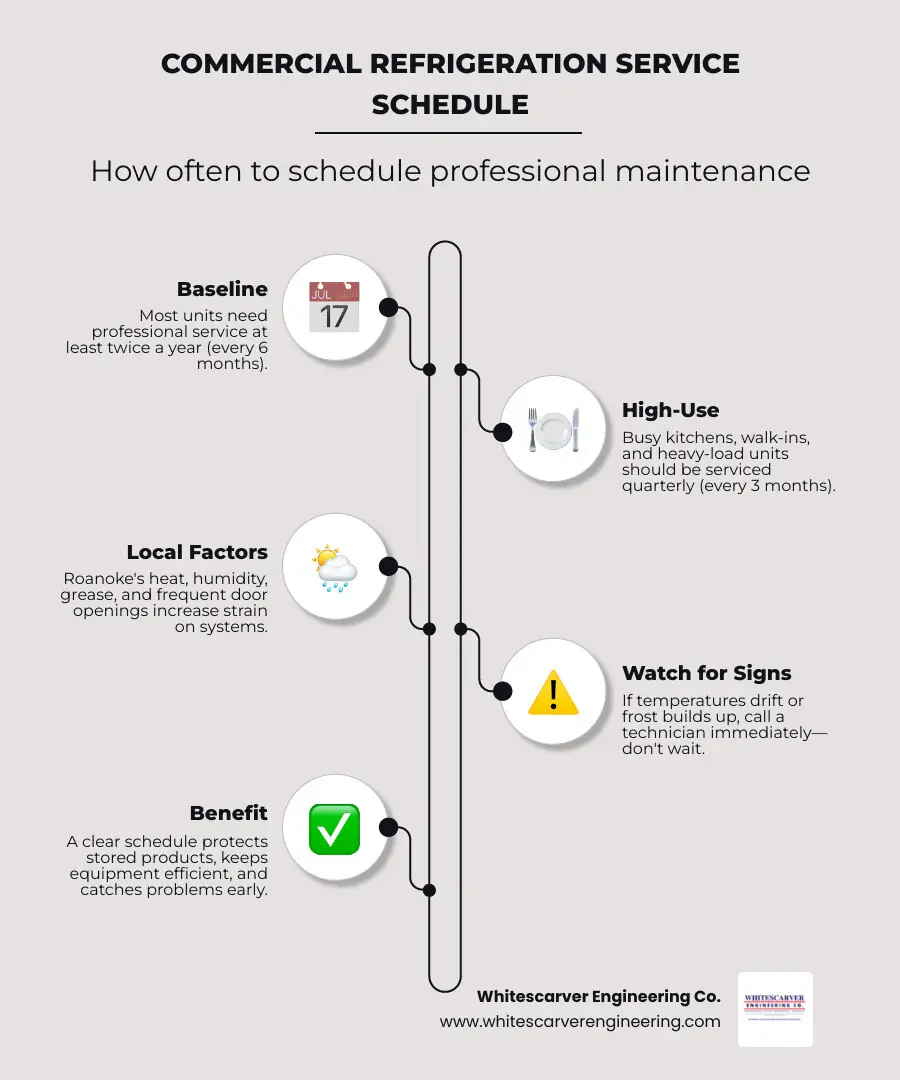
Schedule professional service at least twice a year for most commercial refrigeration equipment. Choose quarterly visits for busy kitchens, walk-ins, and units that run under heavy loads. In Roanoke, VA, heat, humidity, grease, and frequent door openings can all put more strain on a system. If temperatures drift or frost builds up, call a technician rather than wait for the next visit. A clear commercial refrigeration service schedule helps facility managers protect stored products, keep equipment running well, and catch problems early. When planning a maintenance calendar, facility managers often ask, "How often should commercial refrigeration equipment be professionally serviced?"
Read our Roanoke commercial refrigeration service guide, or explore commercial refrigeration service.
For help planning your next visit, contact Whitescarver Engineering Co. about commercial refrigeration service.
Determining How Often Should Commercial Refrigeration Equipment Be Professionally Serviced
Commercial cooling systems are the lifeblood of food service, healthcare, food distribution, and processing facilities. Unlike residential units that cycle on and off under modest loads, commercial hardware runs continuously under intense operational pressure. Determining exact service intervals depends heavily on the specific mechanical demands, ambient conditions, and daily traffic patterns of your facility.
For standard operating environments, bi-annual servicing—typically aligned with spring and fall transitions—serves as the industry baseline. However, high-volume facilities require quarterly inspections to avoid unplanned downtime. Up to 80% of refrigeration breakdowns are preventable with regular maintenance, and routine professional care can reduce total operational disruptions by up to 90%.
Facility managers frequently ask, "How often should commercial refrigeration equipment be professionally serviced?" Answering this requires balancing daily runtime against environmental stressors. Review our comprehensive commercial refrigeration service Roanoke guide for region-specific system demands.
| Facility Type | Recommended Service Frequency | Primary Risk Factors | Key Focus Areas |
|---|---|---|---|
| High-Volume Restaurants & Bars | Every 3 Months (Quarterly) | Airborne grease, high ambient kitchen heat, door cycles (300+ daily) | Condenser coil deep cleaning, door gaskets, defrost calibration |
| Supermarkets & Grocery Stores | Every 3 Months (Quarterly) | High product volume, open display cases, massive thermal loads | Expansion valves, rack systems, refrigerant charge balance |
| Small Cafes, Delis & Convenience Stores | Every 6 Months (Biannual) | Dust accumulation, tight spacing, constant customer foot traffic | Airflow clearances, fan motors, thermostat calibration |
| Monthly Internal / Quarterly Pro | Continuous runtime without recovery periods, constant forklift/loading traffic | Compressor mechanical wear, electrical contactors, subcooling diagnostics | |
| Pharmaceutical & Research Labs | Every 2 Months + Annual Audit | Zero-tolerance temperature drift, regulatory oversight | Sensor accuracy, multi-point calibration, backup systems |
By Unit Type: How Often Should Commercial Refrigeration Equipment Be Professionally Serviced?
Different refrigeration assets experience distinct mechanical wear patterns. A blanket approach across an entire facility often leaves critical machinery vulnerable:
- Walk-In Coolers and Freezers: These high-capacity units should be professionally serviced every 3 months. Walk-ins handle heavy thermal infiltration from staff movement, putting extra strain on evaporator fan motors, defrost heaters, and drain lines.
- Reach-In Coolers and Freezers: Reach-ins located on the cooking line need quarterly service due to grease and flour airborne contamination. Standalone reach-ins in cooler storage rooms can operate reliably on a bi-annual schedule if seals remain airtight.
- Display Cases and Merchandisers: Open-air and glass-door merchandisers in grocery or retail environments require quarterly checks. Because open cases continuously exchange air with the retail floor, their coils collect airborne debris faster than sealed boxes.
- Commercial Ice Machines: Ice makers require dedicated professional service and sanitization every 3 months. Waterborne minerals quickly coat evaporators, while biological biofilms present strict regulatory and health safety risks.
For a deeper operational breakdown across varied cooling equipment, consult our ultimate commercial refrigeration maintenance guide.
High-Stress Environments: How Often Should Commercial Refrigeration Equipment Be Professionally Serviced?
Environmental conditions dictate maintenance frequency just as much as run hours. High ambient kitchen heat, airborne cooking oil, and regional weather all accelerate equipment degradation.
In Southwest Virginia, seasonal atmospheric conditions play a massive role. During peak summer months, outdoor temperature spikes pair with elevated humidity levels. Because humid air holds significant latent heat, cooling systems must work harder to extract moisture, leading to rapid frost accumulation on evaporator coils.
Review our cheat sheet to Virginia humidity commercial refrigeration maintenance and learn how to prevent commercial refrigeration failures during peak summer demand. When kitchens run hot and ambient air is saturated, quarterly technician visits ensure systems do not trip safety limits under heavy loads.
Professional Servicing vs. In-House Daily Staff Upkeep
A successful refrigeration reliability program pairs internal staff diligence with certified mechanical service. Daily and weekly housekeeping cannot replace technical system diagnostics, but it creates the baseline conditions certified technicians need to keep equipment running at peak efficiency.
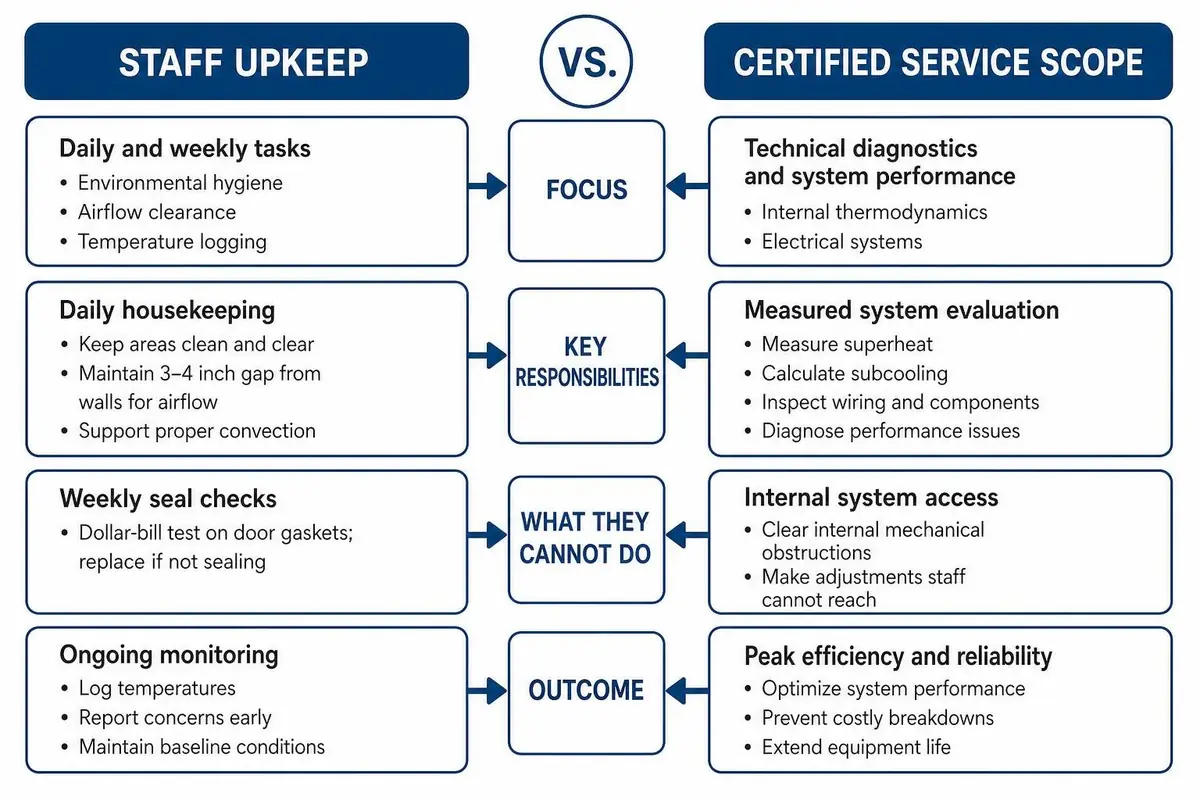
Daily staff tasks focus on environmental hygiene, airflow clearance, and temperature logging. Staff should maintain a 3- to 4-inch gap between stored goods and internal walls to preserve proper convection currents. Similarly, staff should run the "dollar-bill test" on door gaskets weekly: close the door on a dollar bill; if it pulls out easily with no resistance, the seal is compromised and warm air is leaking inside.
Certified technicians handle the internal thermodynamics and electrical systems. Using specialized instruments, technicians measure superheat, calculate subcooling, inspect wiring, and clear internal mechanical obstructions that staff cannot reach.
Explore our commercial refrigeration maintenance tips for 2026 to help structure your internal team's workflow alongside professional visits.
| Task Category | In-House Staff Responsibility | Certified Technician Scope |
|---|---|---|
| Temperature & Airflow | Record daily temperature logs; maintain 3" wall clearance around stock | Calibrate digital controllers; verify sensor placement and accuracy |
| Gaskets & Hardware | Wipe gaskets clean; check for physical tears or loose alignment | Replace failed gasket profiles; realign hinges; adjust latches |
| Coil Care | Sweep loose debris away from exterior intake grills | Chemically degrease and pressure-wash condenser and evaporator coils |
| Condensate Systems | Inspect visible drain pans for pooling water or slime buildup | Flush drain lines with antimicrobial agents; inspect pan heater elements |
| Electrical & Controls | Check that digital controller display is illuminated | Test compressor run capacitors, contactor points, and motor amp draw |
| Refrigeration Circuit | Report abnormal icing or rapid mechanical cycling | Gauge operating pressures; check superheat/subcooling; test for leaks |
Critical Inspection Tasks Included in a Professional Service Visit
When our industrial technicians arrive at your facility for a scheduled maintenance visit, they perform a comprehensive multi-point diagnostic inspection designed to identify component wear before it leads to mechanical breakdown.
- Condenser and Evaporator Coil Deep Cleaning: Technicians apply specialized, non-acidic foaming cleaners to dissolve grease, scale, and particulate matter trapped within aluminum coil fins, restoring proper thermal transfer.
- Motor, Fan, and Bearing Inspection: Technicians inspect evaporator and condenser fan assemblies for blade balance, bearing play, and correct rotational speed to guarantee optimal cubic feet per minute (CFM) airflow.
- Superheat and Subcooling Analysis: Certified technicians connect diagnostic manifolds to measure suction and liquid line pressures alongside line temperatures. These calculations confirm the exact operating state of the refrigerant charge without guessing.
- Defrost Cycle and Thermostat Calibration: Technicians verify defrost timers, mechanical termination switches, and electric heater amp draw to ensure defrost cycles clear ice efficiently without warming the cabinet.
- Condensate Line Clearing and Treatment: Technicians clear internal drain lines using pressurized nitrogen or specialized flushes, eliminating algae, slime, and microbial buildup that cause drain pan overflows.
- Electrical Component Diagnostics: Technicians measure running amperage and starting current on compressors and fan motors, tighten electrical connections, and inspect contactors for pitting or carbon buildup.
To protect your investments with scheduled commercial care, view our full capabilities on our commercial refrigeration services page.
Even with an active maintenance plan, unexpected component strain or physical damage can require immediate intervention. Waiting for your next scheduled quarterly inspection when a unit is actively struggling can lead to catastrophic compressor failure and spoiled inventory.
Look out for these critical operational warning signs:
- Unexplained Temperature Drift: If internal temperatures climb above 41°F in medium-temperature storage or above 0°F in freezers despite correct setpoints, internal thermal transfer has stalled.
- Heavy Frost or Ice Accumulation: Ice on evaporator coils, suction lines, or ceiling panels points to failed defrost heaters, stuck fan relays, or restricted refrigerant flow.
- Short-Cycling (Rapid On/Off Sequences): If the compressor turns on and shut downs every few minutes, it may be tripping high- or low-pressure safety switches.
- Pungent Odors or Burning Smells: Electrical insulation breakdown, slipping fan belts, or failing compressor motor windings release distinct metallic or chemical odors.
- Water Pooling Beneath Equipment: Blocked drain lines or cracked condensate pans can spill water across kitchen and warehouse floors, creating slip hazards and interior moisture issues.
- Unusual Mechanical Noises: Grinding, metallic clattering, or high-pitched squealing from compressors or fan housings points to worn bearings or internal valve damage.
If your facility exhibits any of these symptoms, read our guide on signs your commercial walk-in cooler or freezer needs professional service. You can also review our refrigeration repair signs guide for 2026 or explore diagnostic details regarding commercial refrigeration compressor problems and symptoms.
Frequently Asked Questions About Commercial Refrigeration Service Schedules
Does skipping professional maintenance void equipment manufacturer warranties?
Yes. The vast majority of commercial equipment manufacturers specify regular professional servicing by certified technicians as an explicit condition of their factory warranties. If a major component like a semi-hermetic compressor fails during the warranty term, manufacturers routinely request formal service records, filter logs, and professional maintenance documentation before honoring claims. Skipping preventive maintenance can leave facility managers fully responsible for major replacement parts.
How do dirty condenser coils impact commercial refrigeration energy efficiency?
Condenser coils release heat absorbed from inside your refrigerated space into the surrounding room. When coils become caked with dust, cooking grease, and airborne debris, that dirt acts as an insulating blanket.
Dirty coils alone can reduce cooling efficiency by up to 30%, force compressors to work 40% harder to move thermal energy, and drive overall energy consumption up by 20% or more. ENERGY STAR-certified commercial refrigeration equipment offers 20% to 40% better energy efficiency than non-certified alternatives, but those efficiency gains disappear quickly if thermal surfaces are blocked by debris.
How often should commercial ice machines receive professional deep cleaning?
Commercial ice machines must receive professional deep cleaning, descaling, and sanitization at least every 3 months. Ice machines create ideal conditions for scale deposits, waterborne mineral crystallization, and biological biofilms. Mineral scale coats nickel-plated evaporator plates, slowing harvest cycles and driving up compressor head pressure. Quarterly professional maintenance keeps ice production fast, protects mechanical parts, and ensures full health code compliance.
Conclusion
Commercial cooling systems are foundational assets for food service providers, industrial processors, and institutional facilities across Virginia. Establishing a proactive maintenance schedule is the single most effective way to eliminate emergency system shutdowns, lower energy utility overhead by 15% to 25%, and add 3 to 5 years of operational life to your equipment.
Since 1937, Whitescarver Engineering Co. has delivered premier commercial and industrial HVAC and refrigeration solutions across Roanoke, Salem, Vinton, and the Blacksburg/Christiansburg corridor.
Contact our team today to establish a proactive service agreement through our professional commercial refrigeration services.
Facility intake
Need Help?
Tell us what facility, system, or maintenance risk needs attention so the first conversation starts with useful context.
About the Author
Whitescarver Engineering
Related Posts
- How Often Should a Commercial Rooftop Unit Be Serviced in Virginia? A Survival Guide
- The Definitive Guide to Commercial HVAC Inspection Frequency in VA's Four Seasons
- The Complete Guide to Repair vs. Replace Aging HVAC in Roanoke, VA
- When Should You Replace Commercial HVAC Equipment: A Cheat Sheet
- Understanding the Key Differences Between Industrial and Commercial Cooling
Related service: Refrigeration
Related Articles
Engineering-led support
Ready to Get Started?
Whether you need a repair, maintenance, or a new installation, our expert team is here to help.