
How Do High-Efficiency HVAC Upgrades Impact Total Operating Costs for Blacksburg Facilities?
Whitescarver Engineering
When Should Blacksburg Facilities Upgrade Commercial HVAC?
For commercial HVAC upgrades in Blacksburg, VA, start by comparing your system's energy use, repair history, and downtime with its expected remaining life. A newer high-efficiency system can use less energy when building demand changes during the day. But an upgrade is not always the right move: a well-maintained system with few breakdowns may still have useful life. Track repeat failures, hours of operation, and how often rooms sit partly occupied. Then weigh those findings against the service needs of a new system before deciding whether to repair, retrofit, or replace.
Explore commercial HVAC systems or contact Whitescarver Engineering Co. about your facility.
To review your system's repair history and upgrade options, contact Whitescarver Engineering Co..
Evaluating How New High Efficiency Commercial Systems Affect Total Operating Costs vs Repair Cycles
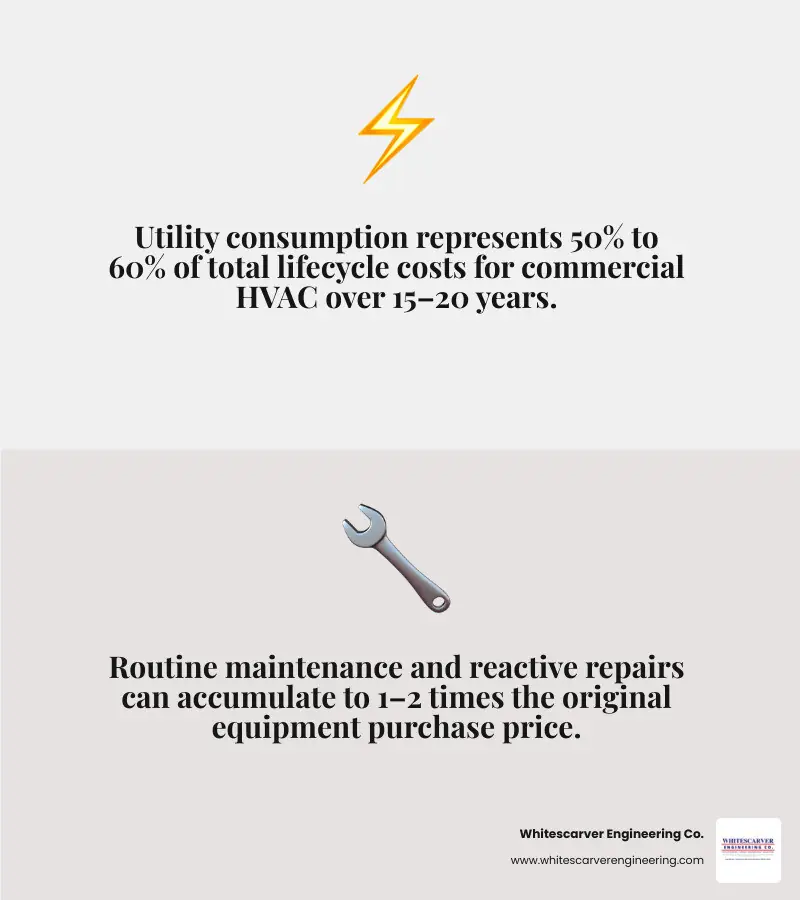
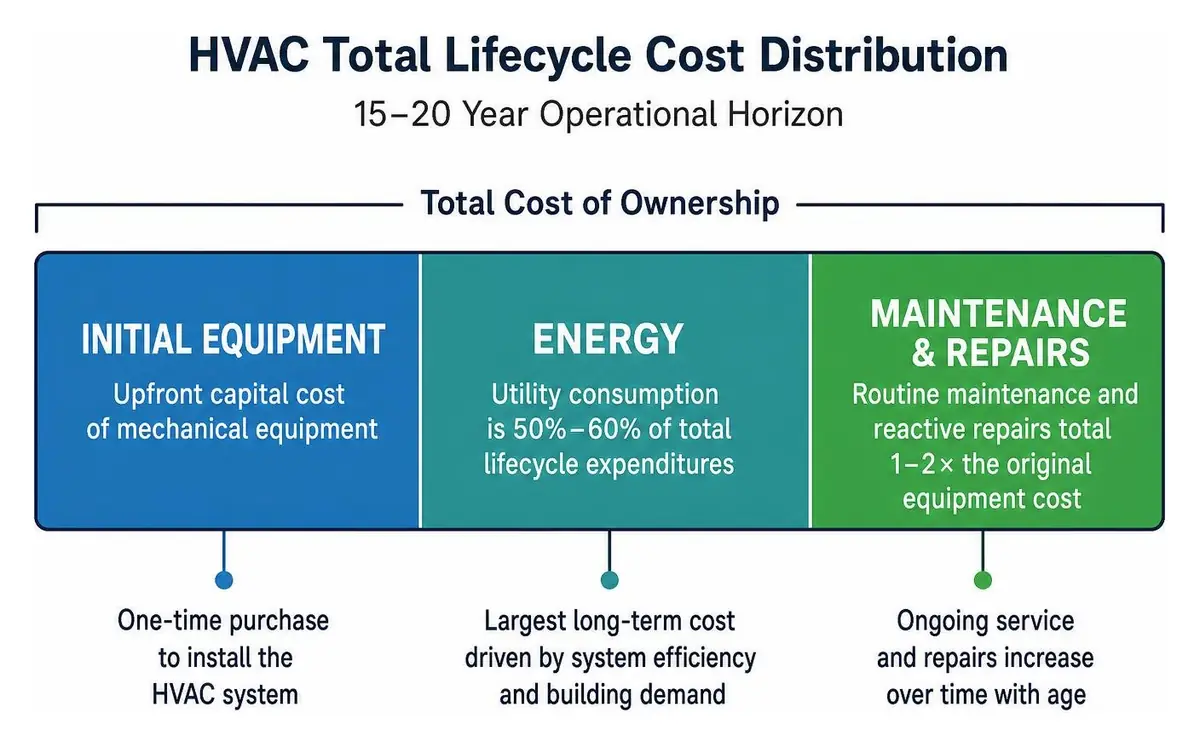
When managing commercial facilities, looking strictly at the upfront capital cost of mechanical equipment introduces substantial long-term risk. Over a 15- to 20-year operational horizon, utility consumption consistently represents 50% to 60% of total lifecycle expenditures for commercial heating and cooling assets. Routine maintenance and reactive repairs account for another significant share, often accumulating to 1 to 2 times the original equipment purchase price.
Understanding how new high efficiency commercial systems affect total operating costs vs repair cycles requires evaluating the total cost of ownership rather than baseline purchase price alone. Recognizing when planning commercial HVAC system replacement is necessary allows facility leaders to prevent legacy systems from consuming excessive operational budgets.
Analyzing How New High Efficiency Commercial Systems Affect Total Operating Costs vs Repair Cycles in Load-Variable Facilities
Commercial properties rarely operate at peak design capacity. In the Mid-Atlantic climate of Southwest Virginia, commercial offices, higher-education facilities, and light industrial spaces experience vast swings in outdoor temperatures and internal occupancy. Traditional constant-speed systems operate inefficiently during these moderate periods, cycling fully on and off, which causes heavy electrical demand spikes and mechanical strain.
Modern high-efficiency architectures leverage variable-frequency drives (VFDs) and inverter-driven compressors that modulate capacity down to matching fractional loads. By operating steadily at part-load conditions, these systems capture substantial efficiency gains:
- Compressor Modulation: Inverter technology continuously matches output to real-time thermal demand, eliminating the high locked-rotor amp draw of repeated fixed-speed motor starts.
- Variable Airflow Integration: Pairing variable compressors with electronically commutated motor (ECM) supply fans reduces fan electrical consumption by 20% to 45% during part-load hours.
- Stable Thermal Performance: Operating continuously at lower speeds prevents rapid temperature swings, reduces duct expansion noise, and maintains precise relative humidity control.
Carefully comparing preventive maintenance and reactive repairs shows that continuously cycling fixed-speed equipment incurs significantly higher wear on contactors, belts, and bearings than smoothly modulating variable-speed infrastructure.
Financial Break-Even: How New High Efficiency Commercial Systems Affect Total Operating Costs vs Repair Cycles Over Time
Upgrading to high-performance mechanical systems requires upfront capital, but cumulative utility reductions and reduced repair frequency yield a predictable financial break-even timeline. Facilities operating long annual runtime hours achieve rapid operational payback, especially when factoring in local utility incentives and peak demand charge reductions.
| Equipment Architecture | Part-Load Energy Reduction | Annual Maintenance Profile | Reliability & Outage Protection |
|---|---|---|---|
| Variable-Speed RTU | 15% – 25% vs. constant-speed units | Standard quarterly filter & coil service; modular inverter checks | Rapid module swap-out; low mechanical vibration |
| Variable Refrigerant Flow (VRF) | 25% – 40% vs. legacy unitary systems | Specialized electronic leak detection; clean sensor calibrations | Independent branch isolation; minimal centralized failure points |
| Modular Inverter Chiller | 15% – 30% vs. legacy central plants | Routine water treatment; standard modular component servicing | Built-in N+1 redundancy; zero total-facility downtime during service |
Over a standard operational lifecycle, understanding how high efficiency systems pay for themselves involves plotting decreasing utility run-rates against the compounding repair expenses of aging baseline assets.
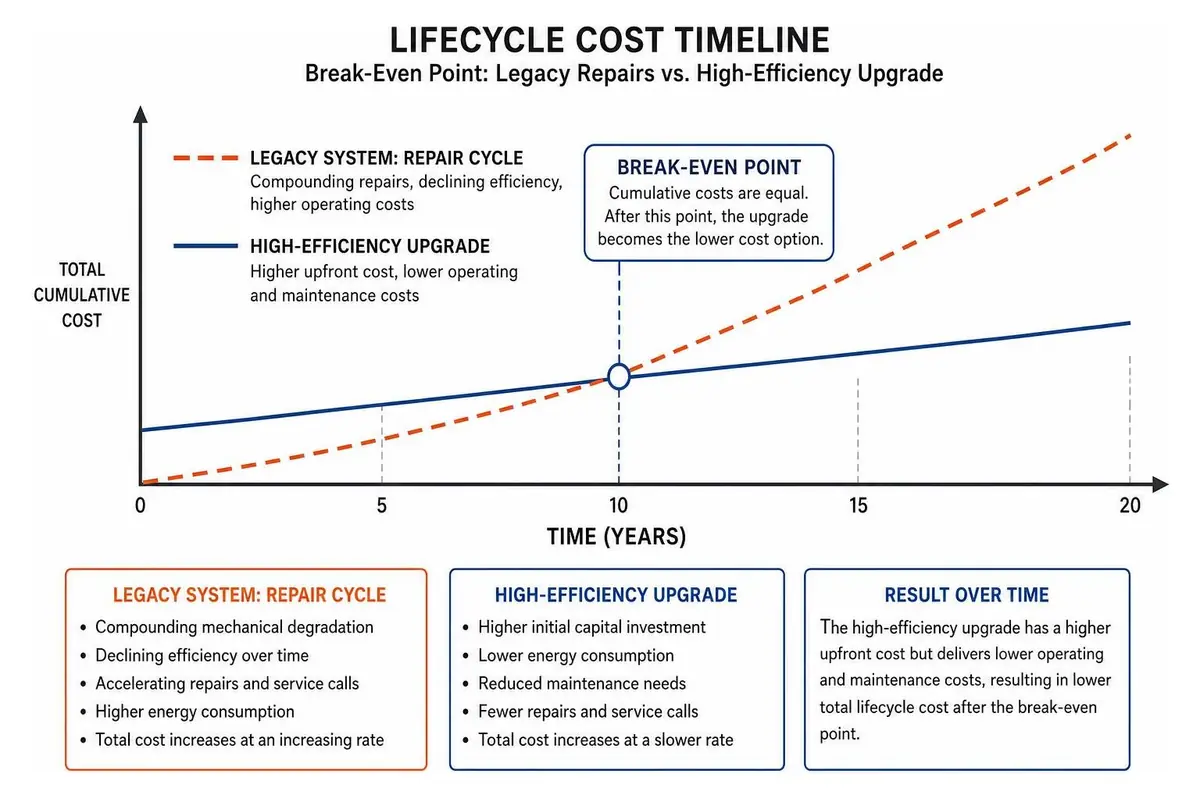
Critical Thresholds: When Continued Repairs Erode Facility Budgets
Pouring operational capital into an aging system past its economic life creates diminishing returns. When evaluating aging plant assets, facilities require clear quantitative benchmarks to determine when continued component overhauls are no longer economically viable. Adopting clear rules on how to budget for commercial HVAC maintenance and repairs shields operations from runaway repair spending.
- The 50% Component Rule: If a single repair estimate (such as a full compressor replacement or heat exchanger changeout) exceeds 50% of the replacement value of the unit, replace the asset.
- Frequency of Failure: Equipment requiring three or more major corrective repairs within a rolling 24-month period indicates broader subsystem breakdown.
- The 60% Service Life Metric: If an asset has exceeded 60% of its ASHRAE median service life (e.g., beyond year 10 for a 15-year packaged rooftop unit) and requires significant motor or refrigeration work, replacement yields superior 10-year net present value.
The Cumulative Impact of Reactive Fixes vs Planned Upgrades
Industry data demonstrates that reactive capital spending on emergency changeouts is 40% to 70% more expensive than planned replacements. When a critical unit fails catastrophically during extreme weather, facility managers face premium freight fees, overtime mechanical labor, emergency temporary rental chillers, and tenant disruptions.
Following established best practices to extend commercial HVAC equipment life keeps equipment running reliably through its design life, but planning capital replacements ahead of outright failure preserves negotiating power, enables engineered selections, and eliminates unbudgeted emergency premiums.
Efficiency Degradation in Aging Commercial Systems
Even when an aging commercial HVAC system appears mechanically functional, internal physical degradation silently drains operational funds. Over 10 to 15 years of continuous service:
- Micro-fouling of internal evaporator and condenser coil surfaces degrades heat transfer rates.
- Mechanical tolerances inside reciprocating and scroll compressors wear down, decreasing volumetric efficiency.
- Defective dampers and drifting pneumatic or legacy electronic controls cause unintended simultaneous heating and cooling.
This performance loss often results in a 10% to 20% increase in baseline electrical consumption over time. Implementing key energy conservation measures for commercial HVAC restores operational balance and pinpoints when underlying thermal degradation makes replacement the smarter financial move.
System Architecture Comparison: Variable-Speed RTUs, VRF, and Modular Chillers
Selecting the ideal high-efficiency system depends heavily on your building layout, internal occupancy profiles, and existing infrastructure. Reviewing a detailed cost comparison of HVAC retrofits vs replacement helps identify which mechanical architecture matches your facility's operational demands.
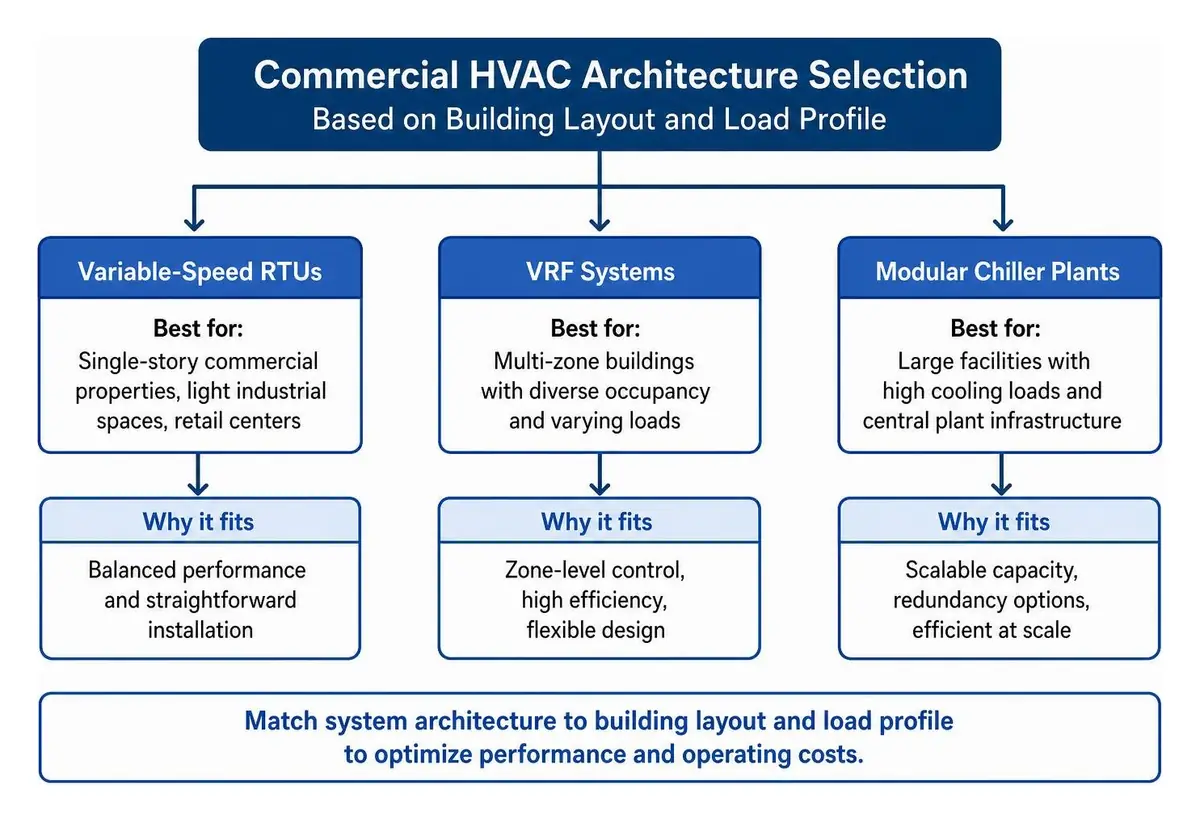
Variable-Speed Rooftop Units (RTUs)
For single-story commercial properties, light industrial spaces, and retail centers, variable-speed packaged rooftop units deliver balanced performance and straightforward installation:
- Modulating Compressors: Modern scroll and inverter compressors throttle smoothly to meet low part-load conditions, cutting median cooling energy use by ~20% compared to legacy fixed-speed units.
- Dynamic Fan Control: Variable-speed ECM blower motors drastically cut energy use during ventilation-only and low-cooling cycles.
- Streamlined Maintenance: Standardized curb footprints and modular electronic swap kits minimize routine servicing time and simplify parts replacement.
Variable Refrigerant Flow (VRF) Systems
Variable Refrigerant Flow systems are ideal for multi-zone commercial buildings such as commercial offices, educational facilities, and healthcare spaces with varying thermal demands:
- Heat Recovery Capabilities: VRF systems simultaneously redirect waste heat from cooling zones (like sunlit perimeters or computer rooms) to zones calling for heating, slashing total building energy demand.
- Precise Zone Control: Independent fan coil units maintain individual room setpoints without requiring extensive, space-consuming ductwork retrofits.
- Refrigerant Network Management: Advanced electronic expansion valves modulate refrigerant volume continuously, though facilities must maintain proper sensor calibrations and leak-detection protocols.
Modular Inverter-Driven Chillers
For larger commercial complexes, academic campuses, and industrial plants, modular inverter-driven chillers offer a flexible alternative to massive single-chiller plants:
- Turndown and Low-Load Efficiency: Staging multiple modular units allows plants to achieve wide turndown ratios, delivering 15% to 30% better low-load efficiency than oversized constant-speed chillers.
- Built-In Redundancy: The modular structure provides native N+1 redundancy. If one module requires service, it is isolated and repaired without taking down the entire facility's cooling loop.
- Compact Physical Footprint: Compact modules fit through standard freight elevators and doorway openings, lowering rigging, structural crane work, and installation costs during plant retrofits.
Strategic Decision Framework: Retrofit vs Full System Replacement
Choosing between an equipment overhaul and a full system replacement requires evaluating the physical plant, projected energy returns, and available incentives. Facility managers can reference guidelines on evaluating when to retrofit vs replace commercial HVAC equipment while researching how Virginia businesses save on HVAC upgrades to offset capital costs through utility rebates and demand response initiatives.
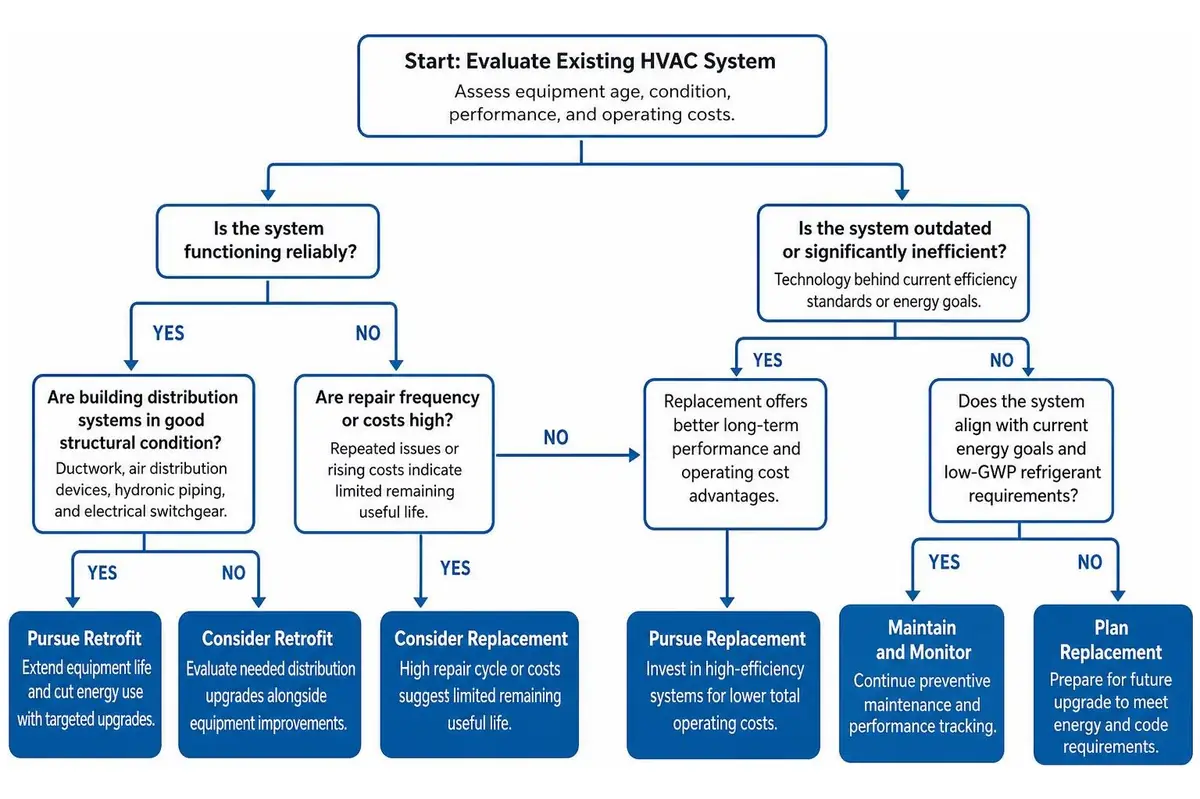
Assessing Existing Infrastructure and Useful Life
Before finalizing capital plans, assess the condition of existing building distribution systems. If your ductwork, air distribution devices, hydronic piping, and electrical switchgear remain structurally sound, targeted retrofits can extend equipment life while cutting energy use.
For facilities planning comprehensive plant modernizations, exploring high efficiency system upgrade opportunities in the Roanoke and Salem region ensures new equipment aligns with current low-global-warming-potential (GWP) refrigerant transitions and modern building code mandates.
Sensitivity Modeling for Long-Term Operating Costs
A reliable lifecycle cost model should account for changing external market factors over a 15- to 20-year horizon:
- Utility Escalation Rates: Test model sensitivity against projected electric rate increases to calculate realistic utility savings.
- Facility Occupancy Shifts: Account for hybrid work models or varying campus class schedules that increase part-load runtime hours.
- Incentives and Grid Programs: Integrate local utility efficiency incentives and peak demand management credits to shorten payback timelines.
Frequently Asked Questions About Commercial HVAC Lifecycle Economics
What is the 50% rule for commercial HVAC repair vs replace decisions?
The 50% rule is a standard capital planning guideline: when a single repair estimate exceeds 50% of the cost to replace the unit with a new system, replacement is the more economical long-term choice. Continuing to repair equipment past this mark generally leads to repeat mechanical breakdowns and higher cumulative operating costs over the following 3 to 5 years.
How do variable-speed systems reduce ongoing maintenance demands?
Variable-speed systems use inverter-driven compressors and ECM motors that ramp up gradually, eliminating the severe electrical inrush currents and mechanical vibrations caused by across-the-line fixed-speed motor starts. This steady operation reduces physical strain on bearings, belts, and electrical contacts, leading to fewer unexpected breakdowns and longer component life.
Why are HVAC replacements significantly more expensive than planned upgrades?
Emergency changeouts cost 40% to 70% more than planned projects because they require rush equipment sourcing, premium freight logistics, unscheduled overtime labor, and often costly temporary rental systems. A planned replacement gives you time to engineer the right system sizing, secure competitive equipment bids, and schedule installation during scheduled facility shutdowns.
Conclusion
Maximizing return on commercial HVAC investments requires looking beyond initial purchase figures to evaluate total lifecycle operating costs.
Since 1937, Whitescarver Engineering Co. has delivered high-performance commercial and industrial HVAC, refrigeration design, custom mechanical engineering, and comprehensive maintenance agreements across Roanoke, Salem, Vinton, and the Blacksburg/Christiansburg corridor. To evaluate your facility's equipment lifecycle and lower operating costs, explore commercial HVAC systems and engineering solutions with our engineering team today.
Facility intake
Need Help?
Tell us what facility, system, or maintenance risk needs attention so the first conversation starts with useful context.
About the Author
Whitescarver Engineering
Related Posts
- Evaluating Commercial HVAC Replacement Costs Versus Repair Cycles Across Vinton
- Are High-Efficiency Chillers Worth Upgrading to if You Only Use Them 8 Months a Year?
- A Comprehensive Guide to High Efficiency HVAC Payback in Virginia Commercial Buildings
- A Practical Guide to R-410A to R-454B Refrigerant Transition & Repair Costs in Virginia
- Central AC vs. High-Efficiency Heat Pumps: An Engineering Guide to Summer Cooling Replacements
Related service: Energy Conservation
Related Articles
Engineering-led support
Ready to Get Started?
Whether you need a repair, maintenance, or a new installation, our expert team is here to help.