
The Complete Guide to Remote Monitoring for Commercial HVAC in Virginia
Why Remote Monitoring for Commercial HVAC Matters in Virginia

Remote monitoring for commercial HVAC uses connected sensors, controls, and software to track equipment performance from one dashboard. For facility managers, it turns warning signs such as temperature drift, long runtimes, pressure changes, and refrigerant alarms into early alerts. Virginia businesses need remote monitoring because changing weather, humidity, energy use, and continuous facility demands can expose problems before staff notice them. Commercial HVAC remote monitoring in Roanoke, VA helps building owners reduce avoidable downtime, improve comfort, protect equipment, and plan service before a small fault becomes a major disruption.
Explore commercial and industrial control solutions | Talk with Whitescarver Engineering Company about your facility
For businesses throughout Roanoke, Salem, Vinton, and the Blacksburg/Christiansburg corridor, Whitescarver Engineering Company applies decades of commercial and industrial HVAC, refrigeration, and energy-conservation experience to help make system data useful and actionable.
I'm Hugh Joyce, and the next sections explain how remote monitoring collects data, flags faults, and supports more reliable facility operations.

What Is Remote Monitoring for Commercial HVAC and Why Do Virginia Businesses Need It?
At its foundation, remote HVAC monitoring combines industrial-grade Internet of Things (IoT) sensors, direct digital controllers, and cloud-based analytics to capture real-time operating metrics from commercial heating, cooling, and ventilation assets. Instead of waiting for a routine walkthrough or an uncomfortable tenant complaint, system telemetry streams continuously to a secure portal accessible from anywhere.
For commercial properties, educational institutions, and industrial operations across the Commonwealth, this shift from reactive repairs to predictive maintenance is essential. Heating and cooling systems account for roughly 40% of the energy consumed in commercial buildings. When equipment operates with undetected airflow restrictions, faulty economizers, or drifting calibration, energy waste accumulates rapidly. Continuous data acquisition ensures operational visibility, keeping mechanical systems operating within strict performance thresholds.
Understanding What Is Remote Monitoring for Commercial HVAC and Why Do Virginia Businesses Need It for Operational Reliability
Operational reliability directly affects productivity, tenant retention, and equipment service life. When asking what is remote monitoring for commercial hvac and why do virginia businesses need it, the answer lies in eliminating blind spots within mechanical infrastructure.
Commercial HVAC units, chillers, and industrial refrigeration systems run for thousands of hours each year. Minor mechanical anomalies—such as an elevated compressor discharge temperature, slight motor bearing vibration, or static pressure imbalance—inevitably precede major component failure. Cloud platforms equipped with Automated Fault Detection and Diagnostics (AFDD) continuously evaluate baseline parameters, alerting facility managers and our engineering staff the moment performance metrics deviate.
This automated oversight prevents catastrophic mechanical loss, extends capital equipment lifespan, and slashes emergency repair calls by up to 50%. Rather than suffering emergency downtime on a sweltering August afternoon in the Roanoke Valley, building operators can address minor component wear during scheduled, non-disruptive service windows.
Core Components of Cloud-Connected Commercial HVAC Systems
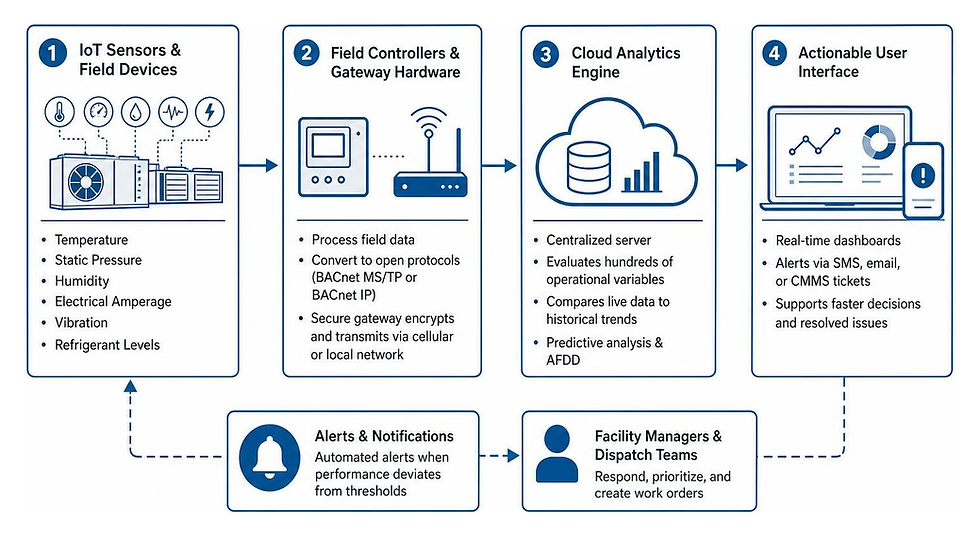
A robust commercial monitoring setup relies on a structured, multi-layered architecture:
IoT Sensors & Field Devices: Physical sensors measure temperature, static pressure, relative humidity, electrical amperage, vibration, and refrigerant levels across chillers, air handling units (AHUs), and packaged rooftop units (RTUs).
Field Controllers & Gateway Hardware: Direct digital controllers process field data and translate raw signals into standardized open protocols, primarily BACnet MS/TP or BACnet IP. Secure IoT gateways encrypt and transmit these data streams via cellular or local network connections.
Cloud Analytics Engine: A centralized server evaluates hundreds of operational variables per unit, cross-referencing live data with historical trends and predictive algorithms.
Actionable User Interface & Alert Dispatch: Facility managers and dispatch teams receive instant notifications via SMS, email, or direct Computerized Maintenance Management System (CMMS) tickets when faults occur.
When selecting hardware architectures, facility directors often weigh factory-installed controls against field retrofit options:
Feature / Consideration | Factory-Installed Monitoring Systems | Aftermarket Retrofit Monitoring Solutions |
Deployment Stage | Specified during new equipment manufacture/procurement | Installed on existing, operational legacy equipment |
System Compatibility | Native integration with unit controls and factory sensors | Uses non-invasive external IoT sensors and universal gateways |
Installation Complexity | Pre-wired and tested at factory; minimal on-site labor | Requires field wiring, sensor mounting, and protocol mapping |
Data Granularity | Up to 260+ internal machine variables and direct error codes | Focuses on key telemetry (temperature, pressure, power, vibration) |
Capital Application | Ideal for scheduled replacements and new facility construction | Maximizes life cycle and ROI of existing mechanical infrastructure |
Key Operational and Energy Efficiency Benefits for Facilities in Virginia
Commercial facilities that transition to telemetry-based oversight frequently capture 15% to 25% reductions in overall energy consumption. Optimization opportunities become immediately apparent once continuous system tracking is activated.
Energy waste in commercial buildings often stems from simple, hidden operational faults:
Simultaneous Heating and Cooling: Zone dampers or fighting thermostats cause heating coils and cooling stages to run at the same time in adjacent spaces.
Unoccupied Run Hours: Schedules revert to default "always on" modes following power blips, running heavy rooftop equipment throughout weekends and holidays.
Compressor Short Cycling: Faulty pressure switches or improper control loops cycle large compressors on and off rapidly, spiking peak electrical demand charges and causing premature motor failure.
By integrating automated scheduling and continuous fault diagnostics, our custom industrial HVAC solutions and comprehensive maintenance agreements ensure your systems draw only the power strictly necessary to satisfy load conditions.
Climate and Code Compliance Across Virginia Commercial Properties
The diverse climate of Virginia presents unique engineering challenges. From humid summer air masses moving across the Roanoke, Salem, and Vinton areas to crisp winter freezes across the higher elevations of the Blacksburg and Christiansburg corridor, commercial mechanical equipment must handle wide thermodynamic swings.
High outdoor humidity requires precise latent cooling control. If an air handling unit suffers from low airflow or a malfunctioning chilled water valve, indoor relative humidity can quickly surpass 60%. This spike risks indoor air quality (IAQ) degradation, mold growth, and structural moisture damage. Remote monitoring continuously verifies that outdoor air intake volumes and humidity levels meet the rigorous standards established by ASHRAE Standard 180 and the Virginia Uniform Statewide Building Code.
Early Fault Detection and Refrigerant Leak Prevention
Refrigerant regulation and safety standards continue to evolve. Commercial chillers and industrial process refrigeration systems operating with modern A2L refrigerants require precise oversight.
Remote monitoring systems equipped with integrated A2L leak detection sensors immediately notify facilities if trace concentrations of refrigerant escape. Catching a micro-leak early prevents environmental compliance infractions, protects sensitive inventory in cold-storage applications, and prevents expensive compressor burnout caused by operating under low suction pressure. Furthermore, continuous vibration and temperature tracking on large industrial compressors flags bearing fatigue weeks before a total seizure occurs.
Applications Across Virginia Industries and Facility Types
Real-World Applications: What Is Remote Monitoring for Commercial HVAC and Why Do Virginia Businesses Need It Across Facilities
Every commercial sector experiences distinct operational vulnerabilities that telemetry-driven management directly addresses:
Commercial Office Complexes: Multi-zone air handling units and variable air volume (VAV) systems balance airflow dynamically based on conference room and floor occupancy, maintaining high tenant satisfaction scores and curbing utility overhead.
Educational & Institutional Campuses: Centralized monitoring allows a single facilities team to manage multiple academic halls, verifying setpoint setbacks during semester breaks while ensuring laboratory spaces maintain tight ventilation tolerances.
Logistics & Warehousing Hubs: Large-volume spaces require constant monitoring of destratification fans and makeup air units to safeguard inventory and manage heating costs across expansive footprints.
Industrial & Manufacturing Plants: Process cooling, cleanrooms, and production-line HVAC demand tight temperature and pressure control. Our custom engineering designs help industrial operators avoid production halts and maintain environmental compliance.
Retrofit vs. Factory-Installed Solutions for Existing Infrastructure
A common misconception among building owners is that remote monitoring requires replacing functioning chillers or rooftop units. While factory-installed controls offer deep integration for new construction projects, retrofit IoT platforms can bring legacy equipment into modern building automation frameworks.
Using non-invasive split-core current transformers (CTs), strap-on pipe temperature thermistors, and external static pressure transducers, older mechanical infrastructure can broadcast critical performance data into a centralized dashboard without disturbing refrigeration circuits.

Essential Features to Look for in a Commercial Monitoring Platform
When modernizing building control infrastructure, facility teams should evaluate platforms based on several core industrial requirements:
Open-Protocol Interoperability: Systems should communicate over open architectures like BACnet, Modbus, or LonWorks to ensure equipment is never locked into a single proprietary ecosystem.
Role-Based Access Control: Strong enterprise cybersecurity demands tiered permissions, separating view-only dashboards for executive teams from control override access for authorized mechanical engineers.
Direct CMMS & Work-Order Integration: Automated alerts should integrate seamlessly with facility management ticketing software, generating service work orders the moment a key performance metric crosses an alarm threshold.
Predictive Diagnostics & Historical Trend Logging: The system must record minute-by-minute operational data for multi-year historical tracking, aiding long-term capital replacement planning and energy benchmarking.
Mobile & 24/7 Remote Accessibility: Facility managers and our 24/7 emergency response teams need immediate access to system conditions via secure web dashboards and mobile alerts.
Frequently Asked Questions About Commercial HVAC Remote Monitoring
Can remote monitoring be integrated into older commercial HVAC equipment?
Yes. Legacy rooftop units, chillers, split systems, and boilers can be retrofitted with universal IoT sensor packages and communication gateways. These field-mounted devices measure current draw, vibration, supply and return temperatures, and operating pressures, converting analog signals into digital BACnet protocols without requiring unit replacement.
How does remote monitoring prevent unexpected HVAC downtime?
The system uses continuous parameter tracking and Automated Fault Detection and Diagnostics (AFDD) to monitor equipment behavior. Instead of waiting for mechanical failure, the software flags subtle performance drifts—such as rising motor temperatures or abnormal refrigeration cycles—weeks before an outage occurs, allowing service during planned maintenance visits.
What operational data points are tracked by remote HVAC monitoring systems?
Typical commercial installations track dozens to hundreds of data points, including compressor amperage, suction and discharge pressures, evaporator coil delta-T, supply and return air temperatures, fan speeds, indoor relative humidity, damper positions, economizer status, and building Energy Use Intensity (EUI).
Modernize Your Facility Operations with Whitescarver Engineering Company
Managing complex mechanical infrastructure requires a shift away from reactive troubleshooting. Real-time telemetry, predictive diagnostics, and centralized building automation give facilities teams the tools needed to lower utility expenses, extend equipment lifespan, and guarantee uninterrupted indoor environmental quality.
Operating from Roanoke, VA, since 1937, Whitescarver Engineering Company brings over 85 years of technical heritage, industrial process capability, and B2B service reliability to organizations across the Commonwealth. Our engineering team specializes in custom industrial HVAC projects, advanced refrigeration engineering, planned maintenance agreements, and comprehensive commercial and industrial control solutions tailored specifically to your facility's operational demands.
Whether you oversee a multi-tenant commercial office in Roanoke, an industrial manufacturing plant in Salem, a distribution center in Vinton, or a high-tech facility throughout the Blacksburg/Christiansburg corridor, our technicians and engineers provide the proactive oversight your mechanical assets require.
Connect with Whitescarver Engineering Company today to assess your mechanical systems and implement dependable remote monitoring across your facility.


Comments