
Why water cooled chillers usually win the efficiency race
Fundamental Differences in Heat Rejection Mechanisms
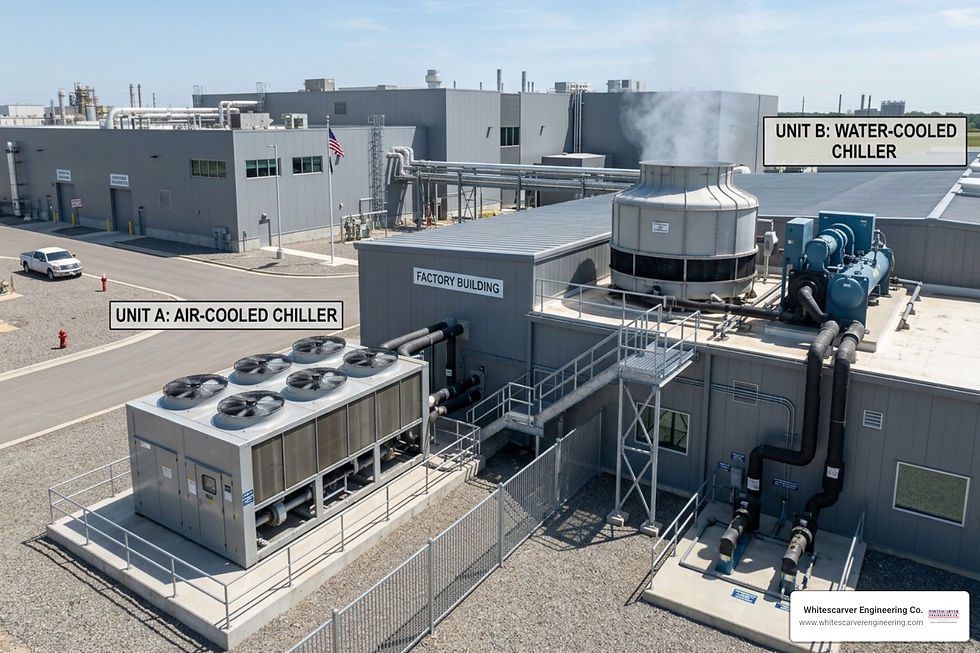
To understand air cooled chiller vs water cooled chiller efficiency, we first have to look at how these machines actually get rid of heat. Every chiller is essentially a heat mover. It takes heat from your building’s interior and pushes it outside. The "how" behind that push is where the two systems diverge.
Air-Cooled Chillers: The Giant Radiator
Think of an air-cooled chiller like a massive version of your car’s radiator. It uses a set of condenser coils and powerful fans. The refrigerant inside the coils is hot, and the fans pull ambient air across those coils to soak up the heat.
This process relies entirely on the dry-bulb temperature—which is just the standard temperature you see on a weather app. Because air isn't a great conductor of heat, these systems require a lot of surface area and high-velocity airflow to work. They are self-contained and "packaged," meaning they don't need external cooling towers or bulky water piping, which is a hallmark of many Commercial HVAC Systems.
Water-Cooled Chillers: The Power of Evaporation
Water-cooled chillers are a bit more sophisticated. Instead of blowing air over coils, they use a heat exchanger to transfer heat from the refrigerant into a separate loop of water. That water is then pumped to an outdoor cooling tower.
Inside the tower, the magic of evaporative cooling happens. A small amount of the water evaporates, which significantly cools the remaining water. This process is tied to the wet-bulb temperature, which accounts for humidity. Because the wet-bulb temperature is almost always lower than the dry-bulb temperature (especially in Virginia’s humid summers), the chiller doesn't have to work nearly as hard to reject heat.
Comparing Air Cooled Chiller vs Water Cooled Chiller Efficiency Metrics
When we talk about efficiency in the engineering world, we use a few specific "yardsticks." If you are looking into Energy Conservation Solutions Complete Guide, you'll likely run into these terms:
Metric | Definition | Why it Matters |
kW/ton | Power consumption per ton of cooling. | Lower is better. Water-cooled units often hit 0.50, while air-cooled sit around 0.85+. |
EER | Energy Efficiency Ratio (Full Load). | Shows how the system performs on the hottest day of the year at max capacity. |
IPLV | Integrated Part Load Value. | The "real world" metric. It calculates efficiency across various loads and temperatures. |
COP | Coefficient of Performance. | A ratio of heating or cooling provided to electrical energy consumed. |
The IPLV is perhaps the most important for a facility manager. Most chillers spend 99% of their life operating at something less than 100% capacity. A water-cooled chiller with a Variable Speed Drive (VSD) can achieve an IPLV as high as 10.45, whereas a comparable air-cooled model might hover around 5.07. That is a massive difference in your monthly power bill.
Why Water-Cooled Systems Lead in Air Cooled Chiller vs Water Cooled Chiller Efficiency
Why is the gap so wide? It comes down to physics. Water has a much higher heat capacity than air. In fact, water can hold about 4,000 times more heat than the same volume of air.
Because water is so much better at absorbing and moving heat, the thermal conductivity is higher, and the heat transfer coefficients are superior. This allows for lower condensing temperatures. When the condensing temperature is lower, the compressor doesn't have to "lift" the refrigerant pressure as high. Less lift equals less compressor work, which leads directly to the massive energy savings we see in High Efficiency System Upgrades in Roanoke VA.
Impact of Climate on Air Cooled Chiller vs Water Cooled Chiller Efficiency
In Virginia, our climate plays a huge role in this "battle." We experience high humidity and hot summers, which significantly impacts HVAC System Design in Roanoke VA.
Humidity Levels: In humid environments, the "gap" between dry-bulb and wet-bulb temperatures can shrink, but the wet-bulb still remains lower. This allows water-cooled systems to maintain performance stability even when the sun is beating down.
High Ambient Temperatures: Air-cooled chillers struggle when the mercury rises. For every 10°F increase in ambient air above 95°F, an air-cooled chiller's efficiency can drop by 6% to 8%.
Arid vs. Humid Regions: In very dry climates, water-cooled systems are even more efficient because evaporation happens more easily. However, in those areas, water scarcity becomes the bigger concern. In Virginia, we generally have enough water to make the efficiency of water-cooling very attractive.
Operational Considerations: Maintenance, Lifespan, and Capacity

Efficiency isn't just about the electricity used today; it's about how the system performs over 20 years.
Maintenance: The Trade-off
There is no such thing as a free lunch. The higher efficiency of water-cooled systems comes with a more rigorous maintenance schedule. Because they use open cooling towers, they are susceptible to biological growth (like algae), scale buildup, and corrosion.
Water Treatment: This is non-negotiable for water-cooled plants to prevent mineral deposits from insulating the tubes.
Tube Cleaning: Condenser tubes must be brushed or chemically cleaned regularly to maintain that high heat transfer.
Air-Cooled Simplicity: Air-cooled units are much simpler. You mostly need to keep the coils clean and ensure the fans are balanced.
Lifespan and Capacity
If you follow a Commercial HVAC System Engineering Guide Salem VA, you’ll see that water-cooled chillers generally live longer. Because they are typically installed indoors—protected from the rain, snow, and sun of Virginia—they often last 20 to 30 years. Air-cooled units, sitting on the roof and battling the elements, usually have a lifespan of 15 to 20 years.
Capacity is also a major divider. Air-cooled units usually top out around 500 to 600 tons. If you have a massive industrial complex or a hospital requiring 3,000 tons of cooling, you would need a small army of air-cooled units, whereas a few large water-cooled centrifugal chillers could handle the job with a much smaller total footprint.
Selecting the Right System for Your Facility

So, how do we help you choose? We look at several "on-the-ground" factors to determine the best Energy Conservation strategy for your specific site.
Cooling Load: Is your load consistent (like a data center) or highly variable (like an office building)? Water-cooled systems excel at heavy, continuous loads.
Space Constraints: Do you have room for a massive mechanical room and an outdoor cooling tower? If not, a rooftop air-cooled packaged unit is often the winner.
Water Availability: Does your facility have a reliable, affordable water source? A 500-ton water-cooled chiller can use about 1.5 gallons of water per ton-hour.
Sustainability Goals: Are you trying to minimize carbon footprint (favoring water-cooled efficiency) or minimize water consumption (favoring air-cooled)?
Total Cost of Ownership: We look past the initial purchase price. Often, the energy savings of a water-cooled system will "pay back" the higher installation and maintenance costs within just a few years.
Frequently Asked Questions about Chiller Efficiency
Which chiller type is better for small-scale applications?
For smaller facilities (generally under 200–300 tons), air-cooled chillers are usually the preferred choice. Their installation simplicity is a major plus; you don't need to worry about cooling towers, condenser water pumps, or complex piping. They are also excellent for space-limited retrofits where adding a water loop is physically impossible. If you're looking for the Best HVAC System Engineering in Salem VA, we often recommend air-cooled for mid-sized offices or retail spaces.
How does water consumption impact sustainability?
This is the "Water-Energy Nexus." While water-cooled chillers save a massive amount of electricity (reducing the carbon footprint of power generation), they do consume water through evaporation and "blowdown" (draining water to remove concentrated minerals). In regions with water scarcity, this is a major factor. However, for many large-scale operations, the energy saved actually outweighs the environmental cost of the water used, especially when using high-efficiency closed-loop systems.
Can hybrid systems bridge the efficiency gap?
Yes! We are seeing more "adiabatic" cooling systems. These are essentially air-cooled chillers that have a misting system or evaporative pads that activate only during the hottest hours of the day. This provides a "boost" in efficiency when you need it most without requiring a full cooling tower infrastructure. Combining these with Variable Speed Drives (VSDs) and advanced controls allows for peak load management that rivals traditional water-cooled performance.
Conclusion
At Whitescarver Engineering Co., we’ve spent over 75 years navigating the complexities of industrial and commercial cooling in Virginia. We know that the "best" chiller isn't just the one with the highest rating on a spec sheet—it’s the one that fits your building’s footprint, your maintenance capabilities, and your long-term budget.
Whether you are looking for HVAC System Engineering in Salem VA to design a new plant from scratch or you need to optimize an existing system for better reliability, our team is ready to help. We pride ourselves on technical solutions that are second-to-none, ensuring your facility stays cool while your energy bills stay under control.
Ready to see which system wins the race for your facility? Request a consultation for industrial refrigeration solutions today and let us put our decades of experience to work for you.


Comments