
A Practical Guide to Commercial Refrigeration Compressor Problem Symptoms
Why Early Compressor Symptoms Matter in Commercial Refrigeration

Commercial refrigeration compressor problems symptoms often include poor cooling, frequent short cycling, overheating, unusual noise, high amp draw, and rising box temperatures. For facility managers in Roanoke, VA, the key is to treat these as warning signs, not a diagnosis. A dirty condenser, refrigerant leak, failed fan, electrical fault, or oil-return issue can create the same symptoms as an internal compressor failure. Check operating pressures, line temperatures, voltage, and current draw before deciding the compressor is at fault. Early testing helps protect temperature-sensitive inventory and prevent a manageable system issue from becoming a major shutdown.
Whitescarver Engineering Company helps businesses across Roanoke, Salem, Vinton, and the Blacksburg/Christiansburg corridor identify the root cause of refrigeration problems in commercial and industrial systems.
For expert support with critical refrigeration equipment, contact Whitescarver Engineering Company.
I'm Hugh Joyce, and the next sections break down the warning signs that deserve immediate attention.

Top Commercial Refrigeration Compressor Problems Symptoms to Identify Early
In any commercial vapor compression system, the compressor serves as the mechanical heart, maintaining the pressure differential necessary to circulate refrigerant and transfer heat away from stored product. When internal or external operating conditions degrade, the unit exhibits distinct performance anomalies before total breakdown occurs.
Recognizing these critical indicators allows facility operators to consult a comprehensive refrigeration repair signs guide 2026 and execute corrective measures before valuable inventory is compromised. In cold storage, food service, or pharmaceutical environments, even a 2°C to 3°C deviation from setpoint can violate regulatory standards or spoil sensitive stock.
Thermal and Operational Commercial Refrigeration Compressor Problems Symptoms
Thermal stress is one of the most destructive operational anomalies a commercial compressor can encounter. Several performance warning signs point to severe thermal imbalance:
Excessive Discharge Temperature: A discharge line temperature exceeding 120°C (248°F) measured within six inches of the compressor service valve indicates severe overheating. At this temperature threshold, refrigeration lubricating oil begins to break down, carbonize, and form harmful system acids.
Internal Thermal Overload Tripping: Modern commercial compressors feature internal or external line-break overloads designed to interrupt control power when motor winding temperatures exceed safe thresholds. If a compressor frequently drops offline on thermal overload during peak operating hours, it is struggling with insufficient suction gas cooling, high ambient conditions, or excessive compression ratios.
Continuous Running with Capacity Loss: A compressor that runs continuously without satisfying the target box temperature often suffers from worn internal valves or blowby across the compression mechanism.
Rapid Short Cycling: A unit that starts and stops excessively within a short timeframe creates severe electrical and mechanical stress. Short cycling typically stems from low-pressure cutouts reacting to low suction, high-pressure cutouts tripping under extreme head pressures, or improperly calibrated thermostat differentials.

Electrical and Mechanical Commercial Refrigeration Compressor Problems Symptoms
Electrical anomalies and mechanical wear frequently manifest as audible or measurable electrical irregularities:
Locked Rotor and High Starting Amperage: When energized, a mechanically seized or electrically compromised compressor draws locked rotor amperage (LRA)—often 5 to 7 times the rated load amperage (RLA)—before tripping the circuit breaker or overload protector.
Humming or Buzzing Sounds: An audible hum without motor rotation suggests single-phasing on a three-phase power supply, open run windings, or a defective starting component (such as a seized potential relay or open start capacitor).
Rattling and Metallic Knocking: Internal mechanical clatter typically signals broken internal suspension springs (on hermetic units), damaged connecting rods, worn wrist pins, or loose valve plates.
Liquid Slugging Clatter: A distinct knocking or metallic hammering immediately following startup or defrost termination indicates liquid refrigerant entering the suction port. Because liquid cannot be compressed, slugging quickly bends valve reeds, shatters scroll plates, and snaps crankshafts.
Lubrication Breakdown and Poor Oil Return
Compressors depend on a continuous circulation of specialized lubricating oil (such as polyolester or alkylbenzene) to protect bearings, cylinder walls, and scroll flanks. If this lubrication cycle is interrupted, rapid mechanical destruction follows:
Sight Glass Oil Depletion: A visual check of the crankcase sight glass should show oil occupying one-third to one-half of the viewing area during steady-state operation. If the level drops below the sight glass, oil is being pumped into the system piping and failing to return.
Oil Foaming at Startup: Heavy foaming in the sight glass during startup indicates refrigerant migration into the crankcase during the off-cycle. The sudden pressure drop on startup causes the liquid refrigerant to flash violently, boiling the oil out of the sump and depriving bearings of hydrodynamic lubrication.
Acid Accumulation: Overheated oil reacts with moisture and trace contaminants to generate hydrofluoric and hydrochloric acids. This corrosive mixture attacks motor insulation, strips copper from internal lines, and scores bearing surfaces, ultimately leading to catastrophic motor burnout.
Differentiating Compressor Failures from System-Level Issues
A frequent pitfall in commercial facility maintenance is misdiagnosing an external system fault as an internal compressor breakdown. Because the compressor responds directly to everything happening throughout the entire system, external restrictions and airflow blockages mimic mechanical failure.
Understanding the broad range of types of commercial refrigeration systems explained across commercial and industrial facilities helps engineers isolate component failures from piping and airflow design faults.
Airflow Restrictions vs. Mechanical Seizure
Condenser and evaporator airflow problems are among the most common root causes of apparent compressor failures. When a condenser coil becomes heavily fouled with grease, dust, or debris, it cannot reject heat efficiently into the surrounding environment.
This causes condensing pressure (head pressure) and compression ratios to skyrocket, pushing motor amperage up and triggering the thermal overload. Facility teams can review strategies on how to prevent commercial refrigeration failures during peak summer demand to maintain adequate heat transfer clearance and avoid emergency summer outages.
Similarly, an evaporator fan motor failure or a heavily iced evaporator coil prevents refrigerant from absorbing heat from the refrigerated space. The unevaporated liquid refrigerant travels back through the suction line, lowering suction pressure and presenting a high risk of liquid floodback and slugging to the compressor crankcase.
Refrigerant Leaks and Metering Device Restrictions
When a refrigeration circuit develops a leak, the low mass flow of returning vapor fails to cool the compressor motor windings adequately. The system displays:
Low suction pressure
High suction superheat
Low discharge (head) pressure
Unusually high discharge line temperatures
A restricted liquid line filter drier or a malfunctioning thermostatic expansion valve (TXV) produces identical pressure patterns by starving the evaporator. Before condemning a compressor for poor cooling performance, technicians must inspect the liquid line sight glass for bubbles, measure temperature drops across filter driers, and verify proper expansion valve operation.
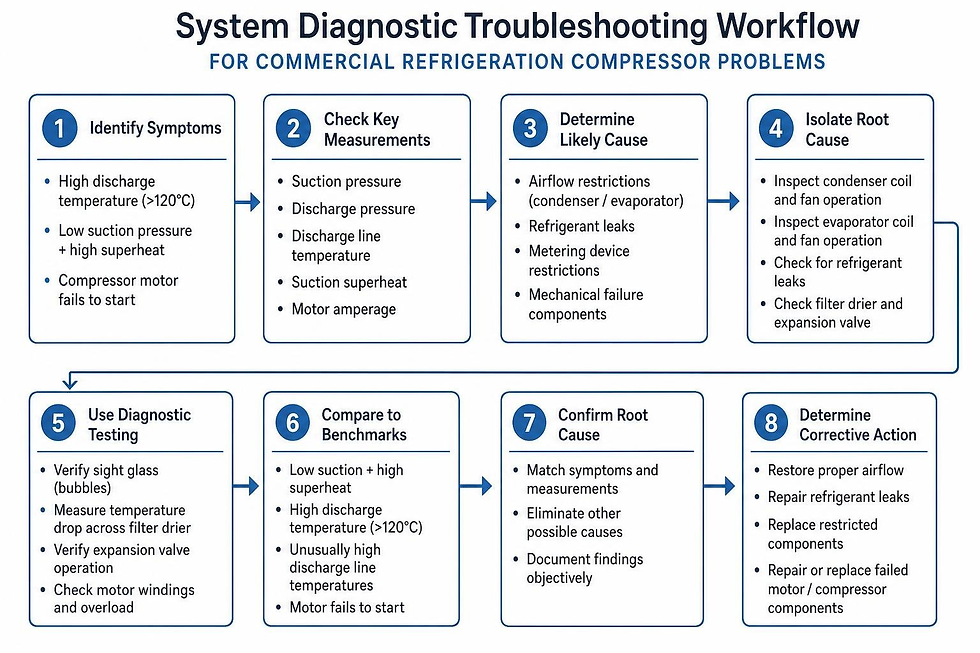
Precision Diagnostic Testing and Measurement Benchmarks
Accurate troubleshooting requires objective measurements rather than visual assumptions. Utilizing precision diagnostic instruments ensures that underlying system dynamics are fully documented before taking equipment offline.
Comparing data across process equipment also demands an understanding of the industrial refrigeration vs commercial refrigeration difference, where charge volumes, operating pressures, and oil management protocols diverge significantly.

Pressure, Superheat, and Subcooling Analysis
Field diagnostics rely on three core thermal and pressure calculations:
Operating Pressures and Compression Ratio: Gauge manifold sets record saturated suction and discharge pressures. The absolute compression ratio (Absolute Discharge Pressure ÷ Absolute Suction Pressure) should remain within design limits—typically under 10:1 for single-stage commercial refrigeration. Ratios exceeding this threshold create extreme discharge temperatures and accelerate oil breakdown.
Evaporator and Compressor Superheat: Evaporator superheat (measured at the evaporator outlet) confirms whether the coil is properly fed with refrigerant. Total compressor superheat (measured within 6 inches of the compressor suction inlet) must generally stay between 11°C to 17°C (20°F to 30°F) to ensure no liquid refrigerant enters the pump while providing adequate motor cooling.
Liquid Subcooling Calculation: Subcooling (measured at the condenser outlet) indicates the quality of the liquid column feeding the metering device. Low subcooling paired with low suction pressure typically points to an undercharged system, whereas high subcooling paired with high discharge pressure indicates non-condensables or an overcharge.
Valve Blowby Testing: In reciprocating units, worn suction or discharge valves reduce pumping efficiency. If a compressor exhibits high suction pressure, low discharge pressure, low amp draw, and very high superheat, the pump is merely churning vapor internally without building compression.
Electrical Testing and Inverter Drive Diagnostics
Electrical troubleshooting requires measuring winding resistance, phase balance, and insulation health under load:
Winding Resistance Measurements: Using a calibrated digital multimeter, test resistance across all terminal combinations (Common, Start, and Run on single-phase; T1, T2, and T3 on three-phase). On three-phase motors, resistance across all phase pairs must be balanced.
Megohmmeter (Megger) Insulation Testing: Standard multimeters cannot detect micro-fissures in motor winding insulation. A Megger test applies 500V to 1000V DC to measure insulation resistance to ground. Any reading below 1 Megohm (1 MΩ) indicates critical insulation degradation, moisture contamination, or acid damage, requiring immediate attention before the motor grounds entirely.
Three-Phase Voltage Imbalance: Supply voltage imbalance between phases must never exceed 2%. A mere 2% voltage unbalance can generate a 12% to 15% current imbalance in the motor windings, causing localized hotspots and winding failure.
Variable-Frequency / Inverter Drive Diagnostics: Modern variable-speed inverter compressors utilize three-phase brushless DC or permanent magnet motors driven by an Intelligent Power Module (IPM). On these systems, balanced winding resistance typically ranges between 2 to 8 ohms across U, V, and W terminals. If the windings test balanced and show no short to ground, diagnostic protocols require testing the inverter board's modulating DC output voltage and checking for thermal breakdown in the drive electronics.
Decision Protocol: Rebuilding, Component Support, or Unit Replacement
When an internal defect is confirmed, facility managers must evaluate whether to replace individual starting components, repair semi-hermetic assemblies, or complete a full compressor replacement.

External starting components on hermetic systems—such as potential starting relays, start capacitors, and run capacitors—can be replaced independently if the internal motor windings test electrically sound. However, if a hermetic compressor suffers mechanical seizure, broken internal valves, open windings, or a direct ground fault, the sealed assembly cannot be rebuilt in the field and requires replacement.
Semi-hermetic compressors offer the advantage of serviceable cylinder heads, valve plates, and oil pumps, allowing targeted mechanical repairs without replacing the entire cast-iron housing.
When evaluating major equipment replacements, facility leaders should also consider what is commercial refrigeration engineering design and when do you need it to optimize system capacity, piping geometry, and long-term energy performance.
Furthermore, aging systems may operate on transitional compounds; understanding how refrigerant phase-out affects commercial refrigeration systems in virginia facilities helps businesses decide whether to retrofit to modern low-GWP refrigerants during a major compressor overhaul.
In the event of a severe motor burnout, thorough system remediation is mandatory before placing a new compressor in service. This cleanup process includes:
Recovering contaminated refrigerant in accordance with environmental standards
Installing high-capacity suction and liquid line burnout filter-driers
Adding acid-scavenging additives
Testing and flushing contaminated piping
Replacing all system oil charges to prevent residual acid from attacking the new compressor motor
Proactive Maintenance Strategies to Prevent Compressor Breakdown
Preventive maintenance is the most effective safeguard against unscheduled downtime, high energy consumption, and premature compressor failure. Incorporating an ultimate commercial refrigeration maintenance guide alongside current commercial refrigeration maintenance tips 2026 ensures consistent operational reliability across facilities.
Routine Logging and Electrical Panel Inspections
Operational Parameter Logging: Log daily suction pressure, discharge pressure, oil pressure, line temperatures, and ambient conditions. Tracking trends over time reveals creeping efficiency losses before safety switches trip.
Thermographic Panel Surveys: Perform semi-annual infrared thermography on electrical disconnects, magnetic contactors, and terminal blocks to detect loose connections, pitted contact points, or high-resistance hotspots.
Vibration and Noise Profiling: Periodically inspect compressor mounting springs, vibration eliminators, and discharge line loops to prevent metal fatigue and refrigerant line fractures.
Lubrication Management and System Cleanliness
Laboratory Oil Analysis: For large commercial and industrial systems, sample compressor lubricant annually to analyze viscosity, moisture content, acid number, and wear metals (iron, copper, aluminum).
Crankcase Heater Verification: Inspect crankcase heaters before cold-weather operation to ensure oil sumps remain at least 11°C (20°F) above saturation temperature during off-cycles, preventing refrigerant migration.
Piping and Suction Riser Design: Ensure vertical suction line risers incorporate properly sized P-traps and double-riser geometry to maintain adequate refrigerant velocity for continuous oil return across all staging loads.
Condenser Coil Hygiene: Establish a strict schedule for chemical washing and debris removal from air-cooled condensing units to prevent elevated head pressures and excessive compression heat.
Frequently Asked Questions About Commercial Compressor Symptoms
What causes a commercial refrigeration compressor to short cycle?
Short cycling is most commonly caused by an improperly adjusted low-pressure control, an undercharged refrigerant circuit, an iced evaporator coil, a restricted thermostatic expansion valve, or a narrow thermostat differential. It can also result from a high-pressure cutout switch opening due to fouled condenser coils, inoperative condenser fan motors, or non-condensables in the line.
How do you distinguish between a failed start component and a seized compressor?
To differentiate the two, isolate electrical power and test the starting relay and capacitors using a digital multimeter and capacitance meter. Measure the compressor motor winding resistance across all terminals and perform a Megger test to check for grounds. If the starting components test defective while the motor windings are intact and show proper resistance, replacing the starting pack will restore operation. If the compressor still draws locked rotor amperage (LRA) with verified, functional starting components, the internal rotor is mechanically seized.
When should a commercial compressor be replaced instead of repaired?
A commercial compressor must be replaced if it has grounded or open motor windings, has suffered an internal motor burnout that contaminated the hermetic housing, has seized internal bearings, or has broken internal mechanical components in a non-serviceable sealed hermetic shell. Semi-hermetic units can often be repaired on-site if damage is isolated to valve plates, cylinder heads, or external oil pumps.
Commercial Refrigeration Solutions for Virginia Facilities
Maintaining peak refrigeration performance requires immediate action whenever warning symptoms arise. Since 1937, Whitescarver Engineering Company has delivered dependable commercial and industrial HVAC and refrigeration engineering, maintenance, and installation across Virginia.
Our team specializes in installing, maintaining, and retrofitting large-scale HVAC systems, industrial process systems, refrigeration engineering and design, custom industrial HVAC projects, and comprehensive energy-conservation solutions. We support facility managers and industrial operations with tailored maintenance agreements, energy cost reduction strategies, and 24/7 service for commercial clients throughout Roanoke, Salem, Vinton, and the Blacksburg/Christiansburg corridor.
Protect your critical cold storage assets and maintain operational continuity. Connect with our engineering and service team today to schedule an advanced diagnostic assessment or discuss an engineered maintenance solution for your commercial facility.


Comments