
The Chiller Truth: Commercial HVAC Lifespan by Equipment Type
How Long Does a Commercial HVAC System Last? A Quick Answer for Facility Managers

How long does a commercial hvac system last depends primarily on the equipment type, maintenance discipline, and operating environment — but most systems deliver between 15 and 25 years of reliable service life.
Here is a quick-reference breakdown by system type:
Equipment Type | Typical Lifespan |
Packaged Rooftop Units (RTUs) | 15-20 years |
Air-Cooled Chillers | 15-20 years |
Water-Cooled Chillers | 20-30 years |
Boilers (condensing) | 15-30 years |
Boilers (cast iron) | 30-35+ years |
Air Handlers | 15-20 years |
Condensers | 10-20 years |
Heat Pumps | 10-15 years |
VRF Systems | 15-25 years |
Ductwork | 20-25 years |
These ranges assume regular professional maintenance. Neglected systems can fail significantly earlier, while well-maintained equipment routinely reaches — and exceeds — the upper end of those ranges.
For facility managers and building owners in the Roanoke, VA region, understanding where each piece of your commercial HVAC infrastructure sits in its lifecycle is not just useful — it is essential for capital planning, budget forecasting, and avoiding costly unplanned downtime.
Think of your HVAC system less like a single machine and more like a fleet of interconnected components, each aging on its own schedule. A chiller installed in 2010 may have another decade of useful life, while the compressor serving it could be approaching the end of its reliable service window right now. Getting that picture right — at the component level — is what separates reactive facility management from strategic operations.
The sections below break down lifespan expectations by equipment category, explain the environmental and operational factors specific to Virginia's climate, and give you a clear framework for deciding when repair no longer makes financial sense.
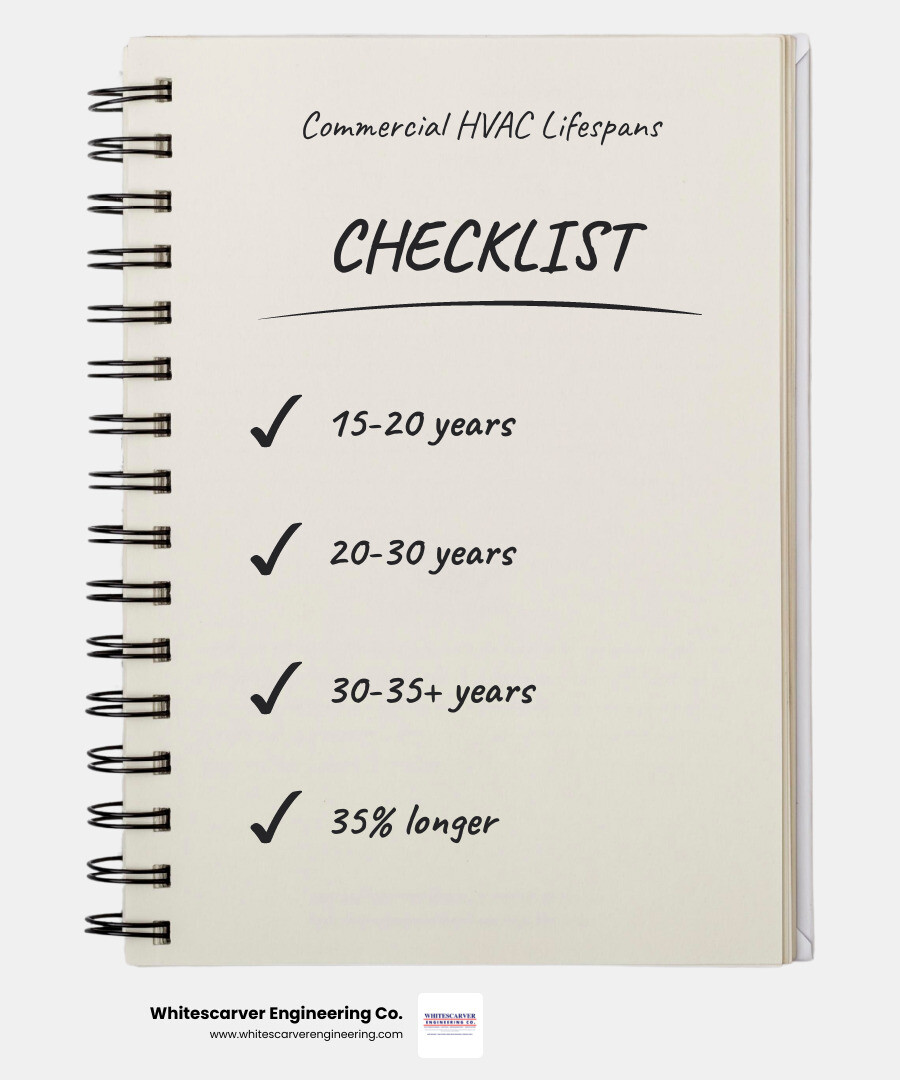
How Long Does a Commercial HVAC System Last on Average?
When we look at the broad spectrum of industrial and commercial properties across the Roanoke Valley, the consensus among mechanical engineers and organizations like ASHRAE is that a system’s median service life sits between 15 and 25 years. However, "average" can be a misleading term in high-stakes mechanical engineering.
As of April 2026, many facilities are managing equipment that was installed during the construction booms of the early 2000s. These systems are now entering their "decision decade." Whether a system lasts 15 years or 25 years is rarely a matter of luck; it is a matter of maintenance discipline. Research indicates that properly maintained commercial HVAC equipment lasts up to 35% longer than neglected systems.
For a facility manager, the "lifespan" isn't just the point where the machine stops turning. It is the period from initial commissioning to the point where the system can no longer deliver the required heating or cooling capacity at an acceptable efficiency level. A system that still "runs" but consumes 40% more energy than a modern equivalent has, for all intents and purposes, reached the end of its economic life.
At Whitescarver Engineering Co., we view Commercial HVAC Systems through the lens of operational value. If your system is approaching the 20-year mark, it may not "fall out of the walls," but its declining efficiency and the increasing scarcity of legacy parts may be silently eroding your bottom line.
Breaking Down Lifespan by Equipment Category
To accurately answer how long does a commercial hvac system last, we have to look at the "Ship of Theseus" paradox. A commercial HVAC system is a collection of parts—compressors, coils, fans, and sensors—that are often replaced at different times. However, the primary chassis or "category" of the system dictates the overall capital planning timeline.
How long does a commercial hvac system last for chillers and boilers?
Chillers and boilers are the heavyweights of the HVAC world, often serving as the heart of a building's hydronic system. Because they are typically housed indoors (in mechanical rooms) and built with heavy-duty materials, they boast some of the longest lifespans in the industry.
Water-Cooled Chillers: These are the gold standard for longevity, frequently lasting 20 to 30 years. Because they use water to dissipate heat rather than outdoor air, the internal components aren't subjected to the same level of temperature-induced stress as air-cooled models.
Air-Cooled Chillers: These typically see a shorter lifespan of 15 to 20 years, as they are exposed to the elements and work harder to reject heat during humid Virginia summers.
Boilers: Traditional cast iron boilers are legendary for their durability, with many units in older Roanoke buildings pushing 35 years or more. Modern high-efficiency condensing boilers are more complex and usually have a practical range of 15 to 30 years.
The "silent killer" for these systems is scale accumulation and poor water chemistry. Without a rigorous water treatment program, minerals can coat heat exchangers, leading to localized overheating and eventual metal fatigue or cracking.
How long does a commercial hvac system last for rooftop units?
Packaged Rooftop Units (RTUs) are the workhorses of retail, office, and industrial spaces. Because they sit on the roof, they are the frontline soldiers against the weather.
Standard RTUs: You can generally expect 15 to 20 years of service. The compressor—the "heart" of the unit—often begins to show declining efficiency after year 10 and may require replacement or major repair around year 12 to 15.
Air Handlers: These components, which circulate air throughout the building, typically last 15 to 20 years. Their lifespan is often limited by the degradation of the blower motor or the corrosion of the internal coils.
To get the most out of these units, seasonal transitions are critical. We recommend following a Spring Maintenance for Commercial Rooftop Units protocol to clear away winter debris and prep the condenser coils for the cooling load ahead. For more detailed local insights, our Commercial HVAC Maintenance Guide Roanoke VA provides a roadmap for preserving these assets in our specific climate.
Environmental and Operational Factors in Virginia
The geography of Southwest Virginia plays a starring role in equipment degradation. In Roanoke and the surrounding Blue Ridge corridor, we deal with high humidity levels and significant seasonal temperature swings.
Humidity and Corrosion: High humidity doesn't just make occupants uncomfortable; it accelerates the oxidation of copper coils and aluminum fins. In industrial settings where chemicals or pollutants are present, this corrosion can happen even faster, leading to refrigerant leaks that are difficult and expensive to patch.
Unit Sizing and Short-Cycling: One of the most common reasons a system fails prematurely in our region is improper initial sizing. If a unit is too large for the space, it "short-cycles," turning on and off rapidly. This puts immense strain on the compressor and electrical components. Conversely, an undersized unit will run constantly, leading to "compressor fatigue" and early burnout.
Industrial Load Patterns: Equipment in a Blacksburg manufacturing plant or a Roanoke data center often runs 24/7. This "high-duty cycle" means the equipment reaches its mechanical end-of-life much faster than the same unit in a 9-to-5 office building. When evaluating Commercial HVAC Retrofit vs Full Replacement, we always look at the actual "run hours" rather than just the calendar age of the machine.
Repair vs. Replacement: The 50% Rule
Deciding whether to keep pouring money into an aging unit or to bite the bullet on a replacement is one of the toughest calls a facility manager has to make. At Whitescarver Engineering Co., we often point to the "50% Rule."
If the cost of a repair exceeds 50% of the replacement cost, and the unit has already passed 50% of its expected service life, replacement is almost always the smarter financial move.
Beyond the 50% rule, there are several "hard thresholds" that trigger a replacement:
Energy Waste: Older systems can consume 30% to 50% more energy than modern, code-compliant units. In a large-scale industrial facility, those utility savings alone can often pay for the new system in just a few years.
R-22 Refrigerant Phase-Out: As of 2020, the production of R-22 (Freon) ended. If you have an older system that uses R-22 and develops a major leak, the cost of the refrigerant alone—if you can even find it—makes the repair economically unviable.
SEER2 Compliance: New federal efficiency standards (SEER2) went into effect in 2023. Upgrading to a compliant system ensures you aren't just meeting current standards but are future-proofing your facility against rising energy costs.
Building Usage Changes: If your Roanoke warehouse has been converted into a high-density office or a temperature-controlled laboratory, your original HVAC system is likely no longer the right tool for the job.
For a comprehensive look at your options, consult our Commercial HVAC Replacement Guide Roanoke VA.
Frequently Asked Questions about Commercial HVAC Longevity
What is the average lifespan of commercial ductwork?
Commercial ductwork is the most durable part of the system, typically lasting 20 to 30 years. However, it is not "set it and forget it." Over time, insulation can degrade, and physical seals can fail. It is estimated that many existing commercial buildings lose 20% to 30% of their conditioned air through duct leaks. In large facilities, we often recommend phased replacement strategies—upgrading duct sections during broader renovations to minimize operational disruption.
How much longer does a well-maintained system last?
On average, a proactive maintenance plan can extend a system's life by 35%. This isn't just about changing filters. It involves quarterly professional inspections, predictive trend analysis (monitoring motor vibration or refrigerant pressure over time), and meticulous coil cleaning. By catching a failing $100 capacitor during a routine check, you prevent the failure of a $5,000 compressor down the road.
When should a facility manager plan for a full system retrofit?
The 15-year mark is the critical threshold for capital planning. Even if the system is running well, this is the time to begin budgeting for a retrofit. Signs that the time is near include rising energy bills that can't be explained by rate hikes, "obsolete" parts that take weeks to source, inconsistent zoning (hot and cold spots), and a noticeable decline in indoor air quality or humidity control.
Conclusion
Understanding how long does a commercial hvac system last is about more than just a number on a chart—it’s about protecting your facility’s operational continuity and your bottom line. Since 1937, Whitescarver Engineering Co. has been the trusted partner for Roanoke’s most complex industrial and commercial HVAC challenges.
With over 75 years of heritage and a deep understanding of the unique demands of Virginia’s climate, we provide more than just repairs; we provide technical solutions designed for the long haul. Whether you are managing a high-tech manufacturing plant in Blacksburg or a historic commercial property in downtown Roanoke, our focus remains on energy conservation, system reliability, and custom engineering that stands the test of time.
If your equipment is approaching its sunset years, don't wait for a catastrophic failure during a summer heatwave. Let us help you transition from reactive repairs to strategic asset management. Explore our full range of Commercial HVAC Systems and maintenance solutions today.

Comments