
Keep Your Cool with These Rooftop Unit Spring Maintenance Tips
Why 68% of RTU Compressors Fail Right When You Need Them Most

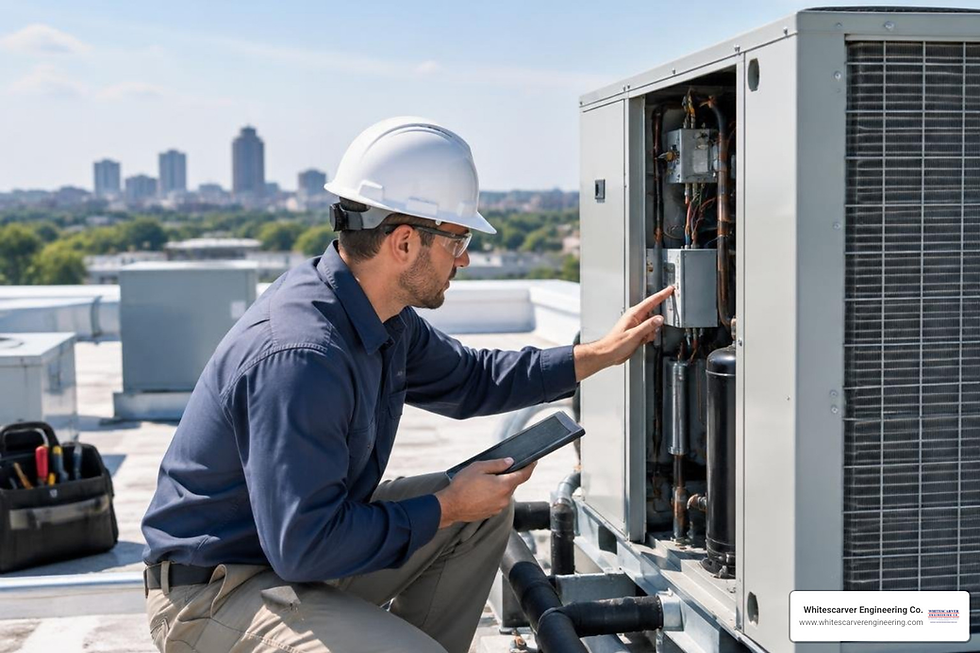
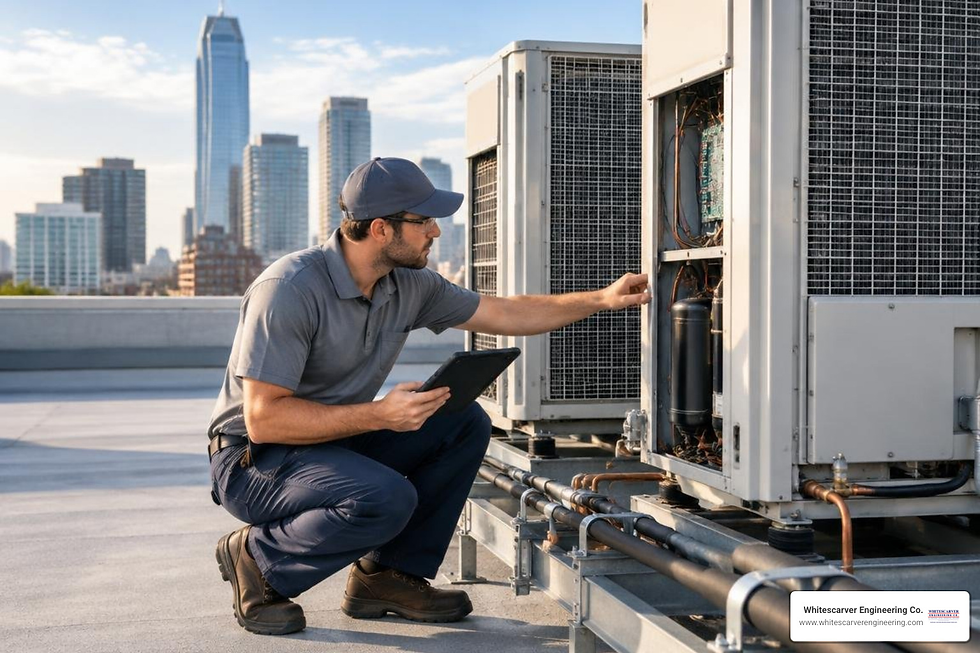
Spring maintenance for commercial rooftop units is the single most important service event in your RTU's annual cycle — and skipping it is one of the most expensive mistakes a facility manager can make.
Here is a quick overview of what spring RTU maintenance involves:
Clean condenser and evaporator coils to restore heat transfer efficiency
Test and replace capacitors if readings fall more than 10% below rated value
Verify refrigerant charge using superheat (10-20°F) and subcooling (10-15°F for TXV systems)
Inspect and replace air filters, establishing a clean static pressure baseline
Clear condensate drain pans and P-traps, and apply algaecide treatment
Check belt tension, bearings, and fan blades for wear after winter downtime
Inspect economizer dampers and actuators for proper operation
Confirm crankcase heaters are functional before first compressor startup
Review all electrical connections, contactor condition, and amp draws
Document all findings with technician sign-off for EPA and warranty compliance
Commercial rooftop units are some of the hardest-working equipment in any building. They sit exposed to UV radiation, temperature swings, vibration, and weather extremes — every single day. After a full winter of heating duty, internal components wear down quietly. Capacitors degrade. Refrigerant levels can drop. Coils collect debris. And when the first hot day of the year arrives, all of that deferred wear shows up at once.
The numbers tell the story clearly: 68% of RTU compressor failures happen within the first 30 days of the cooling season — not because the equipment suddenly breaks, but because pre-season inspections were skipped. A properly maintained RTU can serve your facility for 15 to 20 years. A neglected one may last half that long, and cost significantly more to operate along the way.
For Virginia facility managers and business owners, getting ahead of the cooling season before outdoor temperatures climb past 65°F is the difference between reliable comfort all summer and an emergency repair call on the hottest week of the year.

Why Spring Maintenance for Commercial Rooftop Units is Critical
At Whitescarver Engineering Co., we have seen how the variable climate in Roanoke and the surrounding Blue Ridge areas can take a toll on HVAC systems. Spring is the transition period where we move from heavy heating demand into sustained cooling. This window of time is the ideal opportunity to confirm equipment readiness.
Preventative care is not just about avoiding a breakdown; it is about protecting your bottom line. Research shows that maintaining clean RTU coils and ensuring a correct refrigerant charge can lead to 25% energy savings throughout the season. When you consider that packaged rooftop equipment accounts for roughly 40% of all commercial HVAC installations, those savings add up quickly across a large facility.
Operational reliability is the cornerstone of a successful business. Whether you are managing a retail space in Salem or a warehouse in Roanoke, an RTU failure on a 90-degree day leads to more than just discomfort—it leads to lost productivity and potential revenue loss. By following a Commercial HVAC Maintenance Guide Roanoke VA, you shift from a "run-to-failure" strategy (the most expensive way to operate) to a proactive model.
Furthermore, a disciplined maintenance program extends the lifespan of your unit. While a neglected unit might burn out in 8 to 10 years, a well-maintained system can easily last 15 to 20 years. This long-term view is essential for capital planning. For more localized advice, check out our Commercial Maintenance Salem VA Guide to see how we help businesses stay ahead of the curve. Spring service is your best defense against the need for a 24-Hour Commercial HVAC Repair Blue Ridge VA Guide when the summer humidity hits.
Essential Checklist for Seasonal RTU Readiness
When our technicians arrive for a spring service call, we don't just "kick the tires." A comprehensive inspection involves deep-diving into the components that work hardest during the summer. The most critical areas are the condenser and evaporator coils.
The Impact of Dirty Coils
Dirty coils are the silent killers of RTU efficiency. When dust, pollen, or debris (like the "summer snow" of cottonwood) clogs these coils, the system has to work 30-40% harder to reject heat. This raises the condensing temperature by 10–20°F, putting an immense load on the compressor.
Feature | Clean RTU Coils | Dirty RTU Coils |
Energy Efficiency | Optimal (100%) | Reduced by 25-40% |
Compressor Strain | Low / Normal | High / Dangerous |
Cooling Capacity | Full Design Capacity | Significant Loss |
Component Lifespan | 15-20 Years | 7-10 Years |
Head Pressure | Within Manufacturer Spec | Excessively High |
Filters and Static Pressure
Airflow is the lifeblood of your HVAC system. We recommend replacing air filters at least quarterly, though high-traffic environments like restaurants or gyms may need monthly changes. During spring maintenance for commercial rooftop units, we establish a "clean baseline" static pressure. If the pressure drop across the filter rises more than 0.5 in. w.g. above that baseline, it is time for a change. Proper filtration prevents debris from reaching the evaporator coil, which is much harder to clean than a simple filter swap.
Drain Pans and P-Traps
Spring is also the time to address moisture management. We clear condensate drain lines and P-traps of any winter sludge or biological growth. A clogged drain can lead to "musty" odors, indoor air quality issues, or even ceiling leaks that damage merchandise. We apply algaecide treatments to the drain pan to prevent algae from taking hold during the humid Virginia summer. Our comprehensive Maintenance Services ensure that every "unseen" part of your unit is ready for the workload ahead.
Mechanical Steps for Spring Maintenance for Commercial Rooftop Units
The mechanical side of an RTU involves moving parts that can suffer from friction and vibration.
Belt Tension and Alignment: We check belts for fraying, cracks, or "glazing." A belt that is too loose will slip and reduce airflow, while one that is too tight can cause bearings to fail 3 to 5 times faster. We look for a 1-inch deflection per foot of span.
Bearing Lubrication: Using a hand grease gun (to avoid blowing out seals), we lubricate fan and motor bearings to ensure smooth operation.
Fan Blade Balance: We inspect centrifugal fans and condenser fan blades for dirt buildup or damage that could cause vibration.
Cabinet Integrity: Because RTUs live on the roof, we inspect cabinet gaskets and roof curbs for weather damage. A leaky cabinet allows unconditioned air to enter the stream, wasting energy.
For more tips on keeping your mechanical systems in peak shape, see our Commercial HVAC Maintenance Blue Ridge VA Tips. We also offer Eco-Friendly Maintenance Services in Salem VA for businesses looking to minimize their carbon footprint through high-efficiency tuning.
Electrical and Refrigerant Checks for Spring Maintenance for Commercial Rooftop Units
Electrical failures represent roughly 40% of commercial HVAC service calls. During a spring visit, we focus on:
Capacitors: These are the "batteries" that help your motors start and run. If a capacitor tests more than 10% below its rated microfarad value, it is a leading indicator of an imminent compressor failure.
Contactors: We look for "pitting" or carbon buildup on electrical contacts. A stuck or worn contactor can cause a compressor to burn out.
Crankcase Heaters: These must be functional to keep refrigerant from migrating into the compressor oil during the "off" cycle. Starting a "cold" compressor can cause liquid slugging and instant failure.
Refrigerant Charge: We verify the charge using technical measurements. For fixed-orifice systems, we target a superheat of 10-20°F. For systems with a Thermal Expansion Valve (TXV), we look for a subcooling target of 10-15°F.
All refrigerant work must be performed by EPA Section 608-certified technicians, which is a standard we strictly uphold at Whitescarver Engineering Co. This ensures compliance with environmental regulations and protects your equipment. You can learn more about our commitment to quality at our Best Maintenance Services in Salem VA page, or explore the complexities of Commercial HVAC Systems on our main site.
Optimizing Airflow and Economizer Functionality
One of the most overlooked components of spring maintenance for commercial rooftop units is the economizer. An economizer uses outdoor air to cool the building when the outside temperature is lower than the indoor setpoint—a process known as "free cooling."
In Virginia's spring weather, where mornings are cool and afternoons are warm, a functioning economizer is a gold mine for energy savings. However, industry data suggests that up to 95% of economizers are not functioning correctly. A damper stuck in the "open" position during a hot July day will overload your cooling system, while one stuck "closed" in the spring forces the compressor to run when it shouldn't have to.
We inspect:
Damper Actuators: Ensuring they move freely without binding.
Sensor Calibration: Verifying that the outdoor air and enthalpy sensors are accurately reading the weather.
Minimum Position Settings: Ensuring your building receives the required amount of fresh air for indoor air quality (IAQ) without over-ventilating.
Properly tuned economizers can provide 15% to 40% of annual cooling for free. If you want to ensure your system is taking full advantage of this, our 24-Hour Commercial HVAC Maintenance Blue Ridge VA Guide provides deeper insights into how we manage these complex controls. If an economizer fails, it often leads to comfort complaints that require a Commercial HVAC Repair Salem VA Guide to resolve.
Frequently Asked Questions about Spring Maintenance for Commercial Rooftop Units
When should I schedule spring RTU maintenance?
The "sweet spot" for scheduling is when outdoor temperatures are consistently below 65°F but before the first major heatwave. In the Roanoke and Salem areas, this usually means late March through April. Scheduling early allows us to identify and fix issues before the "emergency rush" begins. If you wait until the first 90-degree day, you may find yourself at the end of a very long waiting list.
How do dirty coils impact my operational costs?
Dirty coils force your system to work 30-40% harder to move heat. This doesn't just increase your energy bill; it creates a "cascade of failure." High head pressure stresses the compressor valves, overheats the motor windings, and degrades the refrigerant oil. What starts as a small energy spike can quickly turn into a total system replacement.
What documentation is required for commercial RTU inspections?
Proper documentation is essential for both regulatory compliance and warranty protection. We provide detailed logs of:
Refrigerant additions (required for EPA Section 608 compliance if the leak rate exceeds 10%).
Component readings (Amps, Volts, Capacitance).
Temperature splits (Delta T) across the coils.
Filter change dates and static pressure readings.
Keeping these records allows us to "trend" your unit's performance year-over-year. If we see amp draws steadily rising, we can predict a motor failure before it happens. This level of detail is why we are the preferred choice for 24-Hour Commercial HVAC Repair in Salem VA.
Conclusion
Your rooftop units are significant investments that play a vital role in your business’s daily operations. Neglecting spring maintenance for commercial rooftop units is a gamble that rarely pays off. From the 25% energy savings to the prevention of the dreaded "first-month failure," proactive service is the most cost-effective way to manage your facility.
At Whitescarver Engineering Co., we bring over 75 years of technical expertise to every rooftop in Roanoke, Salem, and the Blue Ridge region. As a BBB A+ accredited company since 1974, we pride ourselves on providing second-to-none technical solutions that keep Virginia businesses running smoothly.
Don't wait for the heat to arrive—Schedule your comprehensive spring maintenance for commercial rooftop units today and enjoy the peace of mind that comes with a professionally tuned system.

Comments