
The Complete Guide to VRF Energy Savings for Roanoke Businesses
How VRF Reduces Commercial HVAC Energy Use in Roanoke, VA
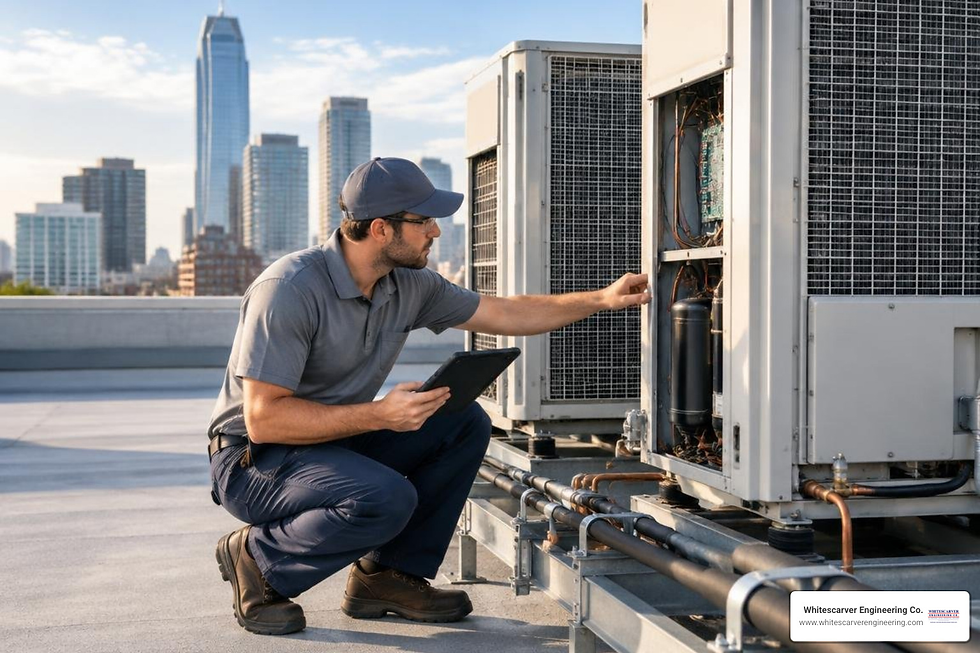
Commercial HVAC energy use climbs when equipment runs at full output for small loads, conditions empty rooms, or heats and cools separate areas without sharing energy. Variable refrigerant flow (VRF) HVAC in Roanoke, VA reduces this waste by matching heating and cooling output to each zone. Start with a load and zoning review, use heat recovery where areas need heating and cooling at the same time, and connect controls to your building automation system. Research modeling shows VRF can reduce HVAC site energy by about 15% to 42% compared with RTU-VAV systems, though results depend on the facility, schedules, ventilation needs, and system design.
VRF uses inverter-driven compressors and refrigerant piping to deliver only the capacity each area needs. This can reduce compressor cycling, fan energy, and duct losses. In heat-recovery designs, heat removed from one zone can help warm another.
Whitescarver Engineering Company has served commercial and industrial facilities from Roanoke since 1937, with large-scale HVAC, refrigeration, retrofit, and energy-conservation expertise across Roanoke, Salem, Vinton, and the Blacksburg/Christiansburg corridor. I'm Hugh Joyce, and contact Whitescarver Engineering Company to discuss a VRF energy review for your facility.

Understanding VRF Architecture and Key Components
Understanding the fundamental mechanical layout is essential when evaluating advanced equipment for commercial facilities. To grasp the core mechanics, it helps to understand what is a Variable Refrigerant Flow (VRF) System and How Does It Work at an architectural level. Rather than moving massive volumes of conditioned air through bulky sheet-metal duct networks or pumping high volumes of chilled water across extensive pipe runs, a VRF system circulates primary refrigerant directly between outdoor condensing units and multiple indoor terminal units.
For building executives navigating complex mechanical upgrades, consulting our comprehensive Commercial HVAC System Type Guide for Building Owners provides clear comparisons between traditional central equipment and modern multi-split options. The primary components powering this advanced thermal network include:
Outdoor Condenser Units: Housing high-efficiency inverter-driven scroll compressors and condenser coils designed for dynamic thermal management.
Electronic Expansion Valves (EEVs): Microprocessor-controlled throttling devices located at each indoor unit that regulate mass refrigerant flow with pinpoint accuracy.
Multi-Zone Indoor Units: Available in ceiling cassettes, concealed ducted units, or wall-mounted profiles, tailored to the specific spatial profile of each zone.
Branch Circuit (BC) Controllers / Selector Boxes: Intelligent manifolds that manage the phase and direction of refrigerant flow, routing hot gas or subcooled liquid to deliver simultaneous heating and cooling.

Inverter Compressor Modulation
Traditional commercial compressors function like basic binary switches—they run at 100% full capacity or shut off entirely. This constant cycling incurs massive starting currents, creates sharp electrical demand spikes, and produces large temperature swings.
In contrast, VRF outdoor units utilize variable-speed, inverter-driven compressors that adjust their operating frequency in real time. By continuously modulating motor rotational speed to match instantaneous building thermal loads, inverter technology eliminates cycling losses and optimizes part-load performance. Because commercial buildings operate under part-load conditions over 90% of the operating year, inverter modulation ensures the system uses only the exact kilowatt input required to maintain comfort setpoints.
Heat Recovery vs. Heat Pump Configurations
VRF technology is deployed in two primary configurations: heat pump systems and heat recovery systems.
Heat Pump VRF (Two-Pipe System): All connected indoor terminal zones operate in the same overall mode—either heating or cooling facility-wide. This configuration suits spaces with uniform thermal loads across the building shell.
Heat Recovery VRF (Three-Pipe or Two-Pipe with Phase Separation): Indoor zones can heat or cool independently and simultaneously. By integrating branch selector boxes, the system captures excess heat extracted from cooling-dominated areas (such as sun-exposed perimeter zones or interior data closets) and redirects that thermal energy to perimeter areas requiring heating.
How Variable Refrigerant Flow Technology Reduces Commercial Energy Consumption
Commercial and institutional facilities face high utility expenses driven primarily by baseline HVAC operation. Implementing smart mechanical design is essential when evaluating how to reduce HVAC energy costs in commercial buildings. VRF technology addresses these energy sinks through precision thermal management, variable-speed operation, and the direct elimination of distribution losses.
Determining what energy conservation measures have the biggest impact on commercial HVAC costs frequently leads engineering teams directly to VRF retrofits. In fact, research demonstrates that VRF systems can achieve 30% to 40% energy savings over traditional legacy HVAC configurations, delivering seasonal coefficients of performance (COP) exceeding 3.0 to 5.0 under typical operating conditions.
Core Engineering: How Variable Refrigerant Flow Technology Reduces Commercial Energy Consumption
The core engineering mechanism explaining how variable refrigerant flow technology reduces commercial energy consumption centers on the thermodynamic properties of refrigerant compared to air or water. Refrigerant carries significantly more heat per unit of mass than air. Traditional Variable Air Volume (VAV) systems rely on massive supply and return fans operating continuously against static duct pressure, consuming immense fan horsepower.
By delivering refrigerant directly to the thermal zone, VRF systems eliminate duct static losses and air leakage paths, which typically account for 10% to 20% of distribution losses in ducted setups. Furthermore, terminal unit fans operate at low speeds, leading to substantial fan energy savings of 26% to 50% compared to central VAV supply fans.
Simultaneous Thermal Management: How Variable Refrigerant Flow Technology Reduces Commercial Energy Consumption
Commercial buildings rarely have uniform heating or cooling requirements across their floorplates. Core zones with interior lighting, servers, and high occupant density demand cooling year-round, while north-facing perimeter zones require heating during transitional months.
Through heat recovery routing, VRF systems balance these divergent thermal loads effortlessly. Rather than rejecting heat to the outdoor atmosphere through cooling towers or condensers while simultaneously burning fossil fuels or energizing electric resistance elements for heating, VRF transfers waste heat internally. Exploring advanced energy conservation strategies for commercial buildings highlights that utilizing core-to-perimeter heat transfer dramatically lowers peak electrical demand and reduces total facility Energy Use Intensity (EUI).
Evaluating VRF Performance, Climate Adaptability, and Building Impact
Selecting the ideal mechanical infrastructure requires detailed engineering evaluations across competing system types. Building executives often evaluate VRF vs traditional HVAC system comparison metrics to understand the long-term operational impact of each system.
Performance Metric | Variable Refrigerant Flow (VRF) | Packaged Rooftop VAV (RTU-VAV) | Central Chilled Water / Boiler Plant |
Site Energy Efficiency | High (15%–42% total HVAC site energy savings) | Baseline standard; limited part-load modulation | Moderate to High; dependent on central plant optimization |
Part-Load COP | High (COP 3.5 – 5.2+) via inverter modulation | Low to Moderate (COP 2.8 – 3.4) | Moderate to High at peak chiller loading |
Zoning Granularity | Exceptional (individual zone control per indoor cassette) | Moderate (limited by VAV terminal box layout) | High (via individual fan coil units / air handlers) |
Simultaneous Heat/Cool | Yes (inherent with heat recovery configurations) | No (requires reheat coils, increasing energy use) | Yes (with simultaneous 4-pipe hydronic routing) |
Distribution Losses | Low (direct refrigerant piping, minimal duct losses) | High (duct friction, air leakage, fan static power) | Moderate (pumping power, piping thermal losses) |
Acoustic Profile | Whisper-quiet (indoor units 22–35 dB(A)) | Moderate to High (air velocity noise in ductwork) | Low to Moderate in conditioned spaces |
To determine whether packaged equipment remains viable versus decentralized units, see our breakdown on whether is VRF better than rooftop units for commercial spaces. For large-scale complexes weighing central configurations, refer to our analysis on chiller vs rooftop unit vs VRF: which is right for a large commercial facility in Virginia.
Cold-Climate Operation and Heating Performance
A historical concern with early-generation air-source heat pumps was capacity loss during low outdoor ambient conditions. Modern cold-climate VRF systems feature enhanced vapor-injection compressors and flash injection technology that sustain heating capacity down to -22°F.

In Virginia and throughout the mid-Atlantic region, where winter temperatures drop significantly, advanced VRF systems maintain high seasonal heating efficiencies exceeding 200% to 300%—making them three to four times more energy-efficient than natural gas heating or electric resistance furnaces. Intelligent defrost optimization algorithms also ensure rapid defrost cycles with minimal setpoint interruption.
Acoustic, Comfort, and Environmental Benefits
Beyond energy metrics, VRF architecture delivers superior non-energy benefits:
Whisper-Quiet Acoustics: Indoor fan cassettes operate between 22 and 35 dB(A), creating quiet indoor environments ideal for corporate boardrooms, classrooms, and patient care areas.
Tight Temperature Maintenance: By modulating refrigerant flow continuously, VRF systems maintain indoor temperatures within ±0.5°F of setpoints, eliminating hot-and-cold spots.
Decarbonization and Lower Carbon Footprint: VRF provides an all-electric heating and cooling pathway that eliminates onsite fossil-fuel combustion. As mechanical codes transition to low-GWP refrigerants (such as R-32 and R-454B), lifecycle greenhouse gas emissions decrease even further.
Best Practices for Implementing VRF Systems in Commercial Facilities
Achieving full energy savings requires precise engineering design, quality installation, and rigorous commissioning. Conducting an upfront audit is crucial, and discovering how an HVAC energy audit identifies savings opportunities in a Roanoke Valley business is the first step toward verifying thermal loads and establishing a dependable baseline.
System Sizing and Ventilation Integration
Proper engineering avoids the common pitfall of oversizing equipment. VRF design requires accounting for zone diversity factors—recognizing that not all zones experience peak solar, occupant, or equipment loads simultaneously.
Because VRF terminal units handle the space thermal conditioning directly, ventilation is managed separately using a Dedicated Outdoor Air System (DOAS) equipped with energy recovery ventilators (ERVs). Decoupling ventilation from space heating and cooling delivers the following benefits:
Precise fresh-air delivery according to ASHRAE 62.1 standards.
Pre-conditioning of outdoor air to reduce sensible and latent loads on indoor VRF cassettes.
Full compliance with ASHRAE Standard 15 and Standard 34 refrigerant safety rules by optimizing room volume-to-refrigerant charge calculations.
Smart Controls and Maintenance Protocols
Integrating VRF systems with centralized building controls unlocks their full efficiency potential. Understanding how building automation systems save energy allows facility directors to establish optimized setpoint boundaries, automated setbacks during unoccupied periods, and demand-limiting routines.

To protect commercial assets, facility directors should maintain custom preventative maintenance agreements. Regular inspections ensure electronic expansion valves operate accurately, filters remain clean, and automated refrigerant leak detection systems stay calibrated.
Frequently Asked Questions About VRF Energy Savings
How much energy can a commercial VRF system save compared to traditional HVAC?
Field research and whole-building energy simulations indicate that VRF systems save 15% to 42% in total HVAC site energy and up to 30% to 40% overall compared to older packaged rooftop VAV systems. Because VRF utilizes inverter modulation and eliminates duct losses, fan energy consumption drops by 26% to 50%, while heating energy efficiency improves significantly over fossil-fuel combustion baselines.
Can VRF systems handle winter heating demands in cold climates?
Yes. Contemporary cold-climate VRF equipment utilizing vapor-injection compressor technology delivers reliable heating capacity down to outdoor ambient temperatures of -22°F. With seasonal heating efficiencies exceeding 200% to 300%, these systems outperform conventional gas or resistance heating systems during freezing weather.
What types of commercial buildings benefit most from VRF technology?
VRF technology is ideal for facilities with multi-zone layouts and diverse thermal requirements, including:
Multi-tenant commercial office buildings
Hotels and hospitality lodging facilities
K-12 schools and university campus buildings
Medical clinics and healthcare centers
Historic buildings with limited ceiling space for bulky ductwork
Modernizing Commercial Facilities with Engineering Excellence
Transitioning to variable refrigerant flow technology provides commercial and industrial facilities with lower utility costs, quiet operation, and dependable multi-zone comfort. Achieving these results requires an engineering team with deep mechanical design and installation experience.
Whitescarver Engineering Company is a commercial and industrial HVAC and refrigeration service firm based in Roanoke, VA, operating since 1937. With over 75 years of experience and a BBB A+ accreditation since 1974, our team delivers high-performance mechanical solutions, custom industrial HVAC projects, preventative maintenance agreements, and responsive 24/7 service for commercial clients. We specialize in installing, maintaining, and retrofitting large-scale HVAC systems, industrial process systems, refrigeration engineering and design, and comprehensive energy-conservation solutions.
We proudly serve businesses throughout Roanoke, Salem, Vinton, and the Blacksburg/Christiansburg corridor. To evaluate whether your facility is ready for a high-efficiency mechanical upgrade, review our guide on what is a Variable Refrigerant Flow (VRF) System and How Does It Work, or reach out to our engineering team today to schedule an onsite commercial facility assessment.


Comments