
The Definitive Guide to HVAC Energy Audits for Roanoke Valley Businesses
How an HVAC Energy Audit Finds Energy Waste in Roanoke Valley Buildings

how an hvac energy audit identifies savings opportunities in a roanoke valley business begins by comparing how a building should operate with how its HVAC equipment actually performs. An audit reviews utility use, operating schedules, controls, airflow, ventilation, ductwork, and the building envelope. It can uncover equipment running when spaces are empty, outside-air dampers that do not respond correctly, leaking ducts, and heating or cooling systems working harder than needed during Roanoke's changing seasons. For offices, warehouses, retail spaces, and industrial facilities, this creates a clear, prioritized plan for reducing waste while protecting comfort, process conditions, and equipment reliability. Whitescarver Engineering Co. provides commercial and industrial HVAC energy-conservation support throughout Roanoke, Salem, Vinton, and the Blacksburg/Christiansburg corridor.
Learn more about what a commercial HVAC energy audit includes or explore energy-conservation solutions.
I am Hugh Joyce, and the next section explains the audit standards and building data that turn utility use into practical findings.
To move from suspected energy waste to a focused plan, contact Whitescarver Engineering Co. about energy conservation.

Understanding Commercial Audits and ASHRAE Standards
Buildings account for over 40% of all energy consumed across the United States. In commercial and industrial facilities throughout Southwest Virginia, heating, cooling, and ventilation typically make up the single largest share of electrical and fossil fuel expenditures. Establishing an energy baseline requires gathering at least 12 months of consecutive utility bill data. This allows us to track seasonal consumption spikes during humid mountain summers and sub-freezing winter weather.
By logging utility benchmarking metrics into tools like ENERGY STAR Portfolio Manager, facility leaders can evaluate energy utilization intensity (EUI) against national benchmarks and similar regional facilities.
How an HVAC Energy Audit Identifies Savings Opportunities in a Roanoke Valley Business vs Standard Maintenance
Facility managers often ask how a diagnostic audit differs from a standard preventive maintenance visit. Routine maintenance is designed to preserve mechanical reliability and prevent catastrophic equipment breakdown. During a standard maintenance call, technicians replace air filters, clean condenser coils, inspect belts, clear drain pans, check refrigerant charges, and lubricate bearings. While essential for preventing emergency service interruptions, regular tune-ups rarely question whether the system's operational logic makes sense for the building's current patterns.

In contrast, a commercial energy audit evaluates total system efficiency, load matching, and operating control strategies. Rather than checking whether a rooftop unit turns on, an audit asks:
Why is this 20-ton rooftop unit cooling an unoccupied conference room at 2:00 AM on a Sunday?
Are simultaneous heating and cooling conditions occurring across adjacent mechanical zones?
Is the fresh air intake damper frozen wide open, forcing mechanical cooling systems to condition humid outside air unnecessarily?
Understanding how an HVAC energy audit identifies savings opportunities in a Roanoke Valley business involves looking beyond basic mechanical integrity to analyze total energy usage patterns, control logic, and airflow design.
Comparing ASHRAE Audit Levels I, II, and III
The American Society of Heating, Refrigerating and Air-Conditioning Engineers (ASHRAE) defines three standardized levels of commercial building energy audits. Matching the right audit level to your capital planning objectives ensures you obtain actionable data without paying for unnecessary engineering overhead.
ASHRAE Audit Level | Primary Scope & Focus | Typical Data & Analysis | Best Suited For |
Level I: Walk-Through Analysis | Brief visual inspection, utility bill review, identifying low-cost and no-cost operational adjustments. | Basic energy usage intensity (EUI) calculation; qualitative operational suggestions. | Initial screening, small facilities, or establishing baseline efficiency opportunities. |
Level II: Energy Survey & Analysis | In-depth mechanical evaluation, diagnostic logging, energy balance calculations, and life-cycle costing. | Detailed breakdown of end-use energy; quantifiable payback calculations for capital upgrades. | Medium to large commercial facilities planning multi-year capital improvements and equipment retrofits. |
Level III: Investment-Grade Audit | Dynamic computer simulation, dynamic building energy modeling, and rigorous engineering risk analysis. | Comprehensive engineering data models suitable for major capital financing and performance contracting. | Large industrial plants, complex central chiller/boiler plants, and multi-building commercial campuses. |
For most commercial enterprises operating across the Roanoke Valley, an ASHRAE Level II energy survey provides the ideal balance between diagnostic depth and practical cost justification. Level II evaluations deliver defensible calculations that executive leadership and accounting teams require to approve capital projects. Read our breakdown on ASHRAE 90.1 energy efficiency standards explained for details on commercial compliance.
How an HVAC Energy Audit Identifies Savings Opportunities in a Roanoke Valley Business
The climate across the Roanoke Valley presents distinct operational challenges for commercial building operators. Summers bring high humidity and heat indexes, while winters produce freezing temperatures punctuated by rapid weather swings. Commercial HVAC systems that are not carefully tuned waste significant power trying to maintain precise indoor setpoints.
When our engineering specialists conduct a commercial facility evaluation, we examine structural load requirements, peak electrical demand charges, and commercial refrigeration integration. Peak demand charges—the fees utility companies assess based on your facility's highest power draw during short window intervals—frequently account for 30% to 50% of a commercial electric bill. Audits pinpoint opportunities to stagger high-horsepower fan start times, load-shift industrial cooling, and reset chilled water temperatures to avoid expensive peak demand penalties.
Discover proven strategies in our guide on how to reduce HVAC energy costs in commercial buildings.
How an HVAC Energy Audit Identifies Savings Opportunities in a Roanoke Valley Business via Building Diagnostics
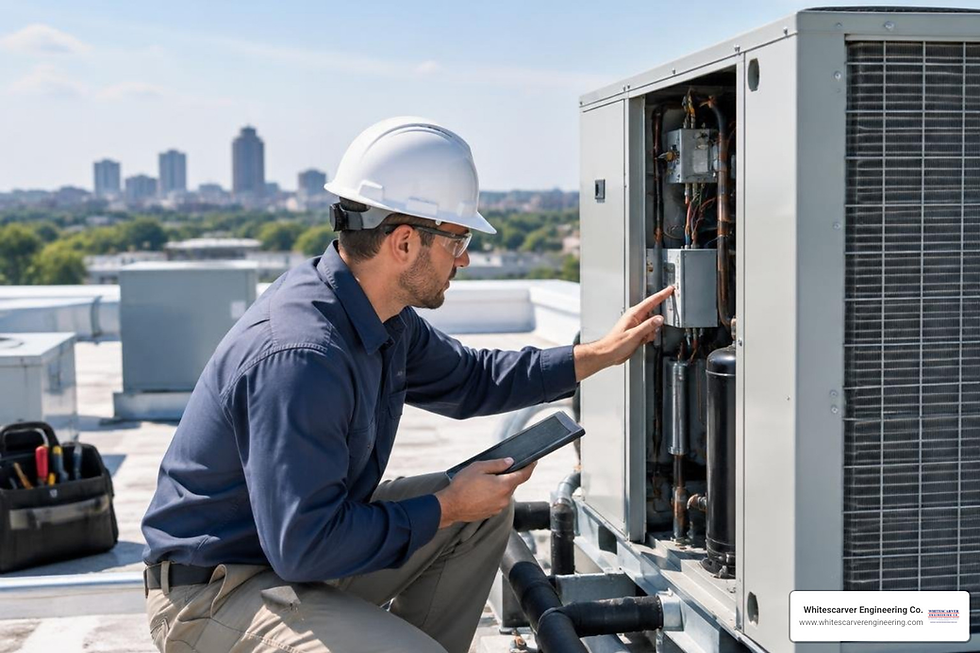
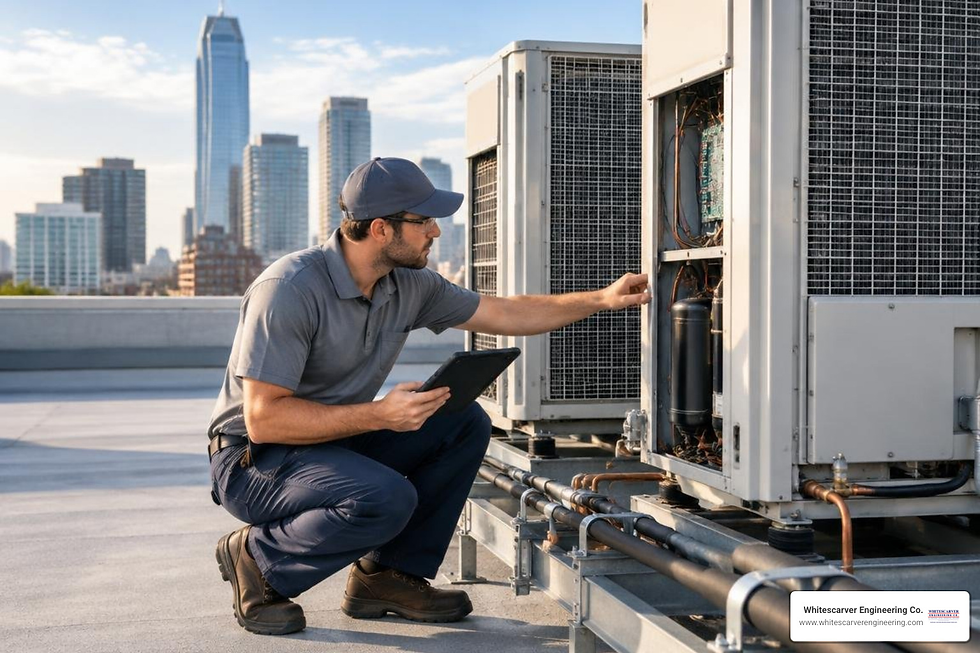
Understanding how an hvac energy audit identifies savings opportunities in a roanoke valley business requires looking at advanced diagnostic tools. Visual inspections alone cannot detect invisible energy losses. Engineers use precision field instruments to measure structural leakage, duct losses, and dynamic airflow performance:
Infrared Thermography: Thermal imaging cameras expose severe envelope thermal bridging, missing structural insulation, and cold air infiltration around loading docks, utility penetrations, and commercial roof assemblies.
Duct Air Leakage Testing: Unretrofitted commercial buildings can lose 30% to 50% of their conditioned air through disconnected duct seams, deteriorated flexible connections, and failed plenum seals. Air sealing commercial envelope and duct leaks can yield 20% to 30% savings on HVAC operating costs alone.
Airflow and Static Pressure Measurement: Flow hoods and pitot tube arrays test actual cubic-feet-per-minute (CFM) output against original mechanical balance reports. Excessive static pressure forces supply fans to draw surplus wattage while starving remote zones of conditioned air.
Economizer & Damper Testing: Commercial rooftop units (RTUs) use economizers to draw in free outside air for cooling when outdoor ambient conditions permit. However, industry statistics indicate over 60% of commercial economizer dampers are stuck open, seized shut, or miscalibrated, forcing compressors to run continuously.
Learn detailed strategies in our commercial HVAC optimization guide for Roanoke VA.
Key Findings: Controls, Duct Leakage, and Airflow Optimization
A comprehensive audit consistently uncovers quick wins that deliver immediate operational savings:
Variable Frequency Drives (VFDs): Installing VFDs on supply fans, return air systems, and chilled water pumps allows motor speeds to modulate based on actual building load rather than running continuously at 100% capacity. According to ASHRAE study data, implementing VFDs on pumps and fans reduces motor energy usage by 20% to 50%.
Schedule and Setpoint Drift: Over time, override switches, manual thermostat interventions, and facility maintenance updates create unintended schedules where heating and cooling systems run at full capacity overnight or on weekends.
Demand-Controlled Ventilation (DCV): By installing carbon dioxide ($CO_2$) sensors in high-occupancy spaces like conference centers, auditoriums, and cafeterias, fresh air intake dampers adjust automatically based on real-time occupant counts rather than supplying maximum outdoor air continuously.
Building Automation Systems (BAS): Modernizing legacy pneumatic or standalone controls into an integrated central BAS allows facility managers to implement night setbacks, supply air temperature resets, and optimum start/stop algorithms automatically.
Explore how modern controls lower operating expenses with our guide on how building automation systems save energy.
Maximizing ROI with Utility Rebates and Tax Incentives
Executing Energy Conservation Measures (ECMs) identified during an audit does not require bearing full capital expenses out-of-pocket. Regional electric utilities in Virginia offer generous incentive structures to help commercial enterprises offset initial equipment retrofits and system recommissioning.

See how nearby facilities optimize performance in our resource on professional HVAC system optimization in Salem VA.
Navigating Appalachian Power and Dominion Energy Programs
Depending on your facility's physical location within Southwest Virginia, your electrical account falls under Appalachian Power (APCo) or Dominion Energy Virginia. Both entities maintain dedicated commercial energy efficiency portfolios:
Appalachian Power Business Energy Solutions: APCo offers a Small Business Direct Install (SBDI) program for commercial customers with peak monthly electrical demand of 200 kW or less. Qualifying facilities receive no-cost energy assessments alongside direct rebates for heat pump upgrades, smart thermostats, variable speed drives, and duct testing. Custom incentives are also available for larger commercial facilities installing high-efficiency chillers or advanced process cooling.
Dominion Energy Non-Residential Programs: Dominion offers rebate bundles tailored for office buildings, healthcare facilities, commercial lodging, and data servers. Programs cover prescriptive incentives for HVAC tune-ups, chiller condenser resets, variable frequency drive retrofits, and building automation system recommissioning.
Our team coordinates directly with utility account managers to verify measure eligibility, calculate projected savings, submit pre-approval applications, and ensure your business claims every available rebate dollar.
ROI Benchmarks, Section 179D, and Long-Term Payback
A common barrier for facility managers is uncertainty regarding project payback timelines. A 2025 BOMA survey revealed that 62% of facility managers were unaware of the specific return on investment (ROI) an energy audit delivers, leaving potential building energy reductions of 20% to 30% untapped.
Real-world financial data confirms the value of comprehensive audits:
Department of Energy (DOE) Benchmarks: A comprehensive DOE study analyzing over 1,000 audited commercial facilities showed median energy savings of 22% resulting directly from implementing audit-recommended conservation measures.
Typical Payback Timelines: Low-cost operational adjustments (such as setpoint resets, schedule corrections, and economizer calibrations) typically achieve full payback within 3 to 12 months. Capital-intensive retrofits (such as VFD retrofits, advanced BAS controls, and air sealing) generally show complete financial payback within 1.5 to 4 years.
Section 179D Commercial Building Energy Efficiency Deduction: Under Federal tax guidelines, commercial property owners who execute energy-efficient retrofits that cut building envelope, lighting, or HVAC power consumption can qualify for substantial tax deductions per square foot.
Review tax qualification requirements in our article on the Section 179D commercial building energy deduction.
Frequently Asked Questions
What is the main difference between an HVAC tune-up and an energy audit?
An HVAC tune-up is a preventive maintenance service focused on restoring individual mechanical components to sound working order—such as cleaning coils, replacing belts, checking electrical connections, and topping off refrigerant.
An HVAC energy audit is a comprehensive diagnostic engineering evaluation of how your heating, cooling, and ventilation systems interact with building controls, air distribution, facility occupancy schedules, and structural envelope conditions. The goal of an audit is identifying overall system waste, operational misconfigurations, and high-ROI efficiency retrofits.
Which ASHRAE audit level is right for a typical Roanoke business?
For most small to mid-sized commercial facilities in the Roanoke Valley—such as corporate offices, light industrial sites, warehouses, and retail spaces—an ASHRAE Level II audit provides the best practical value. Level II surveys deliver detailed mechanical measurements, actual energy usage breakdowns, and precise payback calculations needed to justify capital budgets without incurring the high computer-modeling expenses associated with Level III investment-grade audits.
When should a business hire a certified auditor versus performing a DIY walk-through?
An internal facility maintenance team can easily conduct an initial DIY walk-through to address obvious issues, such as setting back manual thermostats, replacing dirty filters, or sealing visible gaps around exterior entrance doors.
However, a certified professional energy auditor should be hired when evaluating complex commercial systems, multi-zone rooftop units, central chiller plants, building automation networks, or duct static pressure balances. Certified professionals utilize advanced diagnostic equipment (such as thermal cameras and pitot tube flow arrays) to deliver defensible engineering calculations required for utility rebates and federal tax deductions. Learn what to expect during a site visit in our overview of commercial HVAC energy audit expectations.
Modernizing Facility Efficiency with Whitescarver Engineering Co.
A commercial HVAC energy audit turns unpredictable utility expenses into a clear, prioritized capital plan. Rather than guessing which mechanical systems waste electricity and fuel, building managers obtain exact data showing where operational dollars go and how to reclaim them. From eliminating control conflict and sealing leaking ductwork to installing variable speed drives and securing utility rebates, systematic energy audits consistently deliver median energy savings of 22% across commercial building portfolios.
Whitescarver Engineering Co. has delivered high-performance commercial and industrial HVAC and refrigeration solutions across Southwest Virginia since 1937. As a local Roanoke firm with over 75 years of continuous engineering experience and an A+ BBB accreditation, we specialize in large-scale mechanical design, custom industrial HVAC retrofits, process cooling, refrigeration engineering, and comprehensive energy-conservation solutions. We serve commercial facilities, industrial plants, institutional buildings, and warehouse operations across Roanoke, Salem, Vinton, and the Blacksburg/Christiansburg corridor with 24/7 emergency service and customized preventive maintenance agreements.
To turn energy audit insights into long-term utility savings and reliable operational performance, explore our detailed strategies on energy conservation strategies for commercial buildings or reach out to our engineering team today to schedule an energy conservation evaluation.

Comments