
The Essential Guide to Understanding Commercial HVAC Energy Audits
What Is a Commercial HVAC Energy Audit — and Why It Matters for Your Facility

What is a commercial HVAC energy audit is one of the most practical questions a facility manager or building owner can ask. In short, it is a systematic, engineering-driven evaluation of your HVAC system's energy consumption, component health, and operational efficiency — designed to identify exactly where energy is being wasted and what can be done about it.
Here is a quick summary before we go deeper:
A commercial HVAC energy audit at a glance:
What it is: A structured assessment of your heating, ventilation, and air conditioning systems to measure energy use, inspect components, and uncover inefficiencies
What it covers: Air handling units, ductwork, boilers, chillers, controls, thermostats, and building envelope interactions
What it produces: A prioritized report of findings with actionable recommendations and ROI estimates
Who it's for: Facility managers, building owners, and industrial operators responsible for large-scale mechanical systems
How often: Most facilities benefit from an audit every 3 to 5 years, or after significant operational changes
For commercial and industrial facilities in Virginia, this matters more than most owners realize. HVAC systems typically account for 40 to 50 percent of total energy consumption in commercial buildings. Duct leakage alone can be responsible for 20 to 30 percent of heating and cooling energy loss. When those inefficiencies go undetected, they quietly erode your net operating income every single month.
An energy audit turns scattered utility data into a clear, actionable roadmap — moving your maintenance strategy from reactive to proactive, and giving you the data you need to make smart capital decisions.

What is a Commercial HVAC Energy Audit?
At its core, a commercial HVAC energy audit is a deep dive into the "energy story" of your building. It goes beyond a simple maintenance check to examine how energy flows through your mechanical systems and where that flow is interrupted by mechanical failure, poor design, or outdated technology.
An audit provides an objective look at equipment age, condition, and performance metrics. It answers critical questions: How much energy is the system consuming? Where is the heaviest load occurring? Are there health risks or air quality issues tied to system performance? By answering these, we can provide a roadmap for Energy Conservation that aligns with your specific business goals.
To standardize these evaluations, the industry typically looks to ASHRAE (American Society of Heating, Refrigerating and Air-Conditioning Engineers) levels.
Audit Level | Description | Typical Outcome |
Level 1: Walk-Through Assessment | A high-level screening of utility bills and a brief site visit. | Identifies low-cost/no-cost "quick wins." |
Level 2: Energy Survey & Analysis | Detailed equipment inventory, site measurements, and energy breakdown. | Provides clear ROI for equipment upgrades and retrofits. |
Level 3: Investment-Grade Audit | Intensive data logging and computer modeling of system interactions. | Used for large-scale capital projects and financing packages. |
Defining the Scope of a Commercial HVAC Energy Audit
The scope of an audit is defined by the depth of data required. We begin by establishing a baseline of performance, which involves gathering 12 to 24 months of utility data to identify seasonal spikes and baseline "leakage."
We then move into a physical inventory of every mechanical asset. This includes checking nameplate BTU ratings, motor efficiencies, and operational hours. By comparing these against the ASHRAE 90.1 Energy Efficiency Standard Explained, we can determine if your current configuration meets modern benchmarks or if it is a legacy system that is simply too expensive to keep running.
Why Energy Audits are Critical for Virginia Industrial Facilities
In the Roanoke and Salem areas, industrial facilities face unique challenges. From high-humidity summers to freezing mountain winters, HVAC systems are under constant strain. For a manufacturing plant or a large-scale warehouse, energy waste isn't just a line item — it’s a drain on net operating income (NOI).
Conducting an audit allows businesses to extend the lifespan of expensive equipment. When a system is struggling due to poor calibration or a failing component, it works 27% harder, leading to premature failure. By identifying these issues early, you avoid the "budget-destroying surprise" of an emergency replacement. Furthermore, many organizations now have strict sustainability or ESG (Environmental, Social, and Governance) goals. An audit provides the hard data needed to prove carbon reduction and energy savings to stakeholders.
If you are noticing High Energy Bills, an audit is the first step in diagnosing whether the problem lies in the equipment itself or in how the building is being managed. Implementing Energy Conservation Strategies for Commercial Buildings starts with knowing your numbers.
Identifying Inefficiencies in Roanoke and Salem Operations
In our region, we often see inefficiencies tied to occupancy patterns and seasonal transitions. For example, cooling an empty conference room in a Blacksburg office over a weekend or heating a Roanoke warehouse bay that has a poorly sealed loading dock.
A thorough Commercial Energy Conservation Roanoke VA Guide highlights that utility bill analysis can reveal "phantom loads"—energy being consumed when the building should be in sleep mode. These insights allow us to suggest scheduling tweaks that cost nothing but save thousands annually.
Key Components Inspected During an HVAC Energy Audit
When we perform an audit, we look at the system as a whole, but we focus on several high-impact components:
Chillers and Boilers: We check for scale buildup, flue gas efficiency, and proper refrigerant levels.
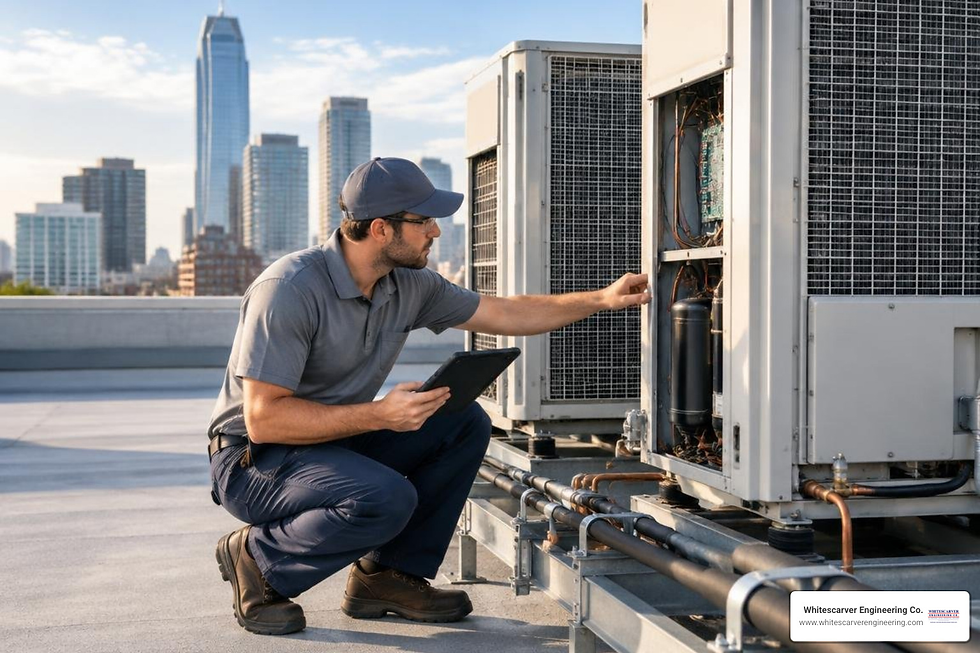
Air Handling Units (AHUs): We inspect fans, belts, and motors. A frayed belt or a struggling motor can drag down the efficiency of the entire floor.
Ductwork: This is a major culprit. We look for gaps, cracks, and disconnected sections that allow conditioned air to escape into unconditioned plenums or crawlspaces.
Variable Frequency Drives (VFDs): We verify if motors are running at 100% capacity when they only need to be at 60%, which is a common source of waste.
Building Envelope: We use infrared cameras to find missing insulation or "thermal bridging" where heat is escaping through the walls or roof.
Understanding How to Reduce HVAC Energy Costs in Commercial Buildings often comes down to these component-level fixes.
Evaluating Controls and Building Automation Systems
Even the most efficient chiller is useless if the controls are fighting each other. We frequently find "simultaneous heating and cooling," where one zone is trying to cool down while an adjacent zone’s heater is running.
We inspect thermostat calibration and sensor accuracy. If a sensor is off by just two degrees, it can trigger a massive increase in energy use. Optimizing your Building Automation System (BAS) ensures that the system responds accurately to the actual needs of the occupants. For more detail, see our Commercial HVAC Optimization Guide Roanoke VA.
The Step-by-Step Process of a Commercial HVAC Energy Audit
The audit process is methodical. It begins with Data Gathering, where we collect utility bills and original design documents. This allows us to compare "theoretical" performance (what the system was designed to do) with "actual" performance (what it is doing today).
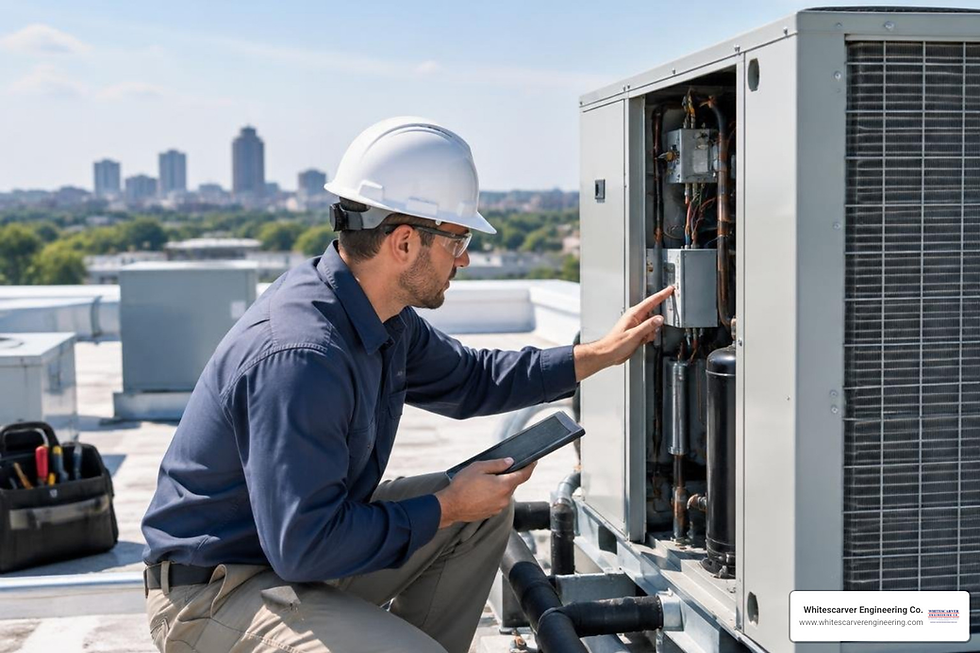
Next is the Site Walkthrough. This isn't just a casual stroll; it’s a technical inspection of every mechanical room, rooftop unit, and terminal box. We interview facility staff to understand daily operations and any comfort complaints from occupants. We then perform Consumption Disaggregation, which is a fancy way of saying we figure out exactly how much of your bill goes to cooling, how much to heating, and how much to ventilation. This is a core part of our Energy Conservation Solutions Complete Guide.
Executing the Physical Phase of a Commercial HVAC Energy Audit
During the physical phase, we use specialized tools to get "under the hood" of your system:
Airflow Measurements: Using flow hoods to ensure that the right amount of air is reaching each zone.
Flue Gas Analysis: For boilers and furnaces, we measure combustion efficiency and ensure safety by checking carbon monoxide levels.
Duct Integrity Testing: Identifying leaks that account for up to 30% of energy loss.
Thermal Imaging: Finding hidden heat loss in the building envelope and identifying electrical "hot spots" in control panels before they cause a failure.
These physical diagnostics are essential for any true Energy Conservation effort.
Leveraging Audit Data for Long-Term Sustainability and Compliance
Once the audit is complete, you receive a report that serves as a strategic roadmap. This report prioritizes recommendations based on ROI—starting with low-cost adjustments (like sensor calibration) and moving toward long-term capital investments (like chiller retrofits).
For businesses in the Blacksburg corridor and Roanoke, this data is vital for compliance with local ordinances and for achieving LEED or ENERGY STAR certifications. It also de-risks your facility for future underwriting or real estate transactions. A building with a documented history of energy efficiency is inherently more valuable.
Post-audit action items typically include:
Implementing a proactive maintenance schedule based on actual equipment health.
Retrofitting high-use motors with VFDs.
Sealing ductwork to prevent conditioned air loss.
Updating BAS schedules to match actual occupancy.
Continuous Monitoring and Performance Benchmarking
An audit shouldn't be a one-time event. By installing IoT (Internet of Things) sensors, we can provide real-time tracking of your Energy Use Intensity (EUI). This allows us to detect anomalies—like a sudden spike in energy use—immediately, rather than waiting for a high utility bill at the end of the month. Regular follow-up cycles every 3 to 5 years ensure that your system doesn't drift back into inefficiency.
Frequently Asked Questions about Commercial HVAC Audits
How often should my facility in the Blacksburg corridor conduct an audit?
For most commercial buildings, an audit every 3 to 5 years is the industry standard. However, high-demand environments like restaurants, healthcare facilities, or industrial plants with process cooling should consider more frequent checks—perhaps every 2 years—due to the heavy load and critical nature of their operations.
What tools are used to detect hidden energy loss in industrial systems?
We utilize a variety of advanced tools, including infrared thermography to see heat loss, ultrasonic leak detectors for compressed air or refrigerant leaks, data loggers to track motor runtimes over several weeks, and flue gas analyzers to measure the efficiency of large-scale boilers.
How does an HVAC audit contribute to LEED or Energy Star certification?
An audit provides the baseline data required for these certifications. It quantifies your current EUI and identifies the specific Energy Conservation Measures (ECMs) needed to meet the required thresholds. Without an audit, you are essentially guessing at your building's performance.
Conclusion
At Whitescarver Engineering Co., we bring over 75 years of Roanoke heritage and technical expertise to every project. We understand that for our B2B and industrial clients, an HVAC system is a critical asset that must perform reliably and efficiently. From complex industrial refrigeration design to comprehensive energy audits, we provide the second-to-none technical solutions that keep Virginia businesses moving.
If you are ready to turn your energy waste into operational savings, our team is here to help you develop a custom roadmap for your facility. Explore our Energy Conservation Solutions today and take the first step toward a more efficient, sustainable future.

Comments