
How Often Should a Commercial Rooftop Unit Be Serviced in Virginia? A Survival Guide
Recommended RTU Maintenance Frequency in Virginia

Managing commercial rooftop units (RTUs) across Virginia requires a proactive service strategy designed for a volatile climate. Between the humid summers in the Roanoke Valley and freezing winter conditions along the mountain corridors, rooftop equipment operates under continuous outdoor strain. Establishing an explicit maintenance cadence ensures that minor mechanical wear is addressed long before it escalates into system instability or tenant disruption.
To keep equipment running at peak performance, a comprehensive maintenance calendar blends routine internal tasks with professional technical inspections. Following our detailed HVAC Maintenance Frequency Guide 2026 allows building operations to balance workload distribution while maintaining strict operational compliance.
Monthly Tasks: How Often Should a Commercial Rooftop Unit Be Serviced in Virginia for Basic Maintenance?
When evaluating how often should a commercial rooftop unit be serviced in virginia for foundational upkeep, monthly checks are the first line of defense. Because RTUs pull massive volumes of outside air directly into building ventilation streams, basic filtration and cabinet hygiene require frequent monitoring.
Monthly tasks focus heavily on air filter inspections and airflow verification. In dirty or high-traffic commercial zones, air filters accumulate dust, debris, and pollen quickly. A clogged filter restricts system airflow, increasing air pressure drops across filter racks. According to industry data from ASHRAE, dirty filters alone can increase HVAC energy consumption by 5% to 15%. Facility personnel should check differential pressure gauges across filter banks, clear tree litter or windblown trash from around exterior cabinet intake hoods, and conduct visual coil checks to ensure surface debris is not restricting fresh air intake.
Quarterly Inspections: How Often Should a Commercial Rooftop Unit Be Serviced in Virginia for Refrigerant and Coils?
While monthly care covers basic hygiene, quarterly inspections dive into mechanical performance and thermodynamic efficiency. Every three months, RTU systems require baseline performance logging to identify component degradation early.
Quarterly servicing performed by qualified specialists includes:
Refrigerant Pressure Logging: Measuring suction and discharge pressures to verify operating charge.
Thermodynamic Diagnostics: Calculating superheat and subcooling parameters to evaluate thermal expansion valve (TXV) metering.
Belt and Drive Servicing: Checking blower belt tension, alignment, and wear, adjusting sheaves to maintain target airflow.
Electrical Connection Verification: Inspecting contactors, checking for terminal discoloration, and verifying tight electrical connections.
Tracking operational trends every quarter allows technicians to spot subtle pressure drops or electrical changes before complete component failure occurs.
How Virginia's Seasonal Weather Dictates RTU Servicing
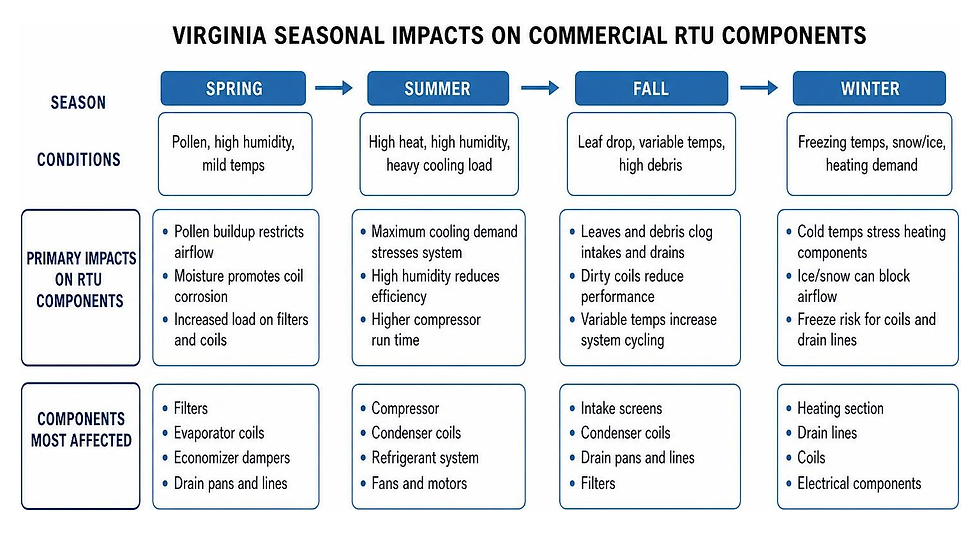
Virginia’s mid-Atlantic climate presents distinct operational challenges throughout the calendar year. High summer relative humidity demands maximum moisture removal capacity, while winter sub-freezing snaps require instant, reliable heating output. Transitional seasons introduce rapid pollen buildup in spring and leaf collection in autumn, making fixed bi-annual seasonal tune-ups essential for continuous comfort.
Spring Pre-Cooling Tune-Up Requirements
Spring service prepares cooling circuits for the severe heat and humidity typical of Virginia summers. Scheduling this work during early spring ensures equipment is fully capable before outdoor wet-bulb temperatures spike.
A standard spring pre-cooling service focuses on thorough physical cleaning and cooling system setup. Technicians execute deep condenser coil cleaning using specialized solutions to remove trapped pollen, mud, and scale. Fouled coils force compressors to operate at higher head pressures, raising compressor energy draw by 10% to 30%. In addition, technicians perform functional tests on economizer dampers to confirm proper outdoor air intake and verify system refrigerant charges. For complete step-by-step guidance, explore our guide on Spring Maintenance for Commercial Rooftop Units.
Fall Pre-Heating Tune-Up Requirements
As temperatures drop across the Blacksburg/Christiansburg corridor, the operational focus shifts from cooling circuits to heating infrastructure. Fall tune-ups ensure gas-fired burners, electric elements, or heat pump reversing valves operate safely and efficiently.
Fall maintenance prioritizes building safety and combustion accuracy. Technicians carefully inspect heat exchangers for microscopic stress fractures or corrosion that could allow combustion gases into supply airstreams. Service checks include calibrating gas manifold pressure, cleaning burner orifices, verifying proper flame ignition sequencing, and testing carbon monoxide levels within exhaust flues. For heat pump RTUs, defrost controls and outdoor coil sensors are tested to guarantee reliable winter heating without auxiliary heat overload.
Essential Monthly, Quarterly, and Annual RTU Maintenance Checklist
Maintaining operational continuity across complex commercial properties requires structured task delegation. Documenting maintenance tasks ensures that every safety system, electrical circuit, and mechanical component undergoes regular inspection. Building owners can reference our comprehensive Commercial HVAC Maintenance Checklist for Facility Managers to streamline operational records.
Professional Technician vs In-House Maintenance Duties
A successful maintenance program clearly separates tasks suitable for onsite facility personnel from specialized procedures requiring licensed, expert technicians. In-house staff handle routine visual tasks, basic filter changes, and clearing surface debris surrounding equipment curbs.
Conversely, technical diagnostics—such as refrigerant handling, high-voltage electrical testing, combustion analysis, and microprocessor control setup—require fully licensed commercial technicians. Attempting complex mechanical or electrical adjustments without specialized training creates serious safety risks and can lead to major equipment damage.
Annual Overhaul and Compliance Checks
Once per year, commercial RTUs require an extensive mechanical overhaul. This annual deep dive addresses long-term structural, electrical, and regulatory compliance requirements.
During the annual overhaul, technicians verify electrical connection torque values to manufacturer specifications, test run capacitors for microfarad (µF) drift, and lubricate fan motor and blower bearings. Capacitors drifting more than 10% below rated capacity are replaced to protect drive motors. Annual checks also cover Environmental Protection Agency (EPA) Section 608 compliance, tracking system refrigerant loss rates to fulfill environmental mandates.
Service Cadence | Task Description | Performed By |
Monthly | Inspect air filters; clear intake hood debris; inspect drain pans | Onsite Facility Staff |
Quarterly | Log refrigerant pressure, superheat & subcooling; adjust drive belts | Licensed HVAC Technician |
Bi-Annually (Spring/Fall) | Deep coil cleaning; economizer calibration; heat exchanger safety audit | Licensed HVAC Technician |
Annually | Electrical torque check; capacitor µF testing; EPA Section 608 audit | Licensed HVAC Technician |
Common RTU Failure Modes and Efficiency Impacts
Rooftop units are completely exposed to outdoor elements, leaving them vulnerable to distinct mechanical failure patterns when routine service is neglected. Understanding these failure modes highlights the operational rationale for preventive care over reactive fixes.
Common commercial RTU failure modes include:
Compressor Burnout: Driven by dirty coils, low airflow, or incorrect refrigerant charge. An RTU running just 10% low on refrigerant charge loses roughly 20% of its cooling performance and strains internal compressor windings.
Coil Fouling: Dust, pollen, and airborne organic matter form an insulating layer over evaporator and condenser fins, disrupting heat transfer and increasing energy consumption.
Economizer Damper Failure: Seized linkages or failed actuator motors leave economizers stuck open or closed. A stuck-closed economizer on a 20-ton unit can result in significant energy waste through unnecessary mechanical cooling.
Refrigerant Circuit Leaks: Vibration and thermal expansion create micro-cracks in copper joints, leading to gradual capacity loss and environmental compliance issues.
For a deeper look into factors that shorten commercial system lifespans, review our detailed guide on What Shortens Commercial HVAC System Lifespan.
Preventive Maintenance vs Emergency Repair Risks
Relying on a run-to-failure strategy introduces substantial operational and reliability risks for commercial enterprises. Unplanned equipment breakdowns frequently strike during peak summer heat waves or severe winter cold snaps—precisely when facility operations cannot afford cooling or heating losses.
Preventive agreements replace unpredictable emergency disruptions with scheduled maintenance visits. Scheduled service eliminates emergency overtime work, protects sensitive industrial processes, and keeps building tenants comfortable. Explore the operational benefits in our article on Preventive Maintenance vs Reactive Repairs Commercial HVAC.
Energy Savings and Lifespan Extension
Systematic preventive maintenance delivers measurable returns by optimizing utility usage and maximizing capital investments. Facilities maintaining strict preventive maintenance schedules typically reduce energy consumption by 15% to 20% and cut overall maintenance needs by nearly 50% compared to reactive repair methods.
Regular maintenance significantly extends physical equipment longevity. Well-maintained commercial RTUs consistently deliver 15 to 20 years of operational service. In contrast, neglected systems frequently suffer major mechanical failure within 10 to 12 years. Learn more about extending capital equipment life in our resource on How Long Does a Commercial HVAC System Last.
How Often Should a Commercial Rooftop Unit Be Serviced in Virginia?
To ensure total operational reliability across Virginia commercial properties, facility leaders should implement a multi-tiered maintenance structure:
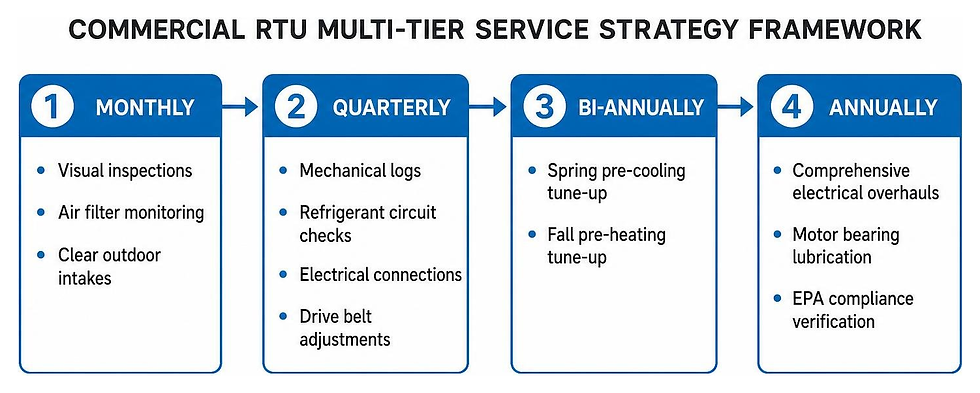
Monthly: Visual inspections, air filter monitoring, clear outdoor intakes.
Quarterly: Mechanical logs, refrigerant circuit checks, electrical connections, drive belt adjustments.
Bi-Annually: Targeted seasonal spring pre-cooling and fall pre-heating tune-ups.
Annually: Comprehensive electrical overhauls, motor bearing lubrication, and EPA compliance verification.
Adopting this structured, proactive approach keeps equipment performing efficiently while protecting building assets year-round. Discover localized servicing strategies in our Commercial HVAC Maintenance Guide Roanoke VA.
Frequently Asked Questions
What happens if you skip RTU maintenance during humid Virginia summers?
Skipping maintenance prior to Virginia's summer heat causes severe operational performance issues. Elevated indoor humidity levels impair indoor air quality, while dirty evaporator coils restrict airflow, causing system temperatures to drop and freezing the coil solid. Frozen coils block air passage completely, running the compressor continuously under extreme thermal stress, accelerating internal wear, and driving up energy costs.
How does EPA Section 608 affect commercial RTU servicing in Virginia?
EPA Section 608 under the Clean Air Act tightly regulates commercial air conditioning systems containing ozone-depleting and substitute refrigerants. Systems holding 50 or more pounds of refrigerant are subject to mandatory leak-rate thresholds. If an RTU exceeds allowable annual leak rates, facility managers must have leaks repaired within 30 days by certified technicians and retain detailed service records. Failure to maintain compliant records or intentional venting carries severe federal administrative penalties reaching up to $37,500 per day per violation.
When is the best time to schedule spring and fall RTU tune-ups in Virginia?
Spring tune-ups should occur between late March and mid-April before sustained cooling loads emerge across the region. Fall pre-heating tune-ups are best scheduled between late September and mid-October, well ahead of the season's first hard freeze. Booking seasonal maintenance early ensures system readiness and prevents peak-season service delays.
Conclusion
Determining how often should a commercial rooftop unit be serviced in virginia comes down to balancing monthly basic upkeep with professional seasonal tune-ups and quarterly performance tracking. Whitescarver Engineering Company is a commercial and industrial HVAC and refrigeration service firm based in Roanoke, VA, operating since 1937. Whitescarver Engineering Company brings over 75 years of technical expertise to commercial and industrial facilities throughout Roanoke, Salem, Vinton, and the Blacksburg/Christiansburg corridor. Whitescarver Engineering Company specializes in installing, maintaining, and retrofitting large-scale HVAC systems, industrial process systems, refrigeration engineering and design, and energy-conservation solutions. Our team provides tailored maintenance agreements backed by 24/7 commercial emergency support.
Protect your facilities against seasonal downtime and unnecessary energy waste. Schedule commercial RTU maintenance in Virginia with our experienced team today.


Comments