
Detailed Guide to Year-End Commercial HVAC Capital Planning
Why Year-End Commercial HVAC Capital Planning Matters

Year-end commercial HVAC capital planning gives facility managers a practical way to protect next year's budget. Start by reviewing every asset, ranking failure and operational risk, reserving funds for the highest-priority work, and scheduling eligible projects before year-end deadlines. For commercial HVAC systems in Roanoke, VA, this matters because a failed rooftop unit, chiller, or process-cooling component can disrupt occupants, production, and critical environments. Build decisions around asset age, repair history, condition scores, energy performance, and equipment lead times instead of waiting for a breakdown.
A strong plan also creates time to review utility incentives, confirm whether equipment must be placed in service before December 31 for potential tax treatment, and phase major upgrades across several budget years. Whitescarver Engineering Co. helps businesses throughout Roanoke, Salem, Vinton, and the Blacksburg/Christiansburg corridor align large-scale HVAC, refrigeration, and energy projects with long-term operational needs.
I am Hugh Joyce, and the next steps will show you how to turn HVAC asset data into a clear, defensible year-end capital plan.

Strategic Framework for Year End Commercial HVAC Capital Planning
Operating commercial mechanical equipment without an overarching strategy is like driving down Interstate 81 with your check-engine light on—you might make it a few miles, but the breakdown will happen at the worst possible time. Capital forecasting bridges the gap between daily operations and financial decision-making.
When evaluating mechanical assets, facilities face two distinct management paths: structured capital renewal or reactionary spending. Understanding the financial differences between preventive maintenance vs reactive repairs commercial hvac clarifies why planned replacements protect balance sheets. Research indicates that planned, forecast-driven replacements cost 40% to 60% less than emergency changeouts. When a rooftop unit (RTU) or boiler fails unexpectedly during peak temperature swings, organizations face premium shipping costs, accelerated contractor overtime, temporary equipment rentals, and severe operational interruptions. Reactive replacements typically cost 2 to 3 times more than planned projects.

By benchmarking equipment against standard ASHRAE design-life estimates and implementing risk scoring, facility directors identify mechanical vulnerabilities early, preventing catastrophic downtime in critical environments like manufacturing floors, server rooms, and medical complexes.
Step-by-Step Execution of Year End Commercial HVAC Capital Planning
A defensible capital forecast relies on data rather than guesswork. To execute a proper year-end evaluation, building operators should follow a structured sequence:
Compile a Centralized Asset Registry: Document every chiller, boiler, air handling unit (AHU), RTU, and cooling tower across your properties. Note make, model, serial number, electrical characteristics, refrigerant type, physical location, and service zone.
Conduct Physical Inspections: Utilize a standardized commercial hvac maintenance checklist for facility managers to assess heat exchangers, compressor health, fan assemblies, damper actuators, and electrical connections.
Calculate Condition and Risk Scores: Grade assets on a standardized 1 to 5 scale combining physical condition, operational criticality, and breakdown history.
Quantify Deferred Maintenance Backlog: Calculate accumulated wear and deferred component replacements to measure true operating strain.
Establish Remaining Useful Life (RUL): Compare current operating status against engineering baselines to map out needed replacements over a multi-year horizon.
Planning Dimension | Proactive Capital Replacement | Reactive Emergency Replacement |
Procurement Costs | Standard manufacturer pricing; volume discounts | Premium emergency rates, rushed freight surcharges |
Project Scheduling | Planned during shoulder seasons or scheduled shutdowns | Unplanned downtime during peak operational periods |
System Engineering | Optimized load calculation and efficiency design | Limited to whatever matching inventory is immediately on hand |
Tax & Rebate Capture | Full access to pre-approved utility rebates and tax deductions | Rebates often forfeited due to lack of pre-approval time |
Tenant & Operational Impact | Negligible; coordinated off-hours installation | Disruptive; emergency comfort loss or halted production |
Data-Driven Metrics for System Lifecycle Assessment
Understanding how long does a commercial hvac system last is the cornerstone of lifecycle modeling. Most commercial systems carry an engineered design life of 15 to 20 years. However, industry data shows that 60% of commercial HVAC units currently operating are past their expected design lifespan.

Several operating stresses explain what shortens commercial hvac system lifespan, including deferred filter changes, severe weather extremes, poor water treatment in hydronic loops, and uncalibrated building automation controls. As systems age beyond 75% of their design life, performance degrades significantly. Older equipment frequently operates at only 60% to 75% of original design efficiency, creating steady, unseen utility budget inflation.
Furthermore, capital forecasts must account for environmental regulations. Under the federal AIM Act, high-GWP hydrofluorocarbon (HFC) refrigerants—specifically R-410A—are undergoing a structured phasedown. Servicing aging R-410A systems will grow increasingly expensive as virgin supplies decrease, making proactive system transitions to modern refrigerants a wise financial move during year-end budgeting.
Building a Multi-Year Capital Replacement and Budget Strategy
Capital budgets rarely accommodate replacing an entire mechanical plant in a single fiscal year. Facility directors must establish a rolling 3- to 5-year replacement roadmap that separates immediate mechanical needs from medium-term renewals.
A strategic guide like a quick start guide to planned replacement for virginia commercial hvac helps portfolio managers prioritize systems by failure probability and space criticality. When structuring capital reserves, pair long-term project allocations with clear operational planning. Mastering how to budget for commercial hvac maintenance and repairs involves allocating a 10% to 20% contingency reserve alongside scheduled capital expenditures to handle unforeseen component failures without disrupting overall business operations.
Assets scoring in upper percentiles should automatically populate the Year 1 replacement schedule.
Prioritizing Retrofit Projects Versus Complete System Overhauls
Not every aging asset requires total structural demolition and replacement. During year-end evaluations, facility executives should weigh the differences between a commercial hvac retrofit vs full replacement.
Deciding when to retrofit vs replace commercial hvac system relies heavily on mechanical structural integrity. If a packaged unit's casing, ductwork distribution, and hydronic piping remain in sound condition, retrofitting key sub-assemblies—such as upgrading to variable-frequency drives (VFDs), installing electronically commutated (EC) fan arrays, or integrating open-protocol building management systems (BMS)—can deliver 20% to 30% gains in operational efficiency. Conversely, if compressors are seizing, heat exchangers are cracked, or coils are corroded, a full replacement is the more prudent long-term investment.
Phasing Multi-Year Upgrades Across Commercial Portfolios
Determining when should you replace commercial hvac equipment across multi-facility portfolios requires practical sequencing. Grouping replacements into multi-year phases offers clear advantages:
Level Capital Outlays: Spreading investments over 3 to 5 years prevents severe capital spikes in a single budget year.
Streamlined Operations: Staging equipment installations during low-load transitional seasons (spring and autumn) keeps facility disruption minimal.
Compound Efficiency Gains: Capturing the benefits of upgrading commercial hvac equipment—including lower utility bills, reduced run hours, and fewer service tickets—generates operational savings that help fund subsequent phases.
Tax Deductions, Utility Rebates, and Procurement Timing
Strategic capital planning involves more than tracking mechanical hours; it requires smart coordination with the tax calendar, utility programs, and supply chains. Understanding how businesses can save on hvac upgrades in virginia ensures organizations extract maximum financial value from their mechanical investments while discovering how to reduce hvac energy costs in commercial buildings.
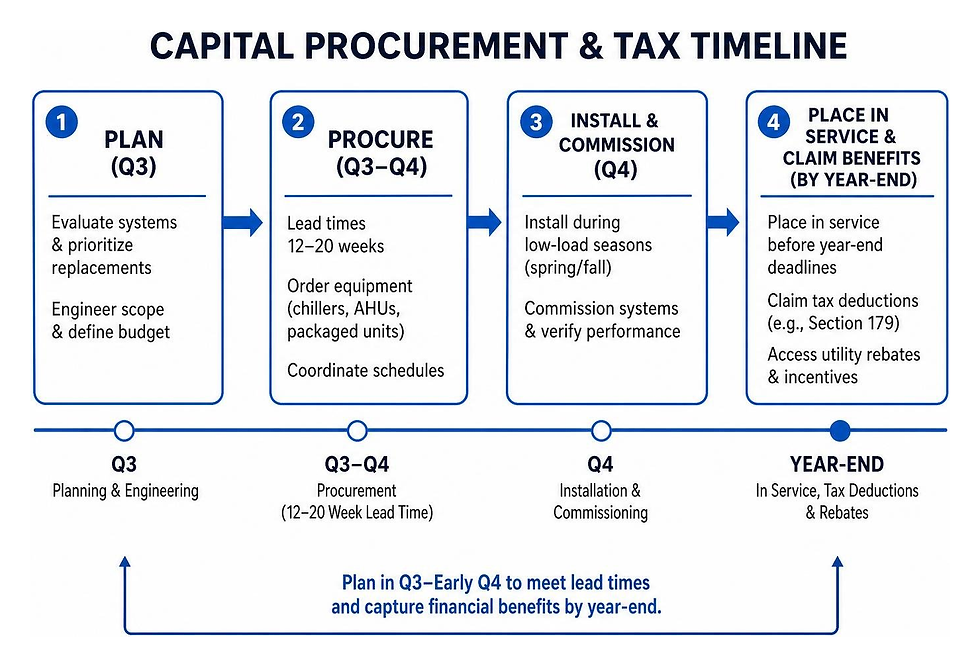
Lead times for commercial chillers, custom air handlers, and large packaged units frequently span 12 to 20 weeks. Planning upgrades in Q3 and early Q4 allows sufficient runway to engineer the application, procure equipment, and complete commissioning before regulatory and financial deadlines close.
Integrating Tax Incentives into Year End Commercial HVAC Capital Planning
The tax code offers substantial opportunities for commercial property owners to offset capital improvements. Under IRS Section 179, qualifying businesses can immediately deduct the full purchase price of eligible commercial HVAC equipment in the tax year it is acquired. This mechanism allows organizations to write off qualifying equipment investments in the first year rather than depreciating assets incrementally over decades, significantly reducing immediate net tax liabilities.
However, Section 179 mandates a strict "placed-in-service" rule: the equipment must be fully installed, operational, and commissioned by 11:59 PM on December 31. Merely signing a proposal, issuing a purchase order, or having crates sitting in a parking lot does not qualify.
Larger facilities investing in whole-building energy reductions can also leverage the section 179d commercial building energy deduction, which rewards significant efficiency milestones across HVAC, lighting, and building envelope systems.
Capturing Utility Rebates and Optimizing Q4 Service Agreements
Electric and natural gas utilities provide substantial financial rebates for upgrading to high-efficiency mechanical systems. However, a frequent misstep is purchasing equipment before obtaining program approvals. Most utility incentive programs mandate formal pre-approval, baseline verification, and engineering modeling before installation begins.
Starting the process with a professional energy audit is the most effective approach. Knowing commercial hvac energy audit what to expect allows managers to identify high-ROI conservation measures, establish accurate baselines, and secure utility pre-approval early in Q4.
Q4 is also the ideal time to review service contracts. Reviewing commercial hvac service contract what to look for ensures maintenance scopes match your updated equipment inventory. Understanding what is a commercial hvac preventive maintenance agreement helps facility directors adjust coverage, align warranties on newly installed equipment, and secure reliable 24/7 emergency response support for the coming year.
Frequently Asked Questions About Year-End HVAC Budgeting
Why is Q4 critical for commercial HVAC capital budgeting?
Q4 represents the convergence of fiscal, tax, and operational deadlines. Organizations must allocate remaining year-end capital surpluses or risk losing those budgets in the subsequent cycle. Furthermore, Q4 is the final window to commission equipment to meet the December 31 Section 179 tax deadline. It is also the ideal timeframe to secure utility rebate funds before annual program allocations close, and to contract equipment deliveries before spring manufacturer price increases take effect.
When should equipment be ordered to meet Section 179 deadlines?
Because the IRS requires equipment to be fully installed, powered, and functioning by December 31, waiting until December to purchase is a high-risk gamble. Given standard commercial HVAC manufacturing lead times of 12 to 20 weeks, planning and equipment ordering should ideally occur in late summer or early Q3. For rapid fourth-quarter execution, projects must focus on readily available equipment configurations that can be delivered, rigged, connected, and commissioned well before the final week of December.
How do maintenance agreements factor into year-end capital planning?
When building owners ask is a commercial hvac maintenance plan worth it, the operational data provides a definitive yes. Maintenance contracts represent operational expenditures (OpEx) that directly protect your capital expenditures (CapEx). Documenting consistent routine service safeguards manufacturer warranties and extends asset useful life by 5 to 10 years. In daily operations, how a maintenance agreement reduces hvac downtime translates into regular filter changes, coil cleanings, and sensor calibrations that prevent minor mechanical faults from developing into full plant shutdowns.
Conclusion
Proactive year-end commercial HVAC capital planning shifts mechanical systems from unpredictable operational liabilities into structured, value-generating assets. By cataloging equipment, analyzing performance data, planning multi-year phases, and timing installations to leverage tax provisions and utility incentives, facility leaders protect their properties against disruptive downtime and erratic budget spikes.
Whitescarver Engineering Company is a commercial and industrial HVAC and refrigeration service firm based in Roanoke, VA, operating since 1937. With decades of dedicated experience, we specialize in installing, maintaining, and retrofitting large-scale HVAC systems, custom industrial process systems, refrigeration engineering and design, and advanced energy-conservation solutions. We proudly deliver reliable solutions and 24/7 service for commercial clients and businesses throughout Roanoke, Salem, Vinton, and the Blacksburg/Christiansburg corridor.
Prepare your mechanical assets for long-term operational success. Contact Whitescarver Engineering Co. today to schedule your comprehensive facility assessment and explore our custom commercial HVAC systems.



Comments