
Commercial HVAC Maintenance Checklist for Facility Managers
Commercial HVAC Maintenance Checklist for Facility Managers in Roanoke, Salem, and Blacksburg

A commercial HVAC maintenance checklist for facility managers is the foundation of any structured preventive maintenance program. Here is a quick-reference overview of the core tasks by frequency:
Frequency | Key Tasks |
Daily/Weekly | Visual inspections, BAS setpoint verification, unusual noise or vibration checks |
Monthly | Air filter inspection/replacement, condensate drain check, belt tension inspection |
Quarterly | Coil cleaning, refrigerant charge verification, electrical connection tightening, bearing lubrication |
Annually | Heat exchanger inspection, refrigerant leak survey, BAS sensor calibration, full system performance test |
Seasonal | Cooling startup (spring), heating startup (fall), economizer damper testing |
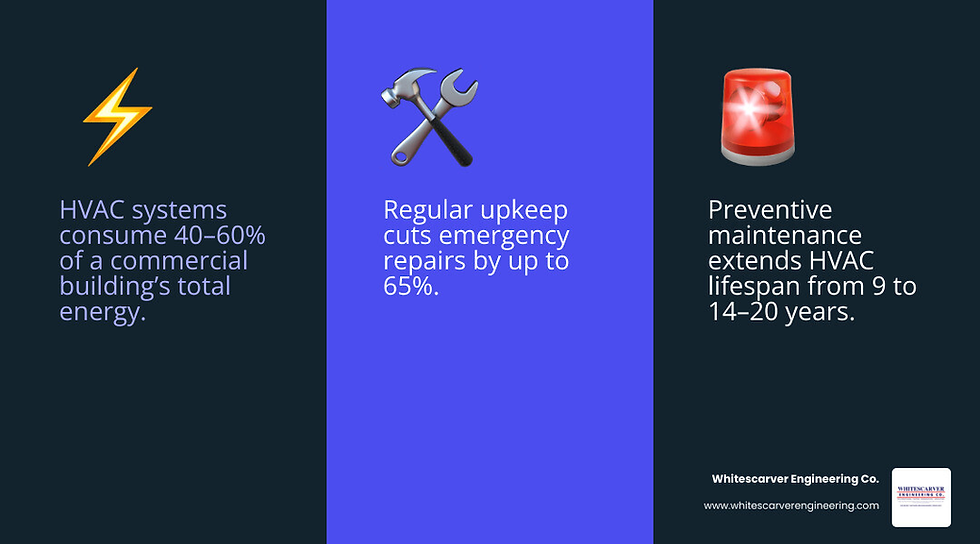
HVAC systems account for 40 to 60 percent of total commercial building energy consumption. When those systems are neglected, the consequences compound fast — dirty coils force compressors to work harder, slipping belts cut airflow, and deferred refrigerant checks can turn a minor issue into a major equipment failure. For facility managers responsible for operational continuity, tenant comfort, and budget accountability, the stakes are real.
The difference between a system that fails after nine years and one that reaches its full 14-to-20-year service life often comes down to one thing: a structured, consistently executed maintenance program. Structured preventive maintenance programs have been shown to reduce emergency call-outs by up to 65 percent and cut energy consumption by as much as 40 percent — results that support operational performance and long-term asset value.
This guide gives you a complete, actionable commercial HVAC maintenance checklist built for Virginia facility managers — covering daily monitoring, seasonal preparation, documentation requirements, and safety protocols.
Why Preventive Maintenance is Critical for Facility Managers

At Whitescarver Engineering Company, we have seen how a proactive approach transforms building operations. For a facility manager, the HVAC system is often the single largest consumer of energy, typically swallowing 40–60% of the total utility budget. A system running with dirty filters or fouled coils can easily see a 15–30% spike in energy waste.
Beyond monthly utility performance, the value of a commercial HVAC maintenance checklist for facility managers is rooted in asset preservation. A neglected 20-ton rooftop unit (RTU) often fails by year nine, whereas a well-maintained unit can reliably serve for 15 to 20 years. By extending equipment lifespan by 30–40%, facility teams can defer disruptive capital replacements and strengthen long-term building performance.
Operational reliability is perhaps the most visible benefit. Emergency repairs can be far more disruptive than scheduled service visits. When a primary air handler fails during a 100-degree Virginia summer, the impact goes beyond the repair itself—it affects productivity, tenant satisfaction, and, in some facilities, inventory protection. Understanding the nuances of Preventive Maintenance vs Reactive Repairs Commercial HVAC is the first step toward moving your facility from a "firefighting" mode to a state of controlled, predictable performance.
The Essential Commercial HVAC Maintenance Checklist for Facility Managers
Commercial HVAC systems are complex mechanical networks, often containing over 100 interconnected parts. To manage this complexity, we recommend a tiered approach that breaks tasks down by frequency. This ensures that high-wear items like filters are addressed often, while deep-system calibrations happen on a strategic annual cycle.
A comprehensive program focuses on four primary pillars: airflow, heat transfer, electrical integrity, and mechanical lubrication. If any one of these pillars fails, the entire system's efficiency collapses. Learning How to Maintain Commercial HVAC Systems requires a commitment to these fundamentals.
Daily and Weekly Monitoring Tasks
While professional technicians handle the heavy lifting, facility staff play a vital role in early detection. Daily "walk-throughs" of mechanical rooms and rooftop areas can catch small issues before they escalate.
Visual Inspections: Look for oil stains (a sign of refrigerant leaks), water pooling around units, or loose panels.
Unusual Noises: Listen for grinding, squealing, or thumping. A squealing belt is a minor fix today but a broken belt is a total system shutdown tomorrow.
Vibration Monitoring: Excessive vibration in fan housings or pumps often indicates misalignment or bearing failure.
BAS Setpoint Verification: Check your Building Automation System (BAS) to ensure that occupied/unoccupied schedules are actually being followed. Sensor drift of just 2 degrees can add 8–12% to your energy costs.
For facilities that operate around the clock, having a 24-Hour Commercial HVAC Maintenance Blue Ridge VA Guide helps ensure that night shifts know exactly what to look for when the primary maintenance team is off-site.
Monthly and Quarterly Maintenance Checklist for Facility Managers
The monthly and quarterly intervals are where the most significant energy savings are captured. These tasks focus on maintaining the physical health of the equipment.
Filter Replacement: In high-traffic or industrial environments, filters should be checked monthly. We recommend moving toward MERV 13 filters where system static pressure allows, as these significantly improve indoor air quality. Replacing a dirty filter can cut energy use by 5–15%.
Belt Tensioning: Inspect blower belts for glazing or cracking. Ensure proper tension (typically a 1/2-inch deflection); a slipping belt can reduce airflow by 15–20%, forcing the system to run longer to meet demand.
Condensate Drain Flushing: Algae and debris can quickly clog drain pans. We use biocides and vacuum out lines to prevent water damage and mold growth.
Bearing Lubrication: Grease motor and fan bearings according to manufacturer specifications. Over-greasing can be just as damaging as under-greasing, so precision is key.
Our comprehensive Maintenance Services are designed to automate these intervals so facility managers can focus on higher-level building strategies.
Seasonal HVAC Maintenance: Preparing for Virginia’s Climate
The Roanoke Valley and the Blue Ridge region present unique challenges for HVAC systems. We experience high humidity in the summer and freezing temperatures in the winter, often with rapid swings in between. This makes seasonal transitions the most critical time for your commercial HVAC maintenance checklist for facility managers.
Effective humidity management is essential for preventing mold and ensuring occupant comfort. In our area, failing to calibrate economizers or check refrigerant charges before the first heat wave can lead to "sick building" symptoms and skyrocketing cooling costs. Reviewing Commercial HVAC Maintenance Blue Ridge VA Tips can provide more localized insights into managing these regional shifts.
Spring and Summer Cooling Preparation
Before the humidity of a Virginia July hits, your cooling systems must be vetted for peak-load performance.
Condenser Coil Cleaning: Dirty coils reduce heat transfer capacity by 20–40%. We use low-pressure washing to remove pollen, dust, and debris that act as an insulator, forcing the compressor to work harder.
Refrigerant Charge Verification: Low refrigerant causes the evaporator coil to freeze and the compressor to overheat. We use precision gauges to ensure the charge is within manufacturer specs.
Economizer Damper Testing: Many facility managers ignore economizers, but a damper stuck open can waste thousands of dollars by pulling in hot, humid air when it shouldn't.
Don't forget that rooftop units take a beating from the sun and storms. Our guide on Spring Maintenance for Commercial Rooftop Units covers these exterior-specific checks in detail.
Fall and Winter Heating Checklist for Facility Managers
In the fall, the focus shifts to safety and combustion efficiency. Whether you are running gas-fired furnaces or large-scale boiler systems, the transition to heating mode requires a different set of eyes.
Heat Exchanger Inspection: A cracked heat exchanger is a major safety hazard, potentially leaking carbon monoxide into the building. We use high-resolution cameras to check for hairline fractures.
Combustion Analysis: We measure flue gases to ensure complete combustion. This ensures safety and maximizes the amount of heat you get out of every therm of gas.
Ignition System Testing: Cleaning burners and checking flame sensors prevents those frustrating "no-heat" calls on the first frost.
For those managing properties in the Salem area, our Commercial Maintenance Salem VA Guide provides a tailored look at heating requirements for local commercial architecture.
Leveraging Technology and Documentation for Compliance
Moving from paper-based logs to a Computerized Maintenance Management System (CMMS) is one of the single most effective ways to improve compliance and accountability.
Feature | Manual Paper Logs | Digital CMMS Software |
Scheduling | Relies on memory or calendars | Automated recurring work orders |
Documentation | Prone to loss/damage | Cloud-based, searchable history |
Compliance | Hard to audit quickly | Instant report generation |
Accountability | Difficult to verify completion | Photo evidence and timestamps |
Data Analysis | Virtually impossible | Identifies failing equipment trends |
Digital tracking is especially critical for regulatory compliance. EPA Section 608 requires strict record-keeping for any system containing more than 50 pounds of refrigerant. If you cannot produce a leak repair history during an audit, the penalties can be severe. Furthermore, ASHRAE 188 standards for Legionella management require documented drain pan inspections and water treatment logs for cooling towers.
Keeping detailed records also protects your equipment warranties. Most manufacturers will deny a major claim (like a failed compressor) if you cannot provide dated proof of professional maintenance. Using the Best Maintenance Services in Salem VA ensures that your documentation is always audit-ready and professional.
Identifying Common Failures and Safety Protocols
Preventive maintenance is designed to stop "cascade failures." For example, a $30 capacitor failure can cause a motor to overheat, which then leads to a $5,000 compressor failure. Common issues we look for include:
Compressor Liquid Slugging: Often caused by low airflow or overcharging, this can destroy a compressor instantly.
Electrical Contactor Pitting: Worn contacts cause voltage drops, which increase heat and lead to motor burnout.
Sensor Drift: When thermostats or CO2 sensors lose calibration, the BAS makes incorrect decisions, wasting energy and compromising air quality.
Safety is paramount during any maintenance activity. We strictly follow Lockout/Tagout (LOTO) procedures to ensure that equipment cannot be energized while a technician is working on it. Facility managers should ensure that all staff—internal and external—adhere to these life-saving protocols.
For facilities focused on sustainability, incorporating Eco-Friendly Maintenance Services in Salem VA can help reduce the environmental footprint of these repairs through better refrigerant management and high-efficiency component upgrades.
Frequently Asked Questions about Commercial HVAC Maintenance
How often should commercial air filters be replaced in high-traffic facilities?
In high-traffic environments like retail centers or healthcare facilities, filters should be inspected monthly. While standard office buildings might get away with quarterly changes, high-occupancy spaces often require a 30-to-60-day cycle to maintain indoor air quality and prevent excessive static pressure on the fans.
What documentation is required for EPA refrigerant compliance?
Under EPA Section 608, for systems with 50+ lbs of refrigerant, you must document the amount added, the technician’s certification number, the date of the service, and the results of any leak verification tests. These records must be kept for at least three years.
How does regular maintenance impact commercial refrigeration systems?
Like HVAC, refrigeration systems rely on clean coils and proper refrigerant levels. Neglected refrigeration leads to product loss and massive energy spikes. For industrial clients, we provide an Ultimate Commercial Refrigeration Maintenance Guide that addresses these specialized needs.
Conclusion
A commercial HVAC maintenance checklist for facility managers is more than just a list of tasks; it is a strategic business tool. At Whitescarver Engineering Co., we bring technical expertise dating back to 1937 to the Roanoke, Salem, Vinton, and Blacksburg/Christiansburg corridor. Our heritage is built on solving complex commercial and industrial HVAC and refrigeration challenges with precision and reliability.
We pride ourselves on being a dependable service partner for facility managers, building owners, and industrial operations. From custom industrial HVAC projects to energy cost reductions, our team supports critical building systems with tailored maintenance agreements and 24/7 service for commercial clients.
Ready to move from reactive repairs to a structured reliability program? Explore our Maintenance Services today and let us build a plan that protects your building and supports long-term performance.


Comments