
How Building Automation Systems Detect HVAC Problems Before Downtime
How Building Automation Systems Find HVAC Faults Early

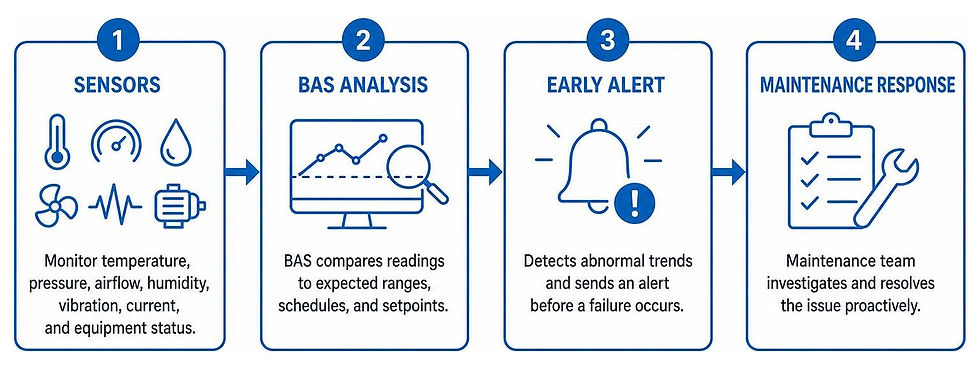
How building automation systems detect HVAC problems before they cause downtime comes down to continuous measurement and fast comparison. Sensors track temperatures, pressure, airflow, humidity, vibration, motor current, and equipment status. The BAS compares those readings with expected operating ranges, schedules, and setpoints. When a trend shifts - such as falling coil temperature difference, rising fan vibration, or a damper that does not respond correctly - it can create an alert before the issue becomes a shutdown. For commercial and industrial facilities in Roanoke, VA, early fault detection supports reliable HVAC and refrigeration service, better environmental control, and less wasted energy.
Explore what a building automation system does or contact Whitescarver Engineering Co. to discuss your facility's controls and equipment needs.
I’m Hugh Joyce, and next we’ll look at how reactive, preventive, and predictive maintenance use BAS data in different ways.
Key Maintenance Strategies: Reactive, Preventive, and Predictive Controls
Every facility manager understands the frustration of unpredicted downtime. When a critical chilled water pump fails or an air handling unit (AHU) freezes up on a humid summer day, operational disruptions follow immediately. Over the decades, maintenance strategies have evolved significantly, transitioning from fixing broken machinery to actively managing equipment health through real-time intelligence.
To appreciate how modern automation keeps operations running smoothly, it helps to understand the three distinct maintenance paradigms:
Reactive Maintenance ("Run-to-Failure"): Servicing equipment only after a complete breakdown occurs. While this approach requires zero upfront planning, it carries severe consequences: higher repair expenditures, catastrophic component damage, emergency contractor fees, and costly business downtime.
Preventive Maintenance (PM): Performing routine calendar- or hour-based servicing, such as changing filters every quarter or replacing belts annually. While far superior to reactive maintenance, traditional PM operates blindly without regard to actual mechanical wear. Healthy components are often replaced prematurely, while developing mechanical faults remain hidden between scheduled service visits.
Predictive Maintenance (PdM): Using real-time telemetry from connected control architecture to monitor physical condition continuously. By analyzing operating signatures, predictive systems flag subtle performance drops, enabling targeted interventions long before hardware failure happens.
Understanding what is a Building Automation System is essential to shifting from schedule-based upkeep to condition-based control. A well-designed BAS serves as the central neural network of a facility, continually gathering data across all mechanical assets to evaluate equipment health in real time.
Predictive Maintenance vs Traditional Schedules
Why choose predictive analytics over calendar-based maintenance schedules? The difference lies in dynamic insights versus fixed assumptions.
Research indicates that over 20% of commercial HVAC systems operate with early-stage gradual faults that remain unmeasured by basic periodic checks. These hidden issues account for over 15% in avoidable energy waste long before full system failure triggers a panic call.

Operational Attribute | Traditional Preventive Maintenance (PM) | BAS-Driven Predictive Maintenance (PdM) |
Trigger Mechanism | Fixed calendar interval (e.g., quarterly) | Real-time sensor threshold or trend anomaly |
Data Reliance | Static maintenance logs and manual logs | Continuous telemetry (temperature, pressure, vibration) |
Resource Efficiency | Low to Moderate (services healthy units) | High (targets degraded assets precisely) |
Fault Detection Capability | Misses inter-service gradual wear | Catches sub-visual component degradation early |
Energy Impact | Unnoticed gradual degradation burns excess kWh | Corrects parameter drift immediately to preserve efficiency |
Typical Payback Period | Ongoing static overhead expense | Median 2-year simple payback via energy and repair savings |
By shifting maintenance schedules from arbitrary calendar dates to actual physical conditions, building operators eliminate unnecessary component teardowns, optimize labor hours, and drastically extend machinery service life.
How Building Automation Systems Detect HVAC Problems Before They Cause Downtime Through Real-Time Monitoring
Modern building infrastructure relies on a vast array of high-precision sensors measuring physical parameters hundreds of times per hour. By understanding the distinction between a Building Management System vs Building Automation System, facility leaders can harness actionable sensor telemetry to detect degradation early:
Differential Temperature Across Coils ($\Delta T$): A decreasing temperature differential across cooling or heating coils signals fouling, air locks, scale accumulation, or reduced refrigerant mass flow before room space temperatures swing out of spec.
Duct and Hydronic Static Pressure: Sudden pressure drops across filter banks indicate clogged air filters, while excessive hydronic pipe pressure variations point to stuck balance valves or pump cavitation.
Electrical Current and Power Consumption: Variable Frequency Drives (VFDs) and smart power meters monitor line current. An unexplained spike in amperage draw on a fan motor usually signals bearing friction, electrical phase imbalance, or severe mechanical binding.
Vibration Signatures: Wireless IoT vibration sensors mounted on motor shafts and bearing housings catch early mechanical unbalance, shaft misalignment, or bearing race pitting weeks before catastrophic failure locks up a motor.
Core Technologies Behind How Building Automation Systems Detect HVAC Problems Before They Cause Downtime

Transforming millions of raw data points into actionable maintenance alerts requires robust hardware, standardized communication frameworks, and advanced diagnostic software. Without open protocols, building controls operate in isolated silos, preventing facility management teams from gaining unified oversight.
Standardized communication protocols like BACnet (developed by ASHRAE) and Modbus serve as the common language connecting diverse mechanical hardware. When integrated with edge computing controllers and IoT gateways, these protocols allow chillers, boilers, air handling units, and variable air volume (VAV) boxes from different equipment generations to communicate seamlessly across a single network overlay.
Rule-Based FDD vs Data-Driven Machine Learning
Once telemetry flows from field devices across BACnet networks, system software applies Fault Detection and Diagnostics (FDD) to interpret operational health. Commercial FDD relies on two primary analytical strategies:
Rule-Based Expert Systems (APAR & Limit Logic): Rule-based systems evaluate live operating data against predefined engineering logic, such as Air Handling Unit Performance Assessment Rules (APAR). For instance, if an AHU control signal calls for 0% heating, but supply air temperature rises 10°F above mixed air temperature, the system logs a leaking heating coil valve fault. While reliable, rule-based systems require careful threshold setup to limit false alarms.
Data-Driven Machine Learning Models: Advanced platforms utilize multivariate statistical tools such as Principal Component Analysis (PCA), Support Vector Machines (SVM), and neural autoencoders. Unsupervised machine learning models learn normal baseline operating profiles across complex weather seasons and building occupancy modes. By evaluating inter-sensor relationships simultaneously—such as comparing damper actuator positions against airflow feedback and fan speed—machine learning identifies subtle "rogue zone" anomalies that standard threshold alarms miss entirely.
How Building Automation Systems Detect HVAC Problems Before They Cause Downtime Across Critical Components
Data-driven automated fault detection targets the most energy-intensive and operationally sensitive mechanical assets in commercial buildings:
Air Handling Units (AHUs) & Mixing Boxes: Detecting stuck return air dampers, leaking heating/cooling valves, supply fan belt slips, and frozen face-and-bypass dampers.
Chillers and Plant Infrastructure: Catching low evaporator delta-T ("Low $\Delta T$ Syndrome"), refrigerant leaks, tube fouling, chiller surging during partial-load operation, and condenser water temperature drift.
VAV Terminal Units: Pinpointing slipping damper actuators, uncalibrated airflow pick-up tubes, stuck re-heat valves, and sensor drift that cause simultaneous heating and cooling energy waste.
Properly integrating building controls with commercial HVAC guarantees that when an anomalous operational signature appears on an AHU or central chiller, system intelligence isolates the root cause immediately.
Figure 1: End-to-end data processing pipeline for automated HVAC fault detection and maintenance dispatch.
Overcoming BAS Diagnostics Challenges: Data Quality, Closed-Loop Masking, and Programming
While automated fault detection offers immense operational benefits, implementing reliable BAS diagnostics comes with technical challenges. Facility managers often encounter three major technical hurdles:
1. The Masking Effect of Closed-Loop PID Controllers
Proportional-Integral-Derivative (PID) loop controllers are engineered to maintain comfortable indoor space conditions regardless of mechanical strain. If a chilled water cooling valve scales up and restricts flow, the PID controller simply overcompensates by driving the valve actuator from 40% open to 80% open.
Space temperatures remain comfortable, hiding the severe mechanical restriction. The fault remains invisible until the valve reaches 100% capacity on a hot afternoon, causing complete system failure. BAS logic must evaluate controller residual output rather than relying solely on room setpoint accuracy.
2. Sensor Drift and Data Decay
A system is only as intelligent as its incoming sensor data. Over time, physical sensors experience calibration drift or moisture degradation. A supply air temperature sensor drifting by just 2°F can cause significant unnecessary mechanical cooling. Deploying automated sensor validation routines and utilizing virtual backup sensor points prevents bad data from corrupting diagnostic models.
3. Load Programming and Environmental Extremes
Unrefined automation logic often generates high rates of false alarms during extreme weather or low-building-occupancy periods. For example, an oversized commercial chiller operating during partial weekend occupancy may begin surging due to low heat loads.
Rather than replacing expensive hardware, our technical team at Whitescarver Engineering Co. solves this issue by reprogramming BAS sequence logic to ignore low-load cooling requests or implement trim-and-respond setpoint resets. Custom control adjustments eliminate false trips while protecting compressors from mechanical strain.
Best Practices for Maximizing BAS Fault Detection and Preventing Facility Downtime
To maximize your automation investment and ensure long-term B2B service reliability, facility managers should establish a systematic management framework around building controls:
Conduct Initial Commissioning and Continuous Recommissioning: Never assume legacy control sequences operate as intended. Complete functional testing validates every sensor input, physical actuator, and relay output under varied load profiles.
Adopt Standardized Metadata Schemas: Organize BAS trend logs using open metadata standards like Project Haystack or Brick Schema. Standardized naming conventions simplify connecting third-party analytics platforms and automated work-order systems.
Link BAS Alerts Directly to Maintenance Workflows: An alarm sitting unread on an operator interface dashboard prevents no downtime. Integrate BAS alarm management with Computerized Maintenance Management Systems (CMMS) so critical diagnostic flags automatically trigger service work orders.
Invest in Continuous Staff Training: Empower maintenance personnel and facility operators to understand building analytics, adjust diagnostic thresholds, and translate early system flags into strategic physical repairs.
Partner with Experienced Commercial HVAC Controls Specialists: Modern building automation systems combine refrigeration engineering, electrical controls, and software networks. Partnering with proven industrial HVAC experts ensures seamless long-term operation.
Discover additional ways intelligent control strategies slash operational overhead in our detailed guide on how Building Automation Systems save energy.
Frequently Asked Questions About BAS HVAC Problem Detection
What is automated fault detection and diagnostics (FDD) in a BAS?
Automated Fault Detection and Diagnostics (FDD) is a software overlay embedded within or connected to a Building Automation System. FDD continuously analyzes operational telemetry—such as temperatures, pressures, valve positions, and power draw—against physical rules or statistical baselines. When deviations occur, FDD automatically flags the specific fault, identifies the probable root cause, and estimates the operational impact, allowing facility teams to fix issues proactively.
How much energy can early HVAC fault detection save commercial facilities?
Uncorrected HVAC operational faults account for 15% to 30% of total energy waste in typical commercial and industrial facilities. Implementing automated fault detection allows commercial office, higher education, and industrial manufacturing sites to achieve median annual energy savings of 10%, with systems consistently delivering a simple payback period of two years or less.
Why do closed-loop controllers sometimes hide HVAC problems?
Closed-loop PID controllers are programmed to maintain target space conditions regardless of component degradation. If an air filter becomes clogged or a coil fouls, the controller automatically ramps up fan speeds or opens control valves wider to compensate. Space temperatures remain normal, masking the developing mechanical failure until the equipment reaches maximum capacity and suffers complete operational breakdown.
Conclusion
Understanding how building automation systems detect HVAC problems before they cause downtime is essential for commercial facility leaders who prioritize operational continuity, environmental control, and long-term cost containment. By transitioning from reactive fire-fighting to predictive automation controls, commercial facilities eliminate unexpected shutdowns, optimize facility labor, and capture significant annual energy savings.
At Whitescarver Engineering Company, we have delivered second-to-none commercial and industrial HVAC, controls, refrigeration engineering, and energy-conservation solutions since 1937. Serving commercial operations throughout Roanoke, Salem, Vinton, and the Blacksburg/Christiansburg corridor, our technical specialists possess the deep expertise required to design, install, retrofit, and maintain complex building control infrastructure. Whether managing industrial process cooling or large-scale commercial facilities, our custom projects, energy reduction strategies, and 24/7 service keep critical systems running reliably.
Ready to protect your facility from unpredicted mechanical failures? Learn how a maintenance agreement reduces HVAC downtime or contact Whitescarver Engineering Co. today to schedule a controls evaluation with our commercial engineering team.


Comments