
The Ultimate Guide to Chiller vs Rooftop Unit vs VRF for Virginia Commercial Facilities
Chiller vs Rooftop Unit vs VRF for Large Virginia Facilities

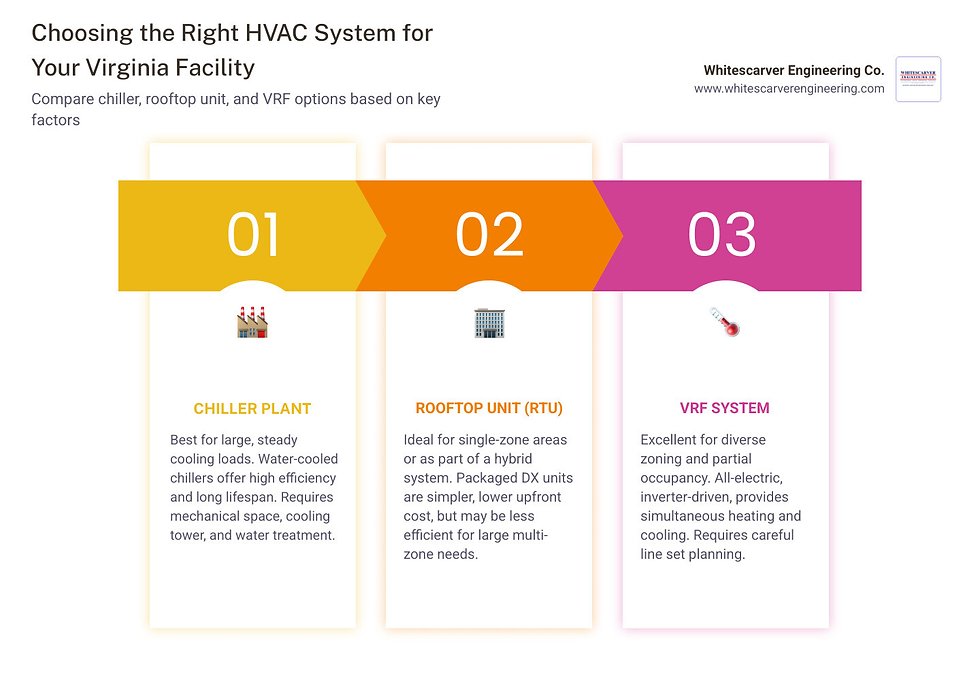
Chiller vs rooftop unit vs VRF which is right for a large commercial facility in Virginia depends on the building's cooling load, layout, humidity needs, and future plans. For large facilities with steady, high cooling demand, a central chiller plant often offers the strongest long-term performance. VRF is a strong fit for buildings with many zones and changing occupancy. Rooftop units can serve straightforward areas or support a larger hybrid system. Virginia's humid summers and changing shoulder seasons make proper load sizing, ventilation, and controls especially important for commercial HVAC systems in Roanoke, VA and across the region.
Explore commercial HVAC systems or contact Whitescarver Engineering Co. to discuss your facility.
Whitescarver Engineering Co. has supported commercial and industrial operations since 1937, with large-scale HVAC, refrigeration, process-system, retrofit, and energy-conservation expertise throughout Roanoke, Salem, Vinton, and the Blacksburg/Christiansburg corridor.
I'm Hugh Joyce, and I can help your team evaluate the right path for reliable facility comfort and performance through a commercial HVAC consultation.
Comparing Chiller, Rooftop Unit, and VRF Performance in Virginia’s Climate
Selecting an HVAC platform for a major facility in Virginia requires matching equipment mechanics to our distinct regional climate. Virginia experiences a humid subtropical climate marked by intense summer heat, sticky humidity, unpredictable transition periods in spring and autumn, and winter temperatures that routinely dip below freezing. Managing indoor humidity is just as vital as maintaining setpoint temperatures. Excess moisture leads to indoor air quality issues, microbial growth, and occupant discomfort.
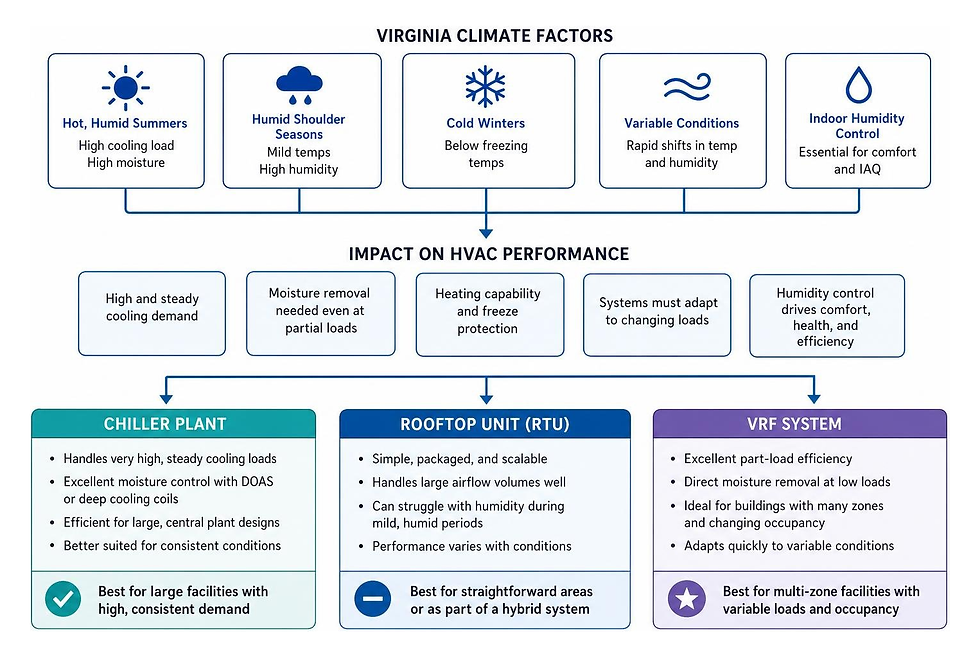
When evaluating system types, facility managers must review our Commercial HVAC System Type Guide for Building Owners to align thermal requirements with mechanical performance. Direct expansion (DX) evaporator coils, such as those found in VRF systems, run at lower refrigerant temperatures than standard chilled water loops. This allows VRF systems to extract moisture directly from the air during partial-load conditions without requiring significant reheat energy. Standard packaged Rooftop Units (RTUs) handle large airflow volumes well but can struggle with humidity during mild, highly humid shoulder seasons when cooling demand drops but latent moisture remains high. Chiller plants handle immense cooling loads and, when paired with Dedicated Outdoor Air Systems (DOAS) or deep cooling coils, deliver moisture control across expansive square footage.
Chiller Plant Characteristics and Efficiency
Chiller plants represent the industrial backbone of large-scale commercial cooling. Chillers do not cool air directly; instead, they cool water or a water-glycol solution, which is circulated through chilled water pipes to air handling units (AHUs) and fan coil units (FCUs) throughout the facility.
Chillers are divided into two main categories: water-cooled and air-cooled systems.
Water-Cooled Chillers: These rely on a secondary condenser water loop connected to open or closed cooling towers. They operate at high thermodynamic efficiency, achieving superior Integrated Part Load Value (IPLV) and low energy draw (measured in kW per ton). Water-cooled plants excel in facilities over 50,000 square feet where continuous, high-tonnage cooling is required. However, they demand dedicated mechanical rooms, condenser pumps, and aggressive water treatment to control scale, corrosion, and biological growth such as Legionella.
Air-Cooled Chillers: Air-cooled models reject heat directly into ambient air using heavy-duty condenser fans. While slightly less efficient than water-cooled alternatives during extreme summer heat peaks, they eliminate cooling tower infrastructure, water consumption, and chemical treatment requirements.
For a deeper dive into these configurations, review our article on Choosing Between Air- and Water-Cooled Chillers for Your Building.
Chiller plants provide exceptional load staging flexibility. In a multi-chiller configuration, facility engineers can run a primary 500-ton centrifugal chiller during high weekday demand and stage down to a smaller 100-ton scroll or screw chiller during off-peak weekend hours. Furthermore, chilled-water and thermal ice-storage systems allow facilities to freeze water during off-peak nighttime hours when utility rates are low, and melt that ice to handle peak daytime cooling, delivering energy cost reductions.
Packaged Rooftop Unit (RTU) Capabilities
Packaged Rooftop Units (RTUs) consolidate all refrigeration, air movement, and heating components into a single weatherproof cabinet mounted on a building's roof. Air is conditioned directly via DX refrigerant circuits and blown through supply ductwork into the space below.
RTUs are popular for retail facilities, single-story light industrial spaces, and open-plan commercial environments under 25,000 to 50,000 square feet. Their major operational advantages include:
Factory-Assembled Simplicity: RTUs arrive pre-engineered, charged, and factory-tested, reducing field assembly requirements.
Roof-Mounted Footprint: By elevating the mechanical footprint to the roof deck, RTUs free up interior floor space for productive operations.
Single-Zone Simplicity: Each unit operates independently, preventing a mechanical issue in one unit from disabling the entire facility.
Despite these benefits, RTUs face performance boundaries in large, complex facilities. Efficiency is measured via Energy Efficiency Ratio (EER) and Seasonal Energy Efficiency Ratio (SEER), which generally fall below the IPLV benchmarks reached by chilled water plants or variable-speed VRF installations. Mounting heavy RTUs—often weighing between 2,500 and 3,500 pounds for a 20-ton unit—requires structural roof reinforcement, adding structural engineering requirements during retrofits. Facility owners weighing packaged choices should read our guide on Which is Better: RTU or Split System for Commercial Buildings?.
Variable Refrigerant Flow (VRF) Systems
Variable Refrigerant Flow (VRF) systems represent an advanced form of direct expansion technology. Rather than moving chilled water or conditioned bulk air through large duct mains, VRF systems circulate variable quantities of refrigerant directly to small indoor fan coils located throughout individual building zones.
Key engineering highlights of VRF systems include:
Inverter Compressor Technology: Variable-speed inverter compressors continuously match motor RPM to real-time zone cooling and heating demands, avoiding energy-intensive start-stop cycles.
Heat Recovery Capabilities: 3-pipe heat recovery VRF systems simultaneously heat zones on the cold side of a building while cooling zones on the sun-exposed side. Thermal energy extracted from cooling spaces is redirected to spaces requiring heat, dramatically improving Integrated Energy Efficiency Ratio (IEER) ratings.
Elimination of Major Water Infrastructure: VRF is an all-electric solution that eliminates chillers, cooling towers, heavy water pumps, and hydronic pipe insulation.
These multi-zone dynamics are detailed in our analysis on VRF vs Traditional HVAC System Comparison.
Chiller vs Rooftop Unit vs VRF: Which Is Right for a Large Commercial Facility in Virginia?

Selecting among chillers, RTUs, and VRF systems requires evaluating how equipment design aligns with long-term facility goals, physical layout, zoning, and lifecycle requirements.
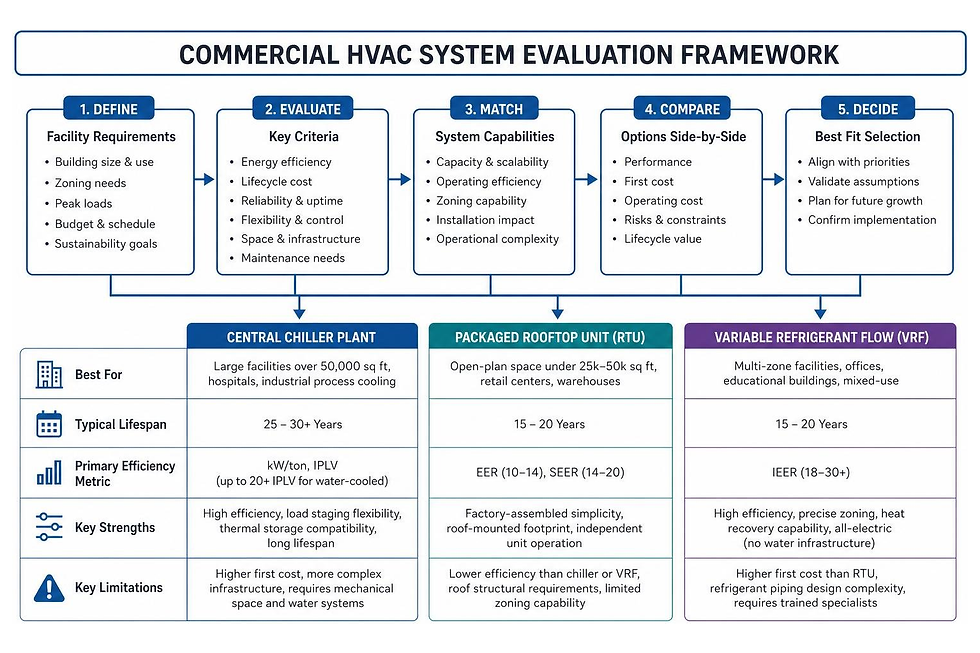
System Metric / Feature | Central Chiller Plant | Packaged Rooftop Unit (RTU) | Variable Refrigerant Flow (VRF) |
Primary Applications | Large facilities over 50,000 sq ft, hospitals, industrial process cooling | Open-plan space under 25k–50k sq ft, retail centers, warehouses | Multi-zone facilities, offices, educational buildings, mixed-use |
Typical Lifespan | 25 – 30+ Years | 15 – 20 Years | 15 – 20 Years |
Primary Energy Efficiency Metric | kW/ton, IPLV (up to 20+ IPLV for water-cooled) | EER (10–14), SEER (14–20) | IEER (18–30+) |
Zoning Capability | High (via AHUs, VAV boxes, and FCUs) | Moderate (typically single-zone or limited multi-zone VAV) | Exceptional (independent micro-zoning per indoor unit) |
Space & Structural Demands | Requires interior mechanical rooms, cooling towers/pads | Requires strong roof deck load capacity and structural curbs | Small exterior pad/roof footprint; minimal line set penetration |
Dehumidification Performance | High (via deep cooling coils and dedicated DOAS) | Moderate (can require hot-gas reheat options) | Superior (continuous variable DX coil surface temperature) |
Water Treatment Needed? | Yes (for water-cooled loops & cooling towers) | No | No |
Chiller vs Rooftop Unit vs VRF: Which Is Right for a Large Commercial Facility in Virginia Based on Space and Layout?
Building square footage and architectural layout often dictate initial system selection.
For facilities under 25,000 square feet, packaged RTUs offer a logical, decentralized footprint. For multi-story or sprawling facilities exceeding 50,000 to 100,000 square feet, central chillers achieve economies of scale that smaller units cannot match. Facilities between 25,000 and 50,000 square feet represent a key decision threshold where VRF and modular chillers compete directly.
Physical layout space requirements differ radically among the three options:
Chiller Space: Chillers require substantial indoor mechanical floor space for compressors, evaporator shells, control panels, primary/secondary pump skids, and expansion tanks. Water-cooled plants also require outdoor space for cooling towers. However, because chilled water moves through compact piping, vertical riser chases remain minimal compared to large ductwork mains.
RTU Space: RTUs eliminate interior mechanical rooms altogether. However, they impose heavy distributed dead-loads and live-loads on structural roof framing. Roof curbs must be structurally calculated, and large supply/return roof penetrations can limit roof space for solar arrays or outdoor amenities.
VRF Space: VRF outdoor modular units feature a compact footprint and can be clustered on ground-level concrete pads or smaller roof sections. Small refrigerant line sets pass through wall penetrations or pipe risers, saving ceiling plenum space. However, designers must keep refrigerant line set length limits and elevation differences within manufacturer specifications.
To compare these spatial tradeoffs, see our article on Is VRF Better Than Rooftop Units for Commercial Spaces?.
Chiller vs Rooftop Unit vs VRF: Which Is Right for a Large Commercial Facility in Virginia with Diverse Zoning Needs?
Commercial facilities rarely have uniform cooling demands throughout the building envelope. An administrative wing, server room, assembly floor, and public atrium each exhibit distinct heat gain patterns, occupancy schedules, and solar loads.
When evaluating chiller vs rooftop unit vs vrf which is right for a large commercial facility in virginia, zoning needs play a primary role:
VRF Zoning Leadership: VRF shines in facilities requiring independent room-by-room thermal control. A single outdoor VRF system can connect to dozens of individual indoor cassettes, wall units, or concealed duct units. Each zone operates independently, allowing a east-facing corner office to cool while a north-facing conference room heats.
Chiller Plant Versatility: Chillers handle complex zoning by supplying chilled water to Air Handling Units equipped with Variable Air Volume (VAV) terminal boxes, or to individual Fan Coil Units (FCUs). Combined with chilled water modulating valves, a chiller plant serves high-occupancy zones and process cooling loads simultaneously.
RTU Zoning Constraints: Standard packaged RTUs traditionally serve single large zones (such as a gymnasium, warehouse, or open retail floor). While VAV-equipped RTUs exist for multi-zone layouts, they rely on mechanical dampers and bypass ducts, which are less precise than VRF heat recovery or hydronic fan coil loops.
Indoor environmental quality (IAQ) and acoustic levels also vary. VRF indoor fan coils run at whisper-quiet sound levels, making them preferred choices for office settings and educational facilities. Centrifugal chillers and heavy supply fans produce significant mechanical noise and vibration, but because equipment is isolated within dedicated mechanical rooms or on exterior slabs, occupied spaces remain quiet. RTUs keep equipment noise outdoors, though supply fan vibration can transmit through roof framing if vibration isolators are neglected.
Operational Efficiency, BMS Integration, and Hybrid HVAC Configurations
Modern commercial facility management relies on central control, automation, and real-time operational feedback. Integrating HVAC platforms into a central Building Management System (BMS) allows engineering teams to monitor temperature setpoints, track kilowatt-hour energy usage, predict maintenance cycles, and optimize thermal performance.
All three platforms integrate with modern BMS protocols such as BACnet, Modbus, or LonWorks:
VRF Systems: VRF control networks utilize native microprocessors that communicate directly with BMS gateways. They offer precise, real-time diagnostic data down to expansion valve positions, compressor frequencies, and individual zone thermistor readings.
Chiller Plants: Central chillers integrate seamlessly into advanced automation systems. Plant controllers sequence multi-chiller staging, control variable-frequency drives (VFDs) on pumps and cooling tower fans, and automatically re-reset chilled water supply temperatures based on outdoor ambient air conditions.
RTU Controls: Standard RTUs integrate via BACnet cards, allowing simple monitoring of supply/return air temperatures, fan status, filter pressure drop switches, and economizer damper positions.
Because Virginia requires strict adherence to energy codes, integrating a Dedicated Outdoor Air System (DOAS) alongside primary HVAC equipment is often required. DOAS units handle 100% outdoor fresh air conditioning—dehumidifying summer intake air before delivering it to indoor spaces—allowing primary chillers or VRF systems to handle sensible space loads efficiently.
Hybrid Configurations: Combining Chillers, RTUs, and VRF
Facility managers do not always have to choose a single system type. Many large commercial and industrial facilities in Virginia deploy hybrid HVAC configurations that pair technologies to match specific space requirements.

A hybrid configuration matches equipment strengths to zone loads:
Central Chiller Plant for Baseloads: A water-cooled or air-cooled chiller handles steady, high-tonnage requirements across large open floor areas, auditoriums, manufacturing floors, or central administrative wings.
VRF for Multi-Tenant & Executive Zones: VRF systems serve perimeter office clusters, executive suites, or mixed-use retail spaces where individual zone control, heat recovery, and extended operating hours are needed.
Packaged RTUs for High-Volume Common Areas: Heavy-duty RTUs condition large single-zone areas like cafeterias, lobbies, storage bays, or mechanical workshops, handling high air turnover cost-effectively.
Hybrid strategies provide built-in redundancy, allow load staging, and lower overall operational energy spend across complex commercial sites.
Preventative Maintenance, Operations, and Virginia Regulatory Compliance
Maintaining long-term reliability and code compliance requires structured preventative maintenance agreements tailored to equipment type:
Chiller Maintenance: Chillers require expert maintenance programs. Water-cooled units demand annual condenser tube brushing, eddy current testing of tube walls, oil analysis, compressor seal inspections, and rigorous chemical water treatment programs to manage biological growth in cooling towers. Air-cooled chillers require coil cleaning, fan motor checks, and refrigerant circuit inspections.
VRF Maintenance: VRF platforms eliminate water treatment and large fan belts but feature complex electronics, inverter boards, electronic expansion valves, and extensive flare connections. Preventative care involves quarterly filter cleanings, condensate drain line flushes, optical inspection of electrical connections, and leak detection monitoring across line sets.
RTU Maintenance: Packaged units demand quarterly preventative visits focused on belt tension adjustments, filter replacements, blower bearing lubrication, burner assembly checks (for gas-heat RTUs), condenser coil washing, and economizer damper calibration.
Virginia regulatory compliance demands strict adherence to environmental safety rules. Facility owners must manage transitioning refrigerant mandates under EPA Section 608 regulations, tracking low Global Warming Potential (GWP) refrigerant transitions across all equipment assets. Water-cooled chiller plants must also follow local health standards for cooling tower operation, drift eliminator maintenance, and mandatory water testing logs.
Partnering with an experienced service firm ensures custom maintenance agreements, energy cost reductions, and 24/7 emergency repair support.
Frequently Asked Questions About Commercial HVAC Systems
Can chillers, RTUs, and VRF systems be combined in a single Virginia facility?
Yes. Combining chillers, RTUs, and VRF systems into a hybrid configuration is common in large commercial facilities, university campuses, and industrial sites across Virginia. Facilities often utilize a central chiller plant to handle continuous high-tonnage base loads, install packaged rooftop units (RTUs) for large open spaces like lobbies or cafeterias, and deploy VRF systems for office wings that require flexible, multi-zone heating and cooling.
How does Virginia's humid summer climate impact system selection?
Virginia's high summer humidity requires HVAC systems with strong latent cooling and dehumidification capabilities. VRF systems feature variable-speed inverter compressors that maintain continuous coil temperatures to extract moisture effectively at partial loads. Central chiller plants manage humidity by supplying cold water to air handlers equipped with deep cooling coils or dedicated outdoor air systems (DOAS). Standard RTUs can be specified with hot-gas reheat options to prevent cold, damp indoor conditions during humid shoulder seasons.
What is the expected lifespan and long-term maintenance requirement for each system?
Central chiller plants deliver the longest service life, frequently operating for 25 to 30+ years with proper tube cleaning, oil analysis, and water treatment. VRF systems typically last 15 to 20 years and require ongoing electrical, filter, and leak-detection maintenance across electronic expansion valves and piping networks. Packaged rooftop units (RTUs) offer a 15 to 20-year operational lifespan, requiring quarterly filter changes, belt adjustments, coil cleaning, and outdoor cabinet weatherproofing inspections.
Conclusion
Choosing between a chiller, rooftop unit, or VRF system is a major capital investment that shapes your building's operational efficiency, indoor air quality, and maintenance workflow for decades. Whether retrofitting an existing facility or building from the ground up, evaluating cooling loads, zone counts, mechanical space, and energy targets helps identify the right technical path.
Whitescarver Engineering Co. provides complete custom facility assessments, commercial and industrial HVAC installations, custom engineering, preventative maintenance agreements, and 24/7 service. Serving businesses throughout Roanoke, Salem, Vinton, and the Blacksburg/Christiansburg corridor since 1937, our team specializes in installing, maintaining, and retrofitting large-scale HVAC systems, industrial process systems, refrigeration engineering and design, and energy-conservation solutions.
To review your building's mechanical requirements or explore our services, explore our Commercial HVAC Systems page or contact Whitescarver Engineering Co. today.


Comments