
A Quick Start Guide to Preventing Equipment Damage & Downtime in Virginia
Prevent Equipment Damage and Downtime With Process Cooling in Roanoke, VA
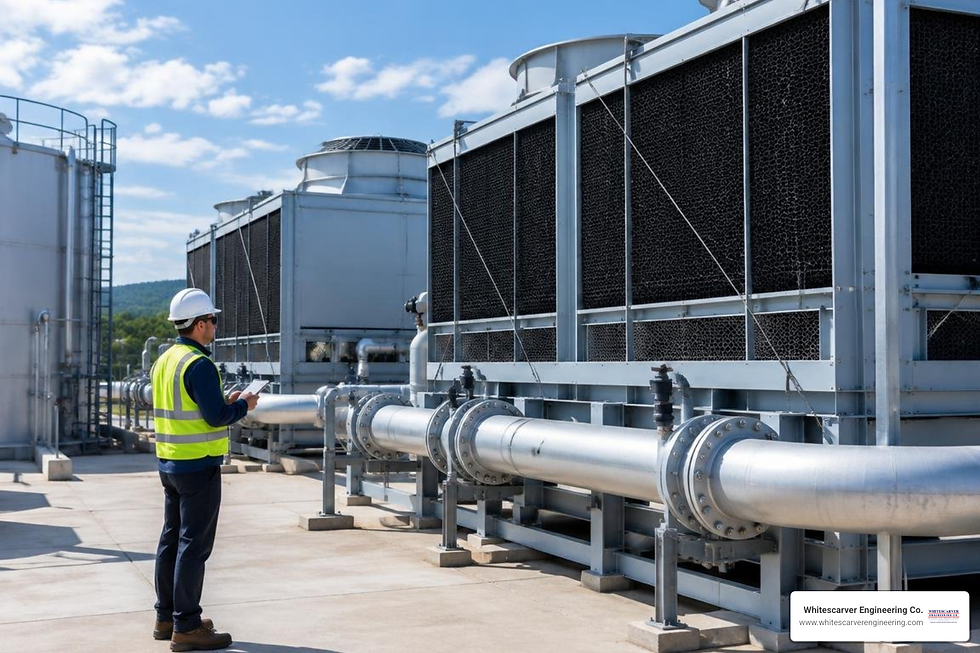
Proper process cooling protects production equipment by matching cooling capacity, fluid flow, and temperature control to the heat your operation creates. For facilities that need industrial process cooling in Roanoke, VA, the practical steps are to monitor supply and return temperatures, maintain clean closed-loop fluid systems, plan backup capacity for critical loads, and inspect pumps, heat exchangers, and controls before they fail. This helps prevent overheating, warped components, seal damage, poor product quality, and unplanned shutdowns during Virginia's hot, humid conditions.
Whitescarver Engineering Company helps industrial facilities throughout Roanoke, Salem, Vinton, and the Blacksburg/Christiansburg corridor design, maintain, and retrofit reliable cooling and refrigeration systems. I am Hugh Joyce, and the next sections explain how to build a cooling strategy that keeps critical equipment protected and production moving.

Understanding How Proper Process Cooling Prevents Equipment Damage and Production Downtime in Virginia Facilities
In manufacturing and heavy processing, heat is an inevitable byproduct of mechanical work, chemical reactions, and electrical power conversion. Without a dedicated thermal management strategy, that heat accumulates rapidly within production machinery. Understanding how process cooling affects manufacturing efficiency begins with recognizing that uncontrolled thermal buildup directly attacks machinery integrity, degrading product tolerances and triggering costly line shutdowns.
When equipment operates above rated thermal thresholds, several destructive failure modes occur simultaneously:
Elastomeric Seal and Gasket Breakdown: Excessive heat hardens and cracks fluoropolymer and nitrile seals, leading to fluid leaks, hydraulic pressure loss, and contamination.
Component Warping and Tolerance Loss: High temperatures cause differential thermal expansion across tool steels, machine beds, and mold platens, destroying precision tolerances.
Lubricant Breakdown: High operating temperatures thin lubricating oils, accelerating mechanical wear and causing bearing seizure.
Electrical Component Burnout: Variable frequency drives (VFDs), automated PLCs, and servo power supplies suffer shortened lifespans or trip out on thermal overload.
By continuously removing excess heat at the exact rate it is generated, stable process cooling protects mechanical assets and ensures uninterrupted plant productivity.
Primary Thermal Risks to Industrial Machinery
The physical stresses caused by insufficient cooling extend deep into internal mechanical and hydraulic assemblies. When looking at how industrial HVAC and refrigeration systems are different from commercial office systems, the primary difference is the sheer density and criticality of the heat load.
Industrial pumps, for example, face severe risk of cavitation when process fluids run too hot. As fluid temperatures climb, vapor pressure increases, forming vapor bubbles at the pump suction inlet that collapse violently against the impeller, eroding the metal. Similarly, hydraulic systems that exceed standard 120°F to 130°F operating thresholds experience severe fluid viscosity breakdown, resulting in erratic valve response, internal cylinder bypassing, and premature pump failure.

Regional Climate Impacts on Thermal Load Management
Facilities across Virginia—from the valley floors of Roanoke and Salem to the mountain terrain of the Blacksburg and Christiansburg corridor—face distinct climatic conditions that complicate heat rejection.

Virginia experiences hot, humid summer conditions with elevated ambient wet-bulb temperatures. Evaporative cooling equipment, such as cooling towers, relies directly on the difference between the ambient wet-bulb temperature and the cooling water temperature. When summer humidity spikes, the evaporative potential of the air drops, reducing cooling tower capacity and driving up process loop supply temperatures.
These ambient swings require robust engineering, including appropriately sized heat rejection equipment, dynamic variable frequency controls, and seasonal economizer loops.
Core Industrial Cooling Technologies and Configurations
Selecting the right cooling method requires matching the operating temperature, heat load, and fluid cleanliness demands of your specific process. Unlike building comfort systems, industrial thermal loops require tight tolerances, 24/7 continuous operation, and tailored fluid dynamics.
Understanding the industrial process cooling vs comfort cooling difference helps plant managers avoid using standard commercial chillers for heavy industrial process loads.
Cooling Technology | Operating Temp Range | Primary Advantage | Best Suited Applications |
Mechanical Chillers (Water/Air-Cooled) | -10°F to 65°F (±0.1°F to 1°F accuracy) | Sub-ambient capability, ultra-tight temperature regulation | Chemical reactors, pharmaceutical synthesis, plastic injection molding |
Closed-Circuit Fluid Coolers | 75°F to 105°F (Approach to wet-bulb) | Isolates process fluid from ambient contamination | Furnace jackets, air compressors, hydraulic power units |
Open Evaporative Cooling Towers | 80°F to 95°F (Approach to wet-bulb) | Highest heat rejection capacity per footprint dollar | Central plant condenser water, large-scale metal cooling |
Direct Contact & Immersion | Sub-ambient to 120°F | Eliminates wall thermal resistance, zero dead zones | Quench tanks, wire drawing, battery manufacturing |
How Proper Process Cooling Prevents Equipment Damage and Production Downtime in Virginia Facilities with Advanced Chiller Designs
Mechanical vapor-compression chillers are the backbone of high-precision thermal control. When processes demand fluid temperatures below the ambient air or wet-bulb temperature, mechanical refrigeration is the only technology that delivers stable, controlled cooling.
Modern industrial installations utilize heavy-duty screw and scroll compressors paired with variable frequency drives (VFDs) to match compressor motor speed directly to changing process loads. Learning how industrial process chillers work shows how closed-loop chillers regulate process fluid within ±0.1°C, preventing thermal cycling shocks to production machinery.
For low-temperature applications, such as chemical synthesis or cold-storage staging, low-charge packaged ammonia chillers provide high thermodynamic efficiency (delivering a full-load COP of 2.49 compared to 2.14 for traditional synthetic refrigerants at 5°F operating temperatures). With charges as low as 1.18 lbs of ammonia per ton of refrigeration, these packaged systems eliminate large refrigerant reservoirs while safeguarding continuous plant uptime.
Water, Evaporative, and Direct Contact Cooling Systems
When process setpoints permit fluid temperatures above ambient wet-bulb conditions (typically 85°F supply water and above), non-chilled water and evaporative systems offer energy-efficient heat dissipation:
Closed-Circuit Fluid Coolers: The process fluid circulates inside a sealed coil bundle while an external water spray and fan drive evaporative cooling over the exterior. This prevents airborne debris, minerals, and biological matter from entering process cooling channels.
Cooling Jackets: Welded around high-temperature process vessels, heat-treating furnaces, and mixing tanks, fluid jackets circulate high-flow water to maintain uniform structural shell temperatures, preventing the thousands of degrees inside a furnace from warping outer steel casings.
Direct Contact and Spray Quenching: Circulating fluids are sprayed directly onto extruded plastics, rolled metals, or submerged parts to rapidly pull heat out through direct surface contact.
Industry-Specific Cooling Challenges and Engineering Strategies
Different manufacturing sectors face unique thermal loads and process parameters. Selecting the right engineering design requires choosing the right process cooling system for your facility based on individual load dynamics.

Chemical and Pharmaceutical Thermal Regulation
Chemical and pharmaceutical production environments in Virginia frequently manage high-heat exothermic reactions, solvent condensation, and active ingredient crystallization. In batch reactors, an uncontrolled thermal spike can ruin entire product batches or create hazardous overpressurization events.
Managing these processes requires a clear understanding of the industrial refrigeration vs commercial refrigeration difference, where systems run sub-zero heat transfer fluids continuously. In sub-freezing applications (such as 5°F glycol loops), fluid selection is critical. Specialized synthetic heat transfer fluids or inhibited ethylene glycol mixtures must be engineered to balance heat transfer rates against fluid viscosity, preventing pump cavitation and ensuring rapid heat extraction from jacketed reactors.
How Proper Process Cooling Prevents Equipment Damage and Production Downtime in Virginia Facilities Across Food and Plastics Lines
In high-speed plastics injection molding and blow molding, cooling accounts for up to 70% to 80% of total cycle time. Molds require steady cooling water (typically around 50°F) to solidify the polymer quickly without part warpage or sink marks.
High-speed tooling runs best with a narrow 2°F temperature differential across the mold faces at high flow rates. However, industrial chillers are designed to operate across a wider 6°F to 10°F delta-T. Coupling molds directly to standard chiller evaporators causes severe short-cycling and erratic temperature control. Decoupled secondary pumping loops resolve this mismatch, delivering high flow to the tooling while maintaining stable delta-T across the chiller.
In dairy and beverage manufacturing, proper process cooling protects product safety. Following thermal pasteurization, dairy products must be chilled below 4°C immediately to stop bacterial growth. Chilling failures halt bottling lines instantly, causing production backlogs and spoiled raw ingredients.
Step-by-Step System Design and Optimization for Continuous Uptime
Achieving continuous industrial uptime requires a cooling system architecture engineered for hydraulic balance, thermal buffer capacity, and mechanical redundancy. Exploring industrial process cooling systems explained provides the foundation for designing high-reliability plant loops.
Decoupled Hydraulic Loops and Redundancy Architecture
The most effective configuration for continuous manufacturing is a decoupled primary-secondary pumping system connected by an open or low-loss header buffer tank.
Chiller (Primary) Loop: Operates dedicated pumps that circulate fluid through chiller evaporators at constant flow rates, ensuring steady heat transfer and preventing evaporator tube freezing.
Buffer Tank: Acts as a thermal flywheel and hydraulic separator, absorbing rapid process load swings and preventing chiller short-cycling.
Process (Secondary) Loop: Utilizes dedicated, VFD-driven distribution pumps to deliver high-velocity fluid out to factory machinery based on real-time process demand.
To ensure uninterrupted operation, critical facilities use N+1 redundancy configurations. By installing dual, identical 50% or 100% capacity chillers with automated lead-lag sequencing, one unit can undergo routine service while the secondary unit carries the process load, eliminating maintenance-related production shutdowns.
Integrating Automated Free Cooling and Variable Frequency Controls
During fall, winter, and early spring in Western and Central Virginia, ambient outdoor temperatures drop well below required process return temperatures. Installing an integrated plate-and-frame heat exchanger alongside the chiller allows facilities to practice "free cooling" (waterside economization).
When ambient wet-bulb temperatures fall low enough, cooling tower water routes directly through the plate heat exchanger to chill the process loop, allowing mechanical chiller compressors to cycle off entirely. Pairing this configuration with VFDs on tower fans and process pumps cuts energy use, reduces compressor run hours, and extends the mechanical service life of critical cooling assets.
Essential Preventative Maintenance and System Monitoring Protocols
Even the best-engineered cooling system will degrade without systematic maintenance. Implementing industrial cooling system maintenance basics keeps fluid loops clean, heat transfer surfaces efficient, and emergency safety devices operational.

Water Treatment and Contamination Management
Water quality issues directly impact cooling system reliability. Unchecked mineral scaling, biological fouling, and corrosion reduce heat transfer efficiency and can cause pipe wall erosion:
Scale Inhibition: Calcium and magnesium scale deposits act as thermal insulators. Just 1/32 of an inch of scale buildup inside chiller tubes can reduce heat transfer efficiency by over 15%, forcing compressors to run hot and drawing higher amperage.
Biological Control: Open cooling towers require automated biocide dosing and regular blowdown cycles to prevent algae, slime, and Legionella bacteria growth from clogging strainer baskets and heat exchanger plates.
Corrosion Protection: Closed-loop glycol systems require regular pH and inhibitor testing. Degraded glycol turns acidic, attacking brass fittings, copper tubes, and pump impellers.
Air-Cooled Condenser Washing: Finned tube bundles on outdoor air-cooled chillers accumulate pollen, dust, and industrial debris, which must be cleaned regularly to prevent high-head-pressure compressor trips during summer heat.
Predictive Sensor Tracking and Automated Failsafes
Modern facilities rely on continuous digital monitoring to identify mechanical anomalies before they lead to catastrophic equipment failure.
Facility managers should review industrial HVAC basics for facility managers to establish predictive monitoring baselines across all critical cooling systems:
Delta-P Transducers: Differential pressure sensors across strainers and plate heat exchangers provide early warning of particulate clogging before flow rates drop.
Vibration Analysis: Accelerometers mounted on screw compressor bearings and main pump motors identify shaft misalignment, bearing spalling, and impeller unbalance weeks before mechanical failure.
Direct Fluid Temperature Tracking: Monitoring supply and return fluid temperatures directly at the production machine provides faster, more accurate process protection than relying solely on compressor suction pressure readings.
Automated Emergency Bypasses: For extreme high-heat operations like vacuum heat-treating furnaces, installing automated city-water bypass valves or nitrogen-powered diaphragm backup pumps guarantees continuous cooling flow during municipal power outages, preventing furnace casing deformation.
Frequently Asked Questions About Industrial Process Cooling
Which Cooling System Is Best for Continuous Manufacturing in Virginia?
For continuous 24/7 manufacturing in Virginia, the most reliable setup is a water-cooled chiller paired with a closed-circuit fluid cooler or cooling tower, configured with N+1 redundancy. This setup provides superior energy efficiency during humid summer months, protects process fluids inside a sealed closed loop, and allows routine maintenance on individual chillers without interrupting plant production lines.
How Does Free Cooling Reduce Operating Stress on Process Equipment?
Free cooling systems use plate-and-frame heat exchangers to transfer process heat directly to cold outdoor air during Virginia's cooler months, allowing mechanical chiller compressors to shut down. This reduces wear and tear on compressor bearings, contactors, and motor windings, cutting seasonal power consumption and extending the overall operating life of your cooling equipment.
What Are the Key Maintenance Steps to Prevent Cooling System Downtime?
Key maintenance steps include:
Conducting quarterly testing of closed-loop glycol inhibitors and open-tower water chemistry.
Pressure-washing air-cooled condenser coils and cooling tower fill before summer peak loads arrive.
Checking pump alignment and recording motor operating amperages.
Inspecting and cleaning all inline strainers and heat exchanger plates.
Verifying temperature and pressure transducer calibration along with emergency flow bypass operations.
Keep Your Process Cooling Systems Running Reliably
Uncontrolled process heat leads to equipment damage, out-of-spec production runs, and costly unscheduled downtime. Protecting your plant requires matching cooling capacity directly to operational heat loads, maintaining clean closed-loop fluid dynamics, and implementing redundant, well-monitored equipment configurations tailored to Virginia's climate.
Whitescarver Engineering Company is a commercial and industrial HVAC and refrigeration service firm based in Roanoke, VA, operating since 1937. With over 75 years of engineering experience and BBB A+ accreditation since 1974, our team specializes in installing, maintaining, and retrofitting large-scale HVAC systems, industrial process systems, refrigeration engineering and design, and energy-conservation solutions. We serve businesses throughout Roanoke, Salem, Vinton, and the Blacksburg/Christiansburg corridor with custom industrial projects, energy-reduction strategies, scheduled maintenance agreements, and 24/7 emergency service for commercial and industrial operations.
Contact Whitescarver Engineering Company today to schedule a comprehensive process cooling evaluation and safeguard your facility against unplanned production downtime.


Comments