
In Depth Guide to Industrial vs Commercial HVAC and Refrigeration Systems in Roanoke, VA
Industrial vs. Commercial HVAC and Refrigeration in Roanoke, VA

How industrial HVAC and refrigeration systems are different from commercial office systems comes down to purpose: office systems keep people comfortable, while industrial systems must also protect production, equipment, materials, and safety. For facility managers in Roanoke, VA, that difference affects system size, controls, ventilation, and reliability. Commercial office HVAC usually responds to occupancy and weather. Industrial HVAC and refrigeration may run around the clock, manage machinery heat, control humidity, remove contaminants, or maintain process temperatures. Whitescarver Engineering Company supports businesses that need dependable large-scale HVAC, refrigeration, and process-system performance.
Explore Commercial HVAC Systems | Contact Whitescarver Engineering Company
System type | Main purpose | Typical design priority |
Commercial office HVAC | Occupant comfort and indoor air quality | Flexible zoning, efficient comfort cooling, and ventilation |
Industrial HVAC and refrigeration | Process control, equipment protection, and safety | High capacity, contaminant control, precise conditions, and continuous reliability |
I’m Hugh Joyce, and the next sections explain the practical design and operating differences facility teams need to consider.

For commercial or industrial system support in Roanoke, Salem, Vinton, or the Blacksburg/Christiansburg corridor, contact Whitescarver Engineering Company.
How Industrial HVAC and Refrigeration Systems Are Different From Commercial Office Systems

When we evaluate how industrial hvac and refrigeration systems are different from commercial office systems, the fundamental distinction lies in their primary operational goals. Commercial office HVAC systems exist to provide human comfort cooling, fresh air ventilation, and basic climate regulation for employees and visitors. In contrast, industrial systems are engineered to serve heavy manufacturing equipment, precise chemical operations, cold chain logistics, and specialized production environments where temperature or humidity fluctuations can ruin product yield or halt production entirely.

Operational Feature | Commercial Office Systems | Industrial Process & Refrigeration Systems |
Primary Focus | Human occupant comfort & indoor air quality | Equipment cooling, process stability, cold storage, & environmental safety |
Operating Hours | Scheduled (typically 8–12 hours daily, 5–6 days a week) | Continuous (24/7/365 uninterrupted operation) |
Load Profile | Steady, predictable, weather- and occupancy-driven | Dynamic, shifting rapidly with production cycles and machinery heat |
System Capacity | Modest tonnage split across discrete zones | Massive cooling capacity with dedicated fluid loops or heavy chillers |
Air Exchange & Filtration | Standard MERV filters for dust and pollen | High air exchange rates, HEPA, scrubbers, and exhaust hoods |
Refrigerants Used | Standard HFCs/HFOs (e.g., R-410A, R-32, R-454B) | Industrial-grade systems, anhydrous ammonia (R-717), CO2, or glycol loops |
Understanding the Industrial Process Cooling vs Comfort Cooling Difference helps facility managers recognize why off-the-shelf commercial equipment cannot simply be scaled up to meet industrial demands. Industrial facilities experience intense heat generation from variable frequency drives (VFDs), heavy machinery, and automated processing lines. While a commercial office system scales down during nights and weekends, an industrial refrigeration loop must maintain rock-solid temperatures without pause, regardless of external ambient conditions.
Capacity and Operational Goals: How Industrial HVAC and Refrigeration Systems Are Different From Commercial Office Systems
The capacity demands placed on industrial mechanical infrastructure dwarf typical commercial configurations. Commercial office spaces usually require air conditioning systems that address external solar heat gain, building envelope conductive losses, and human body heat. Industrial plants, however, must manage massive internal thermal loads created by industrial friction, molten metal processing, chemical reactions, or intensive server clusters.
This level of thermal output requires higher tonnage and rapid air exchange rates. Maintaining operational stability requires process cooling systems that react instantly to dynamic manufacturing loads. Learn more about How Process Cooling Affects Manufacturing Efficiency to see how precision mechanical engineering keeps production lines operating at peak yield without overheating critical machinery.
Equipment Scale and Infrastructure Needs
To handle these heavy thermal burdens, the physical equipment used in industrial environments is substantially larger and far more rugged than standard office equipment. Commercial offices generally rely on packaged rooftop units (RTUs), variable refrigerant flow (VRF) systems, or standard air-handling units hidden inside ceiling voids or small mechanical closets.
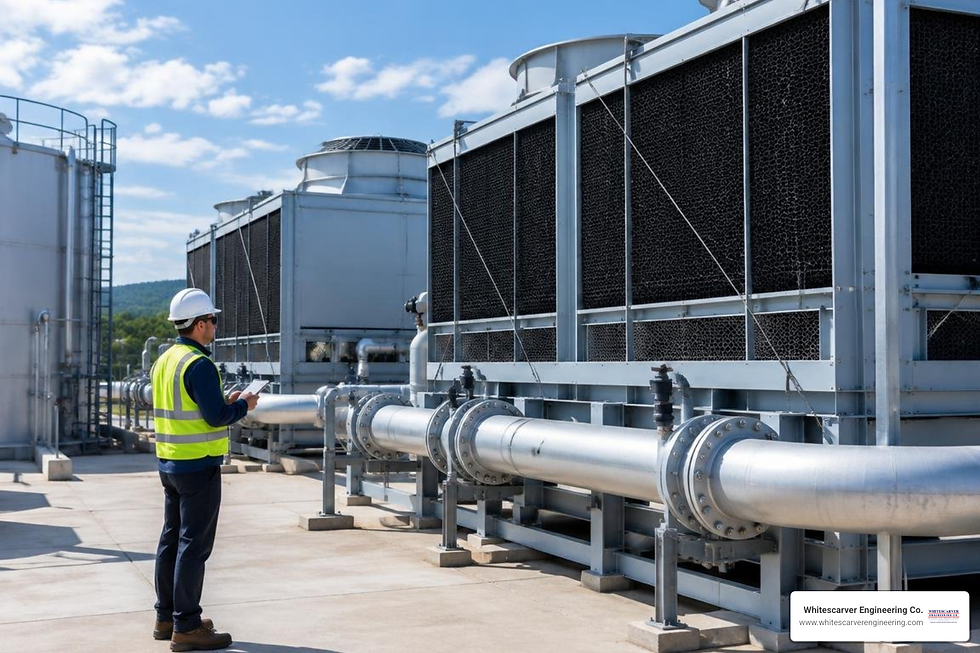
Industrial operations utilize heavy-duty chillers, industrial cooling towers, large-capacity custom air handlers, and specialized piping infrastructure designed to move hundreds or thousands of gallons of conditioned fluid per minute. Our team at Whitescarver Engineering Company designs and builds integrated Industrial Process Systems engineered to withstand heavy mechanical vibration, extreme thermal stress, and harsh operating environments.
Comparing Equipment Types in Commercial vs. Industrial Facilities
Selecting the right mechanical architecture requires matching equipment capabilities with the precise environmental demands of your building. Commercial buildings focus heavily on flexible interior space utilization and quiet operation, whereas industrial sites demand structural durability, corrosion protection, and massive heat rejection capacity.
Commercial Office Systems: Focus on Tenant Comfort and Flexibility
Commercial office buildings require equipment configurations that can adapt to varying floor layouts, tenant density, and individual office preferences. Modern office facilities rely on a range of flexible mechanical setups:
Single-Split Systems: Ideal for individual office suites, server rooms, or small commercial storefronts, offering independent temperature control for small, dedicated spaces.
Multi-Split Systems: Connect several indoor air handlers to a single outdoor condensing unit, allowing distinct temperature settings across multiple offices without extensive ductwork.
Variable Refrigerant Flow (VRF) Systems: Advanced systems that dynamically vary the flow of refrigerant to individual zones. VRF systems deliver exceptional energy efficiency and localized comfort, making them popular for corporate office spaces.
Packaged Rooftop Units (RTUs): Self-contained heating and cooling units mounted on the roof that deliver conditioned air through overhead duct networks across wide open office floors.
For building managers evaluating options, our Commercial HVAC Systems division provides full life-cycle guidance. You can also consult our Commercial HVAC System Type Guide for Building Owners and our comprehensive How Commercial HVAC Systems Work Guide to understand how multi-zone comfort controls keep utility expenses under control.
Industrial Systems: Heavy Cooling and Process Refrigeration
Industrial mechanical installations move far beyond standard air handling to encompass heavy thermal management and low-temperature refrigeration. Common industrial configurations include:
Industrial Process Chillers: High-tonnage water-cooled or air-cooled chillers built to supply chilled water or specialized secondary fluids directly to manufacturing machinery, heat exchangers, or jacketed tanks.
Ethylene & Propylene Glycol Loops: Secondary fluid loops that introduce glycol to prevent fluid freezing, inhibit internal pipe corrosion, and safely absorb high heat loads across expansive manufacturing footprints.
Industrial Ammonia Refrigeration: Large-scale centralized refrigeration systems using anhydrous ammonia (R-717) or transcritical carbon dioxide (CO2) for high-efficiency cold storage warehouses, food processing facilities, and blast freezing plants.
Heavy Industrial Air Handlers: Custom-engineered air handling units constructed with thick-gauge steel, protective anti-corrosion coil coatings, and high-efficiency filtration to manage heavy dust, fumes, and intense moisture loads.
To dive deeper into the mechanics of heavy liquid chilling, read How Industrial Process Chillers Work. For a complete breakdown of cold storage, read our guide on the Industrial Refrigeration vs Commercial Refrigeration Difference.
Design Challenges and Environmental Factors in Industrial Environments
Engineers face vastly different design challenges when building industrial mechanical systems compared to standard commercial office spaces. While office design prioritizes acoustics, visual integration, and occupant energy metrics, industrial environments require heavy-duty engineering capable of operating under aggressive conditions.
Heat Loads, Contaminants, and Indoor Air Quality
Industrial plants present severe environmental risks that require specialized mechanical mitigation. Airborne contaminants like metal dust, volatile organic compounds (VOCs), oil mist, and acid fumes can ruin mechanical coils, corrode standard copper tubing, and create dangerous workplace environments if not managed correctly.
To handle these conditions, industrial systems incorporate heavy exhaust hoods, multi-stage filtration, chemical scrubbers, and specialized protective coatings (such as epoxy or phenolic coil treatments). Our team reviews these extreme operating conditions during early Engineering Design to ensure every component withstands local plant conditions. For additional practical insights, read our reference on Industrial HVAC Basics for Facility Managers.
Regulatory and Environmental Factors: How Industrial HVAC and Refrigeration Systems Are Different From Commercial Office Systems
Compliance demands for industrial facilities are far more complex than those governing commercial offices. While commercial office spaces follow standard local building codes and basic ASHRAE ventilation rules (such as ASHRAE 62.1 and 90.1), industrial facilities must satisfy rigorous safety and environmental mandates:
ASHRAE Standard 15: Governs safety protocols for refrigeration systems, mandating mechanical room leak detection, emergency ventilation, and containment procedures.
ASHRAE Standard 90.4: Establishes energy efficiency requirements specifically for mission-critical data centers and high-density computing rooms.
OSHA Chemical Process Safety Management (PSM): Regulates facilities handling threshold quantities of hazardous chemicals, including industrial anhydrous ammonia systems.
EPA Section 608 & Secondary Containment: Enforces strict leak detection, recordkeeping, and spill-containment measures for industrial glycol loops and large refrigerant charges.
Meeting these stringent regulatory standards requires working with an experienced Industrial Refrigeration Engineering Design Contractor in Roanoke VA who understands both mechanical engineering and compliance enforcement across Virginia.
Maintenance, Redundancy, and Automation Controls
Because industrial systems support continuous manufacturing and cold storage lines, an unplanned mechanical shutdown can cost thousands of dollars per hour in lost productivity or spoiled inventory. As a result, the maintenance, redundancy strategies, and control architectures used in industrial plants are vastly different from those found in standard office buildings.
System Redundancy and Reliability Standards
In a commercial office, if a rooftop unit fails over the weekend, repairs can often wait until normal business hours with minimal impact on business operations. In an industrial or cold storage setting, system failure is a critical operational emergency.
Industrial systems use built-in redundancy strategies, such as N+1 or N+2 configurations. This ensures that if a primary chiller, pump, or compressor fails, backup units automatically start without interrupting production. Protecting these investments requires structured maintenance agreements and routine technical inspections from specialized technicians. Facility teams can explore our detailed Industrial Commercial Refrigeration Roanoke Guide to learn how proactive servicing prevents catastrophic downtime.
Control Complexity and BMS Integration
Both commercial offices and industrial facilities benefit from central automation, but their control strategies are fundamentally different. Commercial controls emphasize occupant comfort scheduling, outdoor air economizers, and simple zone thermostat adjustments.
Industrial controls integrate directly with manufacturing execution systems (MES), programmable logic controllers (PLCs), and facility-wide Building Automation Systems (BAS). These systems adjust refrigerant flow, pump speeds, and air balance in real time based on active manufacturing lines.

Understanding What is a Building Automation System reveals how advanced sensor arrays track system metrics to catch mechanical stress early. Furthermore, learning How Building Automation Systems Save Energy helps facility managers lower operational costs while maintaining full system output. To explore our custom control solutions, visit our Commercial Industrial Controls page.
Frequently Asked Questions
What is the primary operational difference between industrial HVAC and commercial office HVAC?
The primary operational difference lies in their purpose and operating profiles. Commercial office HVAC focuses on occupant comfort, indoor air quality, and seasonal energy efficiency during standard business hours. Industrial HVAC and refrigeration systems prioritize process cooling, equipment heat removal, strict relative humidity control, airborne contaminant extraction, and continuous 24/7/365 operation under dynamic heat loads generated by manufacturing machinery.
Why do industrial refrigeration systems require distinct safety protocols compared to commercial office systems?
Industrial refrigeration systems often utilize specialized refrigerants like anhydrous ammonia (R-717) or large-charge carbon dioxide (CO2) systems, which operate under extreme pressure or carry toxicity and flammability risks. Consequently, industrial installations are subject to strict regulatory oversight, including ASHRAE Standard 15, EPA Section 608 secondary containment rules, and OSHA Chemical Process Safety Management (PSM) guidelines to ensure worker safety and prevent environmental releases.
How does equipment lifespan vary between commercial office and heavy industrial HVAC systems?
Commercial office HVAC systems (such as packaged RTUs, split systems, and VRF equipment) generally have an expected operating lifespan of 10 to 25 years, depending on the system type and maintenance quality. Heavy industrial mechanical equipment is built with heavier structural components designed for severe operating demands; however, because industrial equipment operates under intense continuous loads, extreme temperatures, and harsh contaminants, component wear is significantly higher. Rigorous preventive maintenance agreements and ongoing technical servicing are essential to extending industrial mechanical life and avoiding costly premature replacements.
Conclusion
Understanding how industrial hvac and refrigeration systems are different from commercial office systems is essential for building owners, plant managers, and facility directors who want to protect their mechanical investments and keep operations running efficiently. While commercial office spaces thrive on flexible multi-zone comfort controls, industrial facilities demand high-capacity heat rejection, robust process cooling, strict contamination control, and uncompromised system redundancy.
At Whitescarver Engineering Company, we have been helping regional businesses solve complex mechanical challenges since 1937. Serving commercial and industrial clients throughout Roanoke, Salem, Vinton, and the Blacksburg/Christiansburg corridor, our team brings decades of local experience to every project. As a BBB A+ accredited firm since 1974, we specialize in installing, maintaining, and retrofitting large-scale commercial HVAC systems, custom industrial process systems, complex refrigeration engineering and design, and advanced energy-conservation solutions.
Whether you need tailored maintenance agreements, custom industrial HVAC project design, energy cost reductions, or dependable 24/7 service for commercial systems, our experienced engineering and field teams deliver B2B service reliability you can depend on.
To discuss your facility's mechanical, process cooling, or building automation requirements with our expert team, explore our Engineering Design services or contact Whitescarver Engineering Company today.


Comments