
Everything You Need to Know About Refrigeration System Design's Impact on Energy and Maintenance Costs
Why Refrigeration System Design Determines Long-Term Performance

Facility managers in Roanoke, VA can reduce energy use, service disruptions, and long-term maintenance demands by making refrigeration system design decisions before equipment is installed. The most important steps are to right-size compressors and evaporators, select a refrigerant with a viable compliance path, build in N+1 redundancy, and use controls that keep equipment efficient at part load. For large commercial and industrial facilities, refrigeration system design also should account for heat rejection, leak detection, safe access for service, and future production changes. Whitescarver Engineering Company helps industrial operations plan refrigeration systems that support reliable temperature control and efficient operation.
A well-designed system avoids oversized equipment that short-cycles, lowers compressor lift through proper evaporator and condenser sizing, and uses staging to match real demand. Features such as water-side economizers, variable-speed pumps, and predictive controls can further reduce compressor run time while helping maintenance teams spot fouling, leaks, and performance drift early.
I'm Hugh Joyce, and this guide explains the design choices that shape refrigeration energy use, reliability, and maintenance needs over the life of your facility.

How Refrigeration System Design Affects Long-Term Energy and Maintenance Costs Across Facility Lifecycles
In process-intensive manufacturing and cold chain distribution, cooling infrastructure typically accounts for 30% to 50% of total facility electrical consumption. Over a typical 20-year service life, electricity alone can represent up to 90% of a cooling plant's total lifecycle cost. The initial mechanical layout determines whether a plant runs at a high-efficiency benchmark of 0.5 to 0.6 kW/ton or consumes excess power at 1.0 to 1.2 kW/ton.
Understanding what is commercial refrigeration engineering design and when do you need it ensures your facility balances baseline capital expenses with decades of operational performance. Engineering decisions made during the initial design phase dictate part-load efficiency, seasonal flexibility, and total equivalent warming impact (TEWI).
Design Parameter | Decentralized Direct-Expansion (DX) Systems | Centralized Natural Cascade (NH3/CO2) Systems |
Typical Efficiency (COP) | 2.0 – 2.4 | 3.2 – 3.6+ (up to 54% improvement) |
Part-Load Turndown | Limited step-control; higher cycling | Broad continuous modulating via VFDs |
Refrigerant Charge & GWP | High synthetic charge; high GWP liability | Low ammonia charge (machinery room only); GWP ≤ 1 |
Compressor Overhaul Interval | 20,000 – 30,000 operating hours | 50,000+ operating hours (rotary screw) |
Maintenance Profile | Distributed failure points across rooftop/coils | Centralized machinery room; simplified monitoring |
Examining How Refrigeration System Design Affects Long-Term Energy and Maintenance Costs Through Component Sizing
System oversizing remains one of the costliest procurement mistakes in industrial facilities. When safety margins, unconfirmed expansion estimates, and extreme ambient fouling factors are compounded, cooling capacity is frequently inflated by 15% to 40%. Because peak cooling loads occur during only 5% to 10% of annual operating hours, an oversized compressor operates in inefficient part-load states for over 90% of its working life.
This mismatch causes severe compressor short-cycling. Frequent starting and stopping draws heavy inrush currents and causes rapid thermal and electrical stress on motor windings, contactors, and internal valves. Having industrial process cooling systems explained from a diversified load perspective helps plant operators avoid component oversizing, prevent premature mechanical failure, and maintain optimal lubrication across the system.

Thermodynamic Balancing and Evaporator Temperature Management
Thermodynamic balance across the evaporator and compressor suction directly governs electrical draw. Sizing larger evaporators allows the system to operate at higher saturated suction temperatures (SST), which reduces the compression ratio. Lowering the compression ratio minimizes required compressor shaft power while increasing refrigeration effect.
Reviewing how different types of commercial refrigeration systems explained perform highlights the necessity of precise superheat management. Calibrating electronic expansion valves to maintain stable, useful superheat (typically 5K to 10K) prevents unevaporated liquid refrigerant from returning to the compressor while avoiding high discharge temperatures that break down lubrication oils.
Refrigerant Selection and Cascade Architectures for Operational Reliability
Refrigerant selection establishes both regulatory risk and thermodynamic boundaries. With tightening phasedowns on synthetic hydrofluorocarbons (HFCs), evaluating how refrigerant phase out affects commercial refrigeration systems in Virginia facilities is critical for long-term operational planning. High-GWP synthetic refrigerants face supply constraints, rising replacement costs, and compositional glide issues after leaks.
Natural refrigerants, such as ammonia (R717) and carbon dioxide (R744), offer stable alternatives with zero ozone depletion potential and near-zero global warming impact. Pairing ammonia on the high-temperature stage with carbon dioxide on the low-temperature freezing stage leverages the superior heat transfer coefficients and low pumping viscosity of both fluids.
How Refrigeration System Design Affects Long-Term Energy and Maintenance Costs in Multi-Temperature Facilities
Multi-temperature operations—such as cold storage warehouses managing medium-temperature dock spaces alongside low-temperature blast freezers—gain substantial operational advantages from centralized cascade systems. Transitioning from legacy synthetic setups to an NH3/CO2 cascade architecture can lower absorbed electrical power by over 35% while increasing the overall Coefficient of Performance (COP) from 2.11 to 3.26.
Choosing the right process cooling system for your facility often involves implementing flooded evaporator designs with dedicated liquid separators. Flooded liquid overfeed regimes ensure complete internal tube wetting, delivering superior heat transfer rates compared to direct expansion systems and cutting the run time needed for intensive batch-cooling processes.
Safety Standards and Regulatory Charge Thresholds
Designing industrial refrigeration infrastructure requires balancing thermodynamic output with compliance frameworks like ASHRAE 15 and IIAR standards. Refrigerant charge size directly determines administrative overhead. In industrial facilities, keeping the total ammonia charge isolated to mechanical rooms and below the 10,000-pound regulatory threshold avoids mandatory OSHA Process Safety Management (PSM) and EPA Risk Management Plan (RMP) compliance programs.
Deploying low-charge ammonia chillers paired with secondary glycol or CO2 distribution loops protects plant personnel, streamlines compliance overhead, and provides advanced leak detection safeguards across occupied spaces.
Advanced Mechanical Configuration and Heat Rejection Strategies
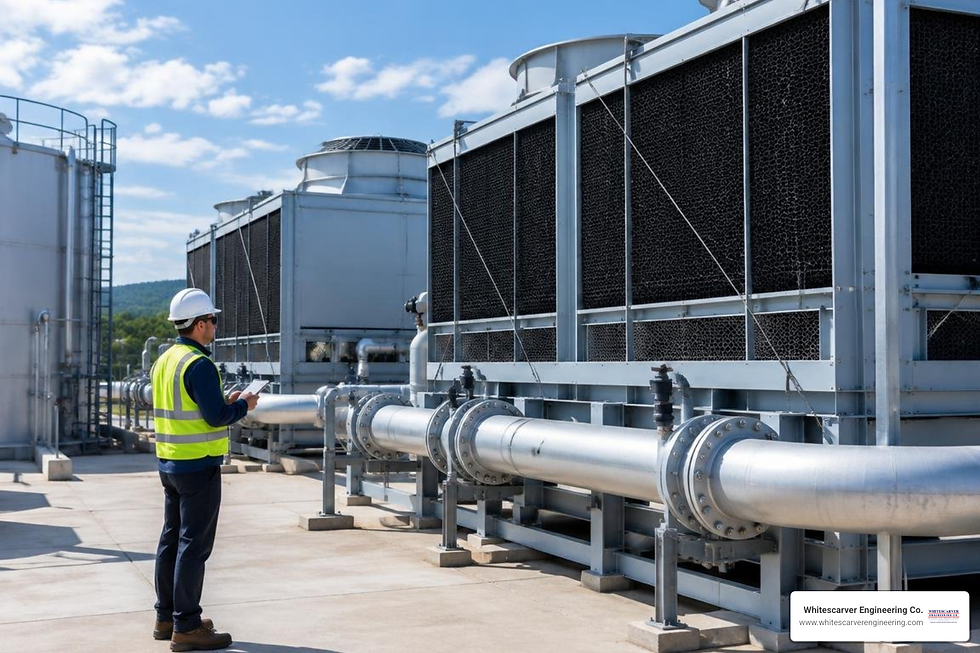
Optimizing heat rejection systems is essential for minimizing compressor lift. Integrating water-side economizers allows cooling towers to reject process heat directly into the chilled water loop whenever ambient wet-bulb temperatures drop. Learning how industrial process chillers work alongside economizer loops helps engineering teams capture 1,200 to 2,500 hours of compressor-free cooling annually in temperate climates.
Complementing economizers with variable primary flow (VPF) pumping yields additional electrical savings. Under affinity laws, reducing pump motor speed by just 10% reduces pump power draw by approximately 27%, cutting auxiliary power across the plant.
Redundancy Architectures and Modular Staging
Designing for business continuity does not require installing an oversized 100% duty standby unit that sits idle. A modular 3 x 50% capacity (N+1) redundancy configuration provides superior operational reliability and energy performance:
Rapid Load Matching: Multi-compressor staging ensures individual screw units operate within their peak efficiency sweet spot (typically 60% to 80% load).
Fast Failure Response: Warm-standby machines can ramp up within 90 to 120 seconds, preventing temperature spikes in sensitive holding chambers.
Balanced Mechanical Wear: Automated PLC lead-lag rotation equalizes operating run hours across all machines, extending major overhaul intervals beyond 50,000 operating hours.
Waste Heat Recovery and Defrost Optimization
Industrial screw compressors reject significant thermal energy through oil coolers and discharge lines. Capturing this discharge heat into a closed-loop glycol system delivers usable thermal energy for sub-floor freeze protection grids, space heating, and clean-in-place (CIP) washdown water.
Applying energy conservation strategies for commercial buildings includes moving away from time-clock electric defrost cycles. Installing demand-based defrost controls—which monitor air pressure drop across evaporator coil fins—initiates defrosting only when frost accumulation occurs. Supplying waste compressor heat or warm glycol to coils during defrost eliminates high-draw electric resistance heaters, protecting plant energy budgets.
Smart Automation and Long-Term Preventative Maintenance
Automated control systems provide continuous optimization by adjusting setpoints in real time based on operating conditions. Modern refrigeration control architectures utilize sensor telemetry—including suction pressure, flow rates, approach temperatures, and motor power—to calculate kW/ton performance dynamically. Dynamic control can reset chilled fluid setpoints upward during mild weather, delivering a 3% to 8% efficiency improvement for every 2°F reduction in lift.
Following an ultimate commercial refrigeration maintenance guide ensures that automation sensors, transducers, and mechanical linkages remain properly calibrated over time.
Extending Compressor Service Intervals Through Predictive Monitoring
Integrating predictive diagnostics shifts plant upkeep from reactive repairs to condition-based servicing. Applying modern commercial refrigeration maintenance tips 2026 involves monitoring critical operating health indicators:
Continuous Vibration Analysis: Detects early bearing race wear, rotor unbalance, or shaft misalignment weeks before physical damage occurs.
Spectrometric Oil Analysis: Measures acid formation, moisture content, and wear metals to identify internal friction and maintain proper lubrication viscosity.
Heat Exchanger Approach Tracking: Identifies condenser tube scaling or biological fouling early, preventing high head pressure spikes and excessive power consumption.
Frequently Asked Questions
How does equipment sizing impact annual maintenance schedules?
Oversized refrigeration systems frequently short-cycle under partial loads, causing excessive wear on compressor contactors, motor windings, and internal valves. This rapid cycling increases mechanical vibration and oil foaming, requiring more frequent oil changes, electrical contact replacements, and valve inspections compared to right-sized, variable-speed systems.
What is the operational difference between direct expansion and liquid recirculation?
Direct expansion (DX) systems feed high-pressure liquid through an expansion valve directly into the evaporator, relying on suction pressure to draw refrigerant back. Liquid recirculation (overfeed) systems pump low-pressure liquid refrigerant at rates 3 to 4 times the evaporation rate through flooded coils. This eliminates dry spots, improves heat transfer efficiency, stabilizes multi-room temperature control, and lowers operating costs in large facilities.
Why are natural refrigerants preferred for long-term compliance?
Natural refrigerants such as ammonia (R717) and carbon dioxide (R744) have zero ozone depletion potential and global warming potential ratings of 1 or less. Because they are environmentally benign, naturally occurring substances, they are exempt from F-gas phase-down schedules, quota restrictions, and refrigerant transition mandates, safeguarding facilities against future supply shortages.
Partner With Industrial Refrigeration Engineering Specialists
Optimizing refrigeration system design requires balancing thermodynamic performance, mechanical layout, safety compliance, and proactive maintenance strategies. Whitescarver Engineering Company is a commercial and industrial HVAC and refrigeration service firm based in Roanoke, VA, operating since 1937. With over 75 years of technical field experience, we specialize in installing, maintaining, and retrofitting large-scale HVAC systems, industrial process systems, refrigeration engineering and design, and energy-conservation solutions.
We engineer custom industrial HVAC projects, execute comprehensive maintenance agreements, and deliver 24/7 service for commercial clients across the region. Whitescarver Engineering Company serves businesses throughout Roanoke, Salem, Vinton, and the Blacksburg/Christiansburg corridor. Contact our engineering team today to review your cooling infrastructure and discover how engineered refrigeration designs protect your long-term operating bottom line.


Comments