
The Ultimate Guide to Industrial Cooling System Maintenance Basics
Why Industrial Cooling System Maintenance Basics Determine Your Uptime — and Your Bottom Line

Industrial cooling system maintenance basics are the foundation of reliable operations for any facility running process cooling, refrigeration, or large-scale HVAC equipment. If your cooling system fails unexpectedly, you are not just dealing with a repair bill — you are looking at 1.5 to 3 days of unplanned downtime and thousands of dollars in lost production.
Here is what every facility manager needs to know at a glance:
Inspect daily: Check temperatures, pressures, and unusual sounds during morning walkthroughs
Lubricate bearings on schedule: Every 1,000 hours for induced draft units; every 2,000 hours for forced draft units
Control water quality: Keep bleed-off rates at or below 3 US GPM per 100 tons and manage pH carefully
Watch airflow: Dirty coils and clogged filters can cut system efficiency by up to 15 percent
Follow seasonal protocols: Flush basins at spring startup; use basin heaters and minimum 50% fan speed during subfreezing weather
Know when to call a pro: Refrigerant leaks, electrical faults, and dynamic fan balancing are not DIY tasks
Apply the 1-3-5 Rule: Every $1 spent on planned maintenance saves $3 in repairs and $5 in avoided downtime
The stakes are highest for facilities in Virginia's manufacturing, food processing, and industrial sectors, where cooling systems run hard, year-round, in demanding conditions. Small maintenance gaps compound quickly into major failures — and by the time you notice a problem, it is often already expensive.
I'm Hugh Joyce, and in this guide I'll walk you through everything you need to keep your industrial cooling systems running at peak performance, from routine inspection schedules to advanced predictive maintenance strategies.

Core Components of Industrial Process Cooling

Before diving into the daily and monthly checklists, we must understand the core machinery keeping your facility at the correct temperature. Industrial cooling is a broad category, but most systems rely on a combination of water-evaporative cooling and mechanical refrigeration.
Understanding how these components interact is key to executing proper industrial cooling system maintenance basics. For a deeper dive into these setups, you can read our guide on Industrial Process Cooling Systems Explained and learn more about How Industrial Process Chillers Work. Choosing the right setup is critical, which we cover in Choosing the Right Process Cooling System for Your Facility.
Cooling Towers and Evaporative Condensers
Cooling towers reject heat by utilizing the evaporative cooling properties of water. Warm process water is pumped to the top of the tower, distributed across the fill media (which maximizes the surface area of the water), and exposed to airflow driven by massive fan systems.
Key subcomponents include:
Fill Media: The PVC or polypropylene structured sheets that facilitate heat transfer.
Drift Eliminators: Baffles that prevent water droplets from escaping the tower into the surrounding air.
Cold Water Basin: The collection pan at the bottom of the tower that holds the cooled water before it is pumped back to the facility.
Fan Drive Systems: Comprising the motor, belts or gears, and fan blades that draw or force air through the tower.
Industrial Chillers and Refrigeration Loops
While cooling towers use ambient air and evaporation, industrial chillers use a closed mechanical loop driven by the vapor-compression cycle. This cycle relies on a circulating refrigerant to absorb heat from process fluids and reject it elsewhere.
The primary components of this loop are:
Compressors: The heart of the refrigeration cycle, raising the pressure and temperature of the refrigerant gas.
Evaporators: Where the cold liquid refrigerant absorbs heat from the process fluid, turning the refrigerant into a gas.
Condensers: Where the hot refrigerant gas rejects its heat to water (from a cooling tower) or ambient air, turning back into a liquid.
Expansion Valves: Precision devices that drop the pressure of the liquid refrigerant, cooling it instantly before it re-enters the evaporator.
Maintaining the proper refrigerant charge and keeping these heat exchangers free of scale is vital. To understand how these heavy-duty systems differ from standard commercial cooling, see our breakdown on the Industrial Refrigeration vs Commercial Refrigeration Difference.
Mastering Industrial Cooling System Maintenance Basics
A structured PM program does not just prevent catastrophic failures; it directly protects your operating budget. In fact, scheduled maintenance helps extend the life of chillers to 25+ years compared to a 15-year average for neglected machinery.
To build a reliable schedule, we recommend checking out our comprehensive resources on How to Maintain Commercial HVAC Systems and downloading the Commercial HVAC Maintenance Checklist for Facility Managers.
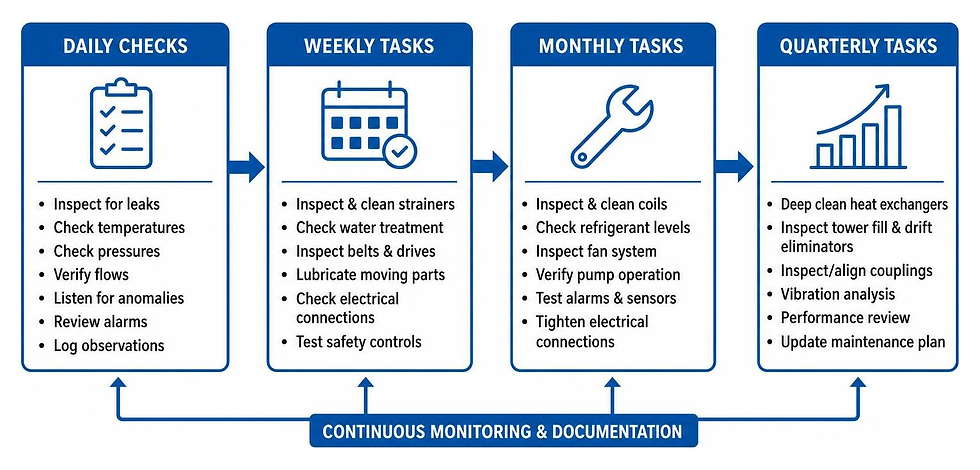
Daily and Weekly Industrial Cooling System Maintenance Basics
Your operators are the first line of defense. Daily visual walkthroughs and logbook documentation are critical to spotting deviations before they trigger high-temperature alarms.
Record Temperature Differentials: Compare entering and leaving water temperatures across chillers and cooling towers.
Log System Pressures: Monitor refrigerant suction and discharge pressures, as well as water pump pressures.
Listen for Anomalies: Train operators to identify weird noises, such as grinding fan bearings or squealing belts.
Inspect Basins and Strainers: Check for visible debris or sludge buildup in the cooling tower basin.
Catching these signs early is the difference between a minor adjustment and an emergency shutdown. Read more on how this proactive approach saves money in Preventive Maintenance vs Reactive Repairs Commercial HVAC.
Monthly and Quarterly Industrial Cooling System Maintenance Basics
At these intervals, maintenance tasks shift toward mechanical adjustments and deep cleaning. For a detailed timeline, consult our HVAC Maintenance Frequency Guide 2026.
Lubricate Fan Shaft Bearings: To prevent friction and premature wear, lubricate fan shaft bearings every 1,000 hours of operation (or every three months) for induced draft units. For forced draft units, lubricate every 2,000 hours of operation (or every six months).
Inspect and Adjust Belt Tension: Check belt tension quarterly. A properly tensioned belt should deflect approximately 1/2 inch when moderate pressure is applied midway between the sheaves. New belts must be readjusted after the first 24 hours of operation under thermal load.
Clean and Replace Air Filters: Change air filters monthly to prevent airflow restrictions. Airflow problems can reduce your system's efficiency by up to 15 percent and strain your fan motors.
Verify Motor Start Limits: Ensure your control systems restrict fan motors to a maximum of six (6) start/stop cycles per hour to prevent motor overheating.
Water Quality, Treatment, and Chemistry Control
Because evaporative cooling towers constantly evaporate pure water, the dissolved solids left behind become increasingly concentrated. Without strict chemistry control, this leads to rapid scale formation, accelerated corrosion, and dangerous biological growth, including Legionella bacteria.
To maintain system integrity and comply with risk management guidelines like ASHRAE Standard 188, keep your water chemistry within these target parameters:
Conductivity: Maintain between 1500 and 2500 µS/cm.
Recirculating Water pH: Maintain between 8.0 and 8.8 for standard operation. However, during the passivation period for newly installed galvanized steel, the pH must be maintained above 7.0 and below 8.0 at all times to prevent white rust.
Makeup Water Pressure: Maintain the mechanical makeup valve pressure between 20 and 50 PSIG.
Bleed-Off Rates: Set the maximum bleed-off rate to no more than 3 US GPM per 100 tons of cooling capacity to control dissolved solids while conserving water.
Biocide Treatment: When treating with sodium hypochlorite (chlorine), maintain 4 to 5 mg/l (ppm) of free chlorine over a six-hour period at a pH of 7.0 to 7.6.
Neglecting water quality ruins heat transfer surfaces, forcing your compressors to work harder and driving up utility bills. Learn more about how scale and poor water quality impact your bottom line in How Process Cooling Affects Manufacturing Efficiency.
Signs of Wear, Failure, and Professional Intervention
Knowing what your in-house team can handle versus when you need to call a specialized industrial contractor is key to safe, cost-effective plant management.
Maintenance Task | Operator DIY | Professional Technician |
Monthly Air Filter Replacement | ✓ | |
Daily Logbook & Visual Inspection | ✓ | |
Basin Cleaning & Strainer Flushing | ✓ | |
Refrigerant Leak Detection & Repair | ✓ | |
Dynamic Fan Blade Balancing | ✓ | |
Electrical Terminal Torque & Megger Testing | ✓ | |
Complex Chemical Pump Calibration | ✓ |
Common Indicators of Cooling System Degradation
If your facility is experiencing any of the following symptoms, your cooling system is losing efficiency and heading toward a breakdown:
Short Cycling: The compressor turns on and off rapidly, which accelerates wear and can overheat motor windings.
Spiking Utility Bills: A sudden increase in energy usage often points to fouled heat exchanger tubes or low refrigerant levels.
Unusual Noise and Vibration: Grinding, squealing, or heavy vibration indicates bearing failure, misaligned sheaves, or unbalanced fan blades.
Visible Rust and Corrosion: Corrosion on condenser coils, piping, or support structures can lead to catastrophic structural failures or leaks.
To understand how these factors affect the lifespan of your facility's infrastructure, read What Shortens Commercial HVAC System Lifespan and How Long Does a Commercial HVAC System Last.
When to Call a Professional Technician
Some tasks require specialized licensing and high-end diagnostic tools. Attempting them without the proper training can result in severe injury, EPA violations, or voided warranties.
Refrigerant Leaks: Handled strictly under EPA Section 608 compliance. For systems containing 50 or more pounds of refrigerant, leaks must be repaired within 30 days if leak rates exceed 20% for comfort cooling or 30% for industrial process refrigeration.
Electrical Troubleshooting: Checking high-voltage contactors, loose terminal blocks, or testing motor windings.
Dynamic Fan Balancing: If fan bearing vibration exceeds 4.5 mm/s RMS, a certified technician must use a vibration analyzer to balance the assembly.
Securing a structured service plan is the best way to keep these issues at bay. Learn more about how these agreements work in What is a Commercial HVAC Preventive Maintenance Agreement and how they help in How to Extend the Life of Commercial HVAC Equipment.
Seasonal Startup, Shutdown, and Safety Protocols
Virginia experiences significant seasonal temperature swings. Safely transitioning your cooling equipment between hot summers and freezing winters requires strict adherence to seasonal checklists.
Spring Startup and Winterization Procedures
When preparing your cooling tower for spring startup, perform a thorough basin flush with the strainer screens in place to remove winter debris. Before starting the fans, run the circulating pump and treat the water with sodium hypochlorite to maintain 4 to 5 ppm of free chlorine for six hours to eliminate any biological contaminants that accumulated during the idle period.
For winterization and subfreezing operations:
Use Basin Heaters: Ensure basin heaters are operational and set to maintain a minimum basin water temperature of 40°F when the system is idle.
Observe Fan Speed Limits: The minimum recommended fan speed for Variable Frequency Drives (VFDs) is 20% (12Hz) to avoid mechanical resonance. However, during subfreezing weather, the minimum speed must be set to 50% to prevent ice buildup on the fan blades.
Avoid Clear Plastic Covers: If you cover your cooling tower for winter storage, use an opaque, reflective tarp. Never use clear plastic sheets, as they trap solar heat inside the unit and can melt or warp internal PVC components.
Critical Safety Precautions and Lockout/Tagout (LOTO)
Industrial cooling systems contain high-voltage electrical circuits, high-pressure refrigerants, and powerful rotating blades.
Establish a Zero Energy State: Before performing any maintenance on fan assemblies, pumps, or compressors, lock and tag out the electrical disconnects. Always verify the zero energy state using a calibrated multimeter.
Protect Against Aerosols: Always wear an N95 respirator or higher and impermeable gloves when cleaning cooling tower fill media or basins to prevent inhaling aerosols that may carry Legionella bacteria.
Advanced Strategies: Predictive Maintenance and Ammonia Systems
Modern industrial facilities are moving away from simple schedule-based maintenance toward condition-based predictive maintenance. If you are upgrading your facility, we can help with a New Industrial Process Systems Installation in Roanoke VA.
Real-Time Monitoring and Predictive Maintenance
By installing real-time sensors, we can track equipment health and catch failures weeks before they happen:
Vibration Sensors: Continuous monitoring ensures fan bearing vibration remains below the critical limit of 4.5 mm/s RMS.
Insulation Resistance Testing: Regularly testing motor windings should yield expected values of >100 MΩ at 500V DC.
VFD Line Protection: If your VFD line lead length exceeds 100 feet at a switching frequency of 2.5 kHz, ensure a dV/dT output filter is installed to protect the motor windings from voltage spikes.
Ammonia Refrigeration vs. Standard Cooling Towers
Ammonia (NH3) is an incredibly efficient natural refrigerant with outstanding thermodynamic properties, making it a staple in food processing and cold storage. However, maintaining an ammonia system is vastly different from maintaining standard cooling towers.
Ammonia is highly toxic and flammable at specific concentrations. Maintenance requires specialized HAZWOPER compliance, strict PPE protocols, and dedicated, automated leak detection systems. While cooling tower maintenance focuses heavily on water chemistry and airflow, ammonia system maintenance focuses on pressure vessel integrity, valve calibrations, and oil management (since ammonia is immiscible with standard compressor oils).
If your facility utilizes these specialized systems, partner with an experienced Industrial Refrigeration Engineering Design Contractor in Roanoke VA.
Frequently Asked Questions about Industrial Cooling Maintenance
How often should cooling tower fan shaft bearings be lubricated?
For induced draft units, fan shaft bearings should be lubricated every 1,000 hours of operation or every three months. For forced draft units, they should be lubricated every 2,000 hours of operation or every six months.
What is the maximum recommended bleed-off rate for cooling towers?
The maximum recommended bleed-off rate is 3 US GPM per 100 tons of cooling capacity. This rate helps control the concentration of dissolved solids in the basin water while avoiding excessive water waste.
How does poor airflow affect industrial cooling system efficiency?
Poor airflow caused by dirty coils, clogged air filters, or slipping fan belts can reduce your cooling system's overall operating efficiency by up to 15 percent. This forces the system to run longer, increasing energy consumption and accelerating wear on the compressor.
Conclusion
Mastering industrial cooling system maintenance basics is not just about keeping the lights on — it is about protecting your company's bottom line, maximizing energy efficiency, and ensuring a safe working environment.
Since 1937, Whitescarver Engineering Co. has provided top-tier commercial and industrial HVAC and refrigeration services throughout Virginia. Based in Roanoke, VA, we proudly serve businesses in Roanoke, Salem, Vinton, and the Blacksburg/Christiansburg corridor. With over 75 years of experience and a BBB A+ accreditation since 1974, we deliver second-to-none technical solutions for custom industrial HVAC projects, process refrigeration, and energy-conservation systems.
Whether you need a comprehensive preventive maintenance agreement, emergency 24/7 service, or a complete system overhaul, our team of experts is ready to help.
Ready to secure your facility's uptime? Explore our Industrial Process Systems and Maintenance Services pages, or read why we are considered the Top Industrial Process Systems Company in Roanoke VA.


Comments