
Virginia Commercial HVAC Code and Regulations Explained
What Facility Managers Need to Know About Virginia Commercial HVAC Code Requirements

Virginia commercial hvac code requirements are governed by a layered set of state and model codes that every facility manager, building owner, and commercial contractor must understand before designing, installing, or modifying a mechanical system.
Here is a quick-reference summary of the core requirements:
Code / Standard | What It Covers |
2021 Virginia Uniform Statewide Building Code (VUSBC) | Overarching building code for all Virginia construction |
2021 Virginia Mechanical Code (VMC) | HVAC system design, ventilation, and equipment installation |
2021 Virginia Energy Conservation Code (VECC) | Energy efficiency for commercial buildings (Chapter 4 [CE]) |
ASHRAE 62.1 | Minimum outdoor air and ventilation rates |
IECC Climate Zone 4 | Applies to most of central Virginia including Roanoke and Charlottesville |
Building envelope air leakage limit | ≤ 0.40 cfm/ft² at 75 Pa pressure differential |
Roof insulation minimum (Climate Zone 4) | R-19 + R-11 LS or U-factor ≤ 0.039 |
Maximum vertical fenestration area | 30% of gross above-grade wall area |
These codes became mandatory for all permits issued after January 18, 2025, and are enforced by local building departments across Virginia's 95 counties and 38 independent cities.
Getting this wrong is costly. Non-compliant systems can trigger stop-work orders, forced removal of equipment, and significant liability exposure for licensed contractors and the businesses they serve. For facility managers overseeing large commercial or industrial operations, the stakes are even higher — a miscalculated envelope assembly or an improperly commissioned ventilation system can mean failed inspections, expensive remediation, and delays in obtaining a certificate of occupancy.
This guide breaks down every major requirement clearly, from thermal envelope insulation and air leakage testing to zone isolation controls and compliance documentation.

Primary Building Codes Governing Virginia Commercial HVAC Systems
Navigating the regulatory landscape in Virginia requires an understanding of the 2021 Virginia Uniform Statewide Building Code (VUSBC). The VUSBC is not just one book; it is a comprehensive set of regulations promulgated by the Virginia Board of Housing and Community Development. As of January 18, 2024, Virginia officially adopted the 2021 edition of the International Codes (I-Codes) with specific state-level amendments.
For those of us in the mechanical and industrial sectors, the 2021 Virginia Mechanical Code (VMC) is our "Bible." This code is based on the International Mechanical Code (IMC) and governs the design, installation, and maintenance of HVAC systems. It is categorized under Part III of the VUSBC. Complementing this is the 2021 Virginia Energy Conservation Code (VECC), which dictates the efficiency standards we must meet to keep Virginia's commercial buildings sustainable.
At Whitescarver Engineering Co., we integrate these codes into our Engineering Design phase to ensure that every chilled water system, boiler plant, or industrial process cooler we install is compliant from day one.
Local Design Criteria for Charlottesville and Roanoke (virginia commercial hvac code requirements)
While the code is statewide, the design parameters change based on geography. Most of our service area, including the Roanoke, Salem, and Charlottesville regions, falls under Climate Zone 4. This classification is critical because it dictates how we size equipment and insulate buildings.
For projects in the Charlottesville/Roanoke corridor, we utilize the following design parameters:
Winter Design Temperature: 16°F. This is the baseline we use to ensure your heating system can keep up during the coldest nights.
Yearly Heating Days: 3,963. This reflects our region's significant demand for reliable heating.
Frost Depth: Minimum of 18 inches. This affects how we run underground piping and structural supports for heavy rooftop units.
Wind Exposure Category: B.
Mean Annual Temperature: 56.8°F.
Specialized Regulations for Assisted Living and Healthcare
Certain commercial occupancies have much stricter rules. Under Virginia Administrative Code 22VAC40-73-880, licensed assisted living facilities must maintain very specific temperatures for resident safety. During the day (awake hours), spaces must be at least 72°F. At night, this can drop slightly to 68°F. Conversely, cooling systems must ensure that temperatures do not exceed 80°F in resident areas.
Furthermore, these facilities are required to have a written emergency plan in the event of an HVAC failure. Understanding these nuances is part of the ASHRAE Standards Every Facility Manager Should Understand to ensure compliance with both building codes and Department of Social Services mandates.
Virginia Commercial HVAC Code Requirements for Energy Efficiency
Energy efficiency is no longer a "nice-to-have"; it is a strictly enforced legal requirement under Chapter 4 [CE] of the Virginia Energy Code. For new construction and major retrofits, there are two primary paths to compliance: the Prescriptive Path (following specific tables for insulation and equipment) or the Total Building Performance Path (using energy modeling to prove the building meets a target).
Most commercial projects also look to the ASHRAE 90.1 Energy Efficiency Standard Explained as an alternative compliance path. To prove we’ve met these goals, we typically submit COMcheck documentation to local building officials.
Thermal Envelope and Fenestration Standards in Climate Zone 4
The "thermal envelope" is the barrier between the conditioned indoor air and the outdoor elements. In Climate Zone 4, the virginia commercial hvac code requirements for opaque assemblies (walls and roofs) are quite specific:
Roofs: For insulation entirely above the roof deck, the code requires an R-value of R-19 + R-11 LS (Liner System) or an equivalent U-factor of ≤ 0.039.
Walls: Above-grade metal-framed walls require R-13 + R-12.5ci (continuous insulation) or a U-factor ≤ 0.064.
Fenestration (Windows/Skylights): Vertical glass area is generally limited to 30% of the gross above-grade wall area. Fixed windows in Climate Zone 4 must have a U-factor of 0.36 or lower, and a Solar Heat Gain Coefficient (SHGC) maximum of 0.25.
Our team at Whitescarver Engineering Co. ensures that when we specify Commercial HVAC Systems, the equipment is perfectly matched to these envelope characteristics to prevent oversizing and energy waste.
Air Leakage Testing and Building Tightness (virginia commercial hvac code requirements)
Virginia has gotten much tougher on "leaky" buildings. The code now mandates that the building thermal envelope air leakage shall not exceed 0.40 cfm/ft² when tested at a pressure differential of 75 Pascals (0.3 inch water gauge). This requires a blower door test for the entire building or specific sections.
Additionally, individual components have their own limits. For example, windows and sliding doors cannot exceed 0.20 cfm/ft². Understanding How ASHRAE Standards Affect Commercial HVAC Design helps us coordinate with architects and general contractors to ensure the mechanical systems aren't fighting against a drafty building shell.
Mechanical System Design and Ventilation Standards
Section C403 of the Energy Code governs the mechanical systems themselves. One of the most important modern requirements is zone isolation. If your facility has multiple tenants or sections that operate on different schedules, the HVAC system must be able to shut off airflow and heating/cooling to unoccupied zones without affecting the rest of the building.
We often solve these challenges through Commercial HVAC Controls Explained. By using Commercial/Industrial Controls, we can implement demand-controlled ventilation (DCV). DCV uses CO2 sensors to adjust outdoor air intake based on actual occupancy, saving immense amounts of energy in high-occupancy spaces like auditoriums or conference centers.
ASHRAE 62.1 and Indoor Air Quality (virginia commercial hvac code requirements)
Proper ventilation is a life-safety issue, not just a comfort one. Virginia references ASHRAE 62.1 Ventilation Requirements for Commercial Spaces to determine the minimum outdoor air (OA) rates.
Key intake requirements include:
Separation: Outdoor air intakes must be at least 10 feet away from any hazardous or noxious contaminant sources (like plumbing vents or exhaust fans).
Natural Ventilation: If you are relying on windows rather than fans, the openable area must be at least 4% of the floor area being ventilated.
Balance: Mechanical systems must provide a balance between the supply air and the exhaust air to prevent building pressure issues (like doors that are impossible to open or close).
Rooftop Access and Safety Requirements
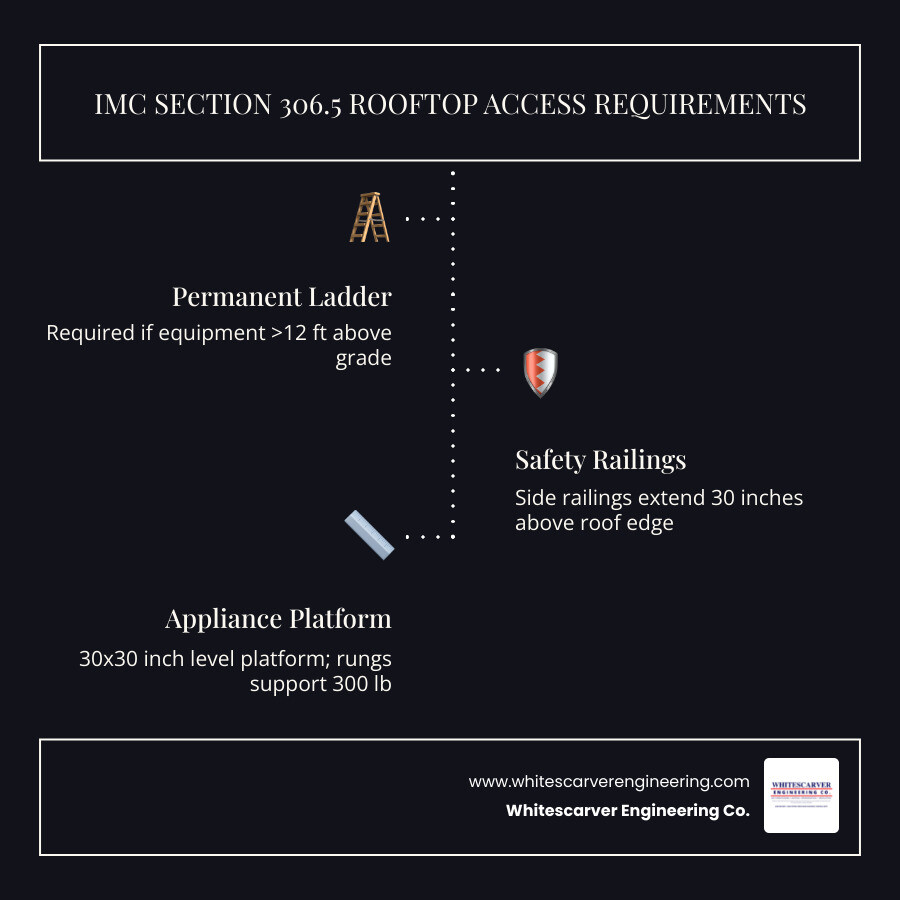
If your HVAC equipment is on the roof—which is common for industrial facilities in Roanoke and Salem—you must comply with IMC Section 306.5. If the equipment requires access and is located more than 12 feet above grade, a permanent access ladder is required.
These ladders aren't just any ladder; they must have:
Side railings extending 30 inches above the roof edge.
Rungs capable of withstanding a 300-pound load.
A clear bottom landing area of at least 30x30 inches.
For sloped roofs (6:12 or greater), a level appliance platform of at least 30x30 inches must be provided for technicians to stand on safely while they work.
Compliance Documentation and Inspection Procedures
Building a compliant system is only half the battle; you have to prove it. For commercial buildings, a permanent thermal envelope certificate must be posted in an approved location. This certificate lists the R-values of insulation installed, U-factors of windows, and the results of the air leakage testing.
At Whitescarver Engineering Co., we handle the Engineering Design and coordination for:
Plan Review: Submitting detailed drawings to the local building department.
Rough-in Inspection: Before the walls are closed, inspectors check ductwork, refrigerant lines, and fire dampers.
Final Mechanical Approval: Testing the equipment for operation, safety, and efficiency before the project is closed out.
Exemptions for Specialized Commercial Structures
Not every building has to meet the full brunt of the energy code. There are a few key exemptions:
Low-Energy Buildings: If the peak design rate of energy usage is less than 3.4 Btu/h per square foot, the building may be exempt from the thermal envelope requirements.
Greenhouses: These have their own fenestration rules (skylight U-factor ≤ 0.5, vertical glass ≤ 0.7).
Equipment Buildings: Small sheds (≤ 1,200 sq. ft.) used solely to house industrial equipment are exempt if they have a heating capacity of less than 17,000 Btu/hr and a thermostat set no higher than 50°F.
Frequently Asked Questions about Virginia HVAC Codes
What is the current applicable building code for commercial HVAC in Virginia?
The current code is the 2021 Virginia Uniform Statewide Building Code (VUSBC), which incorporates the 2021 Virginia Mechanical Code and the 2021 Virginia Energy Conservation Code. These became mandatory for all new permits as of January 18, 2025.
Which climate zone applies to the Roanoke and Charlottesville regions?
Both regions are located in Climate Zone 4. This zone requires specific insulation levels (such as R-19 + R-11 LS for roofs) and limits the amount of glass (fenestration) to 30% of the wall area unless specific efficiency trade-offs are made.
What are the mandatory air leakage testing requirements for new commercial builds?
New commercial buildings must not exceed an air leakage rate of 0.40 cfm/ft² at a pressure of 75 Pascals. This must be verified through a blower door test or an approved equivalent testing method during the final stages of construction.
Conclusion
Understanding virginia commercial hvac code requirements is essential for maintaining the safety, efficiency, and legality of your facility. Whether you are managing a historic building in downtown Roanoke or a modern industrial plant in the Blacksburg corridor, staying ahead of these regulations prevents costly downtime and ensures a healthy environment for your occupants.
At Whitescarver Engineering Co., we bring over 75 years of technical expertise to every project. We specialize in custom industrial HVAC projects, large-scale refrigeration design, and comprehensive maintenance agreements that keep your systems in peak condition. Based in Roanoke, we serve the entire region, providing 24/7 service for our commercial clients to ensure that a code-related issue or equipment failure never slows your operations down.
If you are planning a retrofit or need a code-compliant design for a new facility, trust the experts who have been serving Virginia businesses since 1937. Learn more about our Commercial HVAC Systems and how we can help you navigate the complexities of modern building codes.


Comments