
The No-Sweat Guide to Commercial Refrigerant Compliance
Why Refrigerant Regulations Are Reshaping How Virginia Businesses Operate

What are refrigerant regulations and how do they affect my business is one of the most pressing questions facing commercial facility managers and business owners right now — and for good reason.
Refrigerant regulations are environmental and safety rules that govern how refrigerants are produced, used, handled, and disposed of. Here's how they affect your business at a glance:
New equipment rules: Systems installed after January 1, 2025 must use refrigerants with a Global Warming Potential (GWP) below 700 for most air conditioning applications
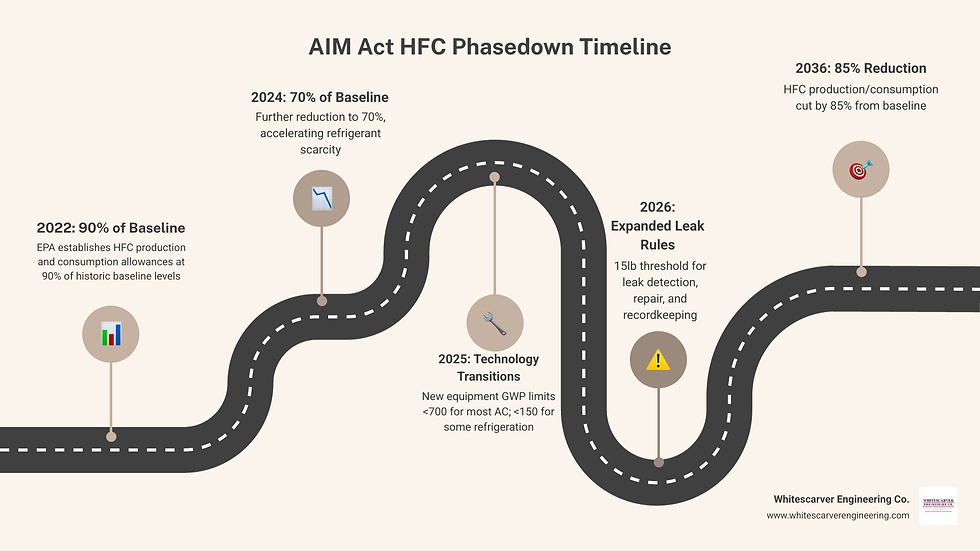
Phase-downs: The AIM Act mandates an 85% reduction in HFC production and consumption by 2036, making common refrigerants like R-410A and R-404A increasingly scarce and expensive
Expanded leak rules: Starting January 1, 2026, any system containing 15 or more pounds of a regulated refrigerant (GWP above 53) must comply with leak tracking, repair timelines, and recordkeeping requirements
Penalties: Non-compliance can result in fines of up to $69,733 per violation per day
State rules: States like California, New York, and Washington have added stricter requirements on top of federal rules
The U.S. refrigeration and HVAC industry is in the middle of its most significant regulatory shift in decades. The American Innovation and Manufacturing (AIM) Act, passed in 2020, gave the EPA authority to phase down hydrofluorocarbons (HFCs) — the refrigerants used in most commercial cooling equipment today. HFCs are potent greenhouse gases. Left unaddressed, they could account for 7 to 19% of global greenhouse gas emissions by 2050, according to Washington State's Department of Ecology.
What makes this complicated for businesses is the sheer number of overlapping rules. You have federal regulations under EPA Section 608 and the AIM Act, plus a growing number of state-level programs with their own deadlines and reporting requirements. If you manage a facility with walk-in coolers, rooftop HVAC units, chillers, or commercial refrigeration racks, there's a real chance some of your equipment is already regulated — or will be very soon.
The good news is that with the right information and a clear plan, compliance is manageable.
What are refrigerant regulations and how do they affect my business?
To understand the current landscape, we first have to look at the two pillars of federal oversight: EPA Section 608 and the AIM Act. For decades, Section 608 of the Clean Air Act focused primarily on ozone-depleting substances (ODS) like CFCs and HCFCs (think R-22). It prohibited intentional venting and required technicians to be certified.
However, as the industry moved away from ozone-depleting gases, we landed on HFCs. While HFCs don't poke holes in the ozone layer, they have a massive "Global Warming Potential" (GWP). GWP is a measure of how much heat a greenhouse gas traps in the atmosphere relative to carbon dioxide (which has a GWP of 1). For example, R-404A has a GWP of 3,922. That means releasing one pound of R-404A is roughly equivalent to releasing nearly two tons of CO2.
The Kigali Amendment to the Montreal Protocol set the global stage for an HFC phase-down, and the U.S. codified this through the AIM Act. This law mandates a step-down approach to reduce HFC production and consumption by 85% by 2036. For a business owner in Roanoke or Vinton, this isn't just "environmental talk"—it directly impacts the availability of the gas needed to keep your Refrigeration systems running.
The Role of the AIM Act
The AIM Act is the engine driving the current transition. It works through an "allowance" system. The EPA grants allowances to companies to produce or import HFCs. Each year, the total number of allowances drops. We already saw a 10% reduction in 2022, followed by a much steeper 40% drop in 2024. By 2029, we will be at a 70% reduction.
When the supply of virgin (newly manufactured) HFCs drops, prices typically rise. This makes Commercial Refrigeration System Engineering in Vinton VA more critical than ever. If your system has a leak, "topping it off" will become an increasingly expensive habit. The goal of the Act is to force the industry toward reclaimed refrigerants and lower-GWP alternatives.
New Equipment Standards and how do they affect my business?
The EPA isn't just limiting the gas; they are also regulating the machines. Under the "Technology Transitions" program, the EPA has set GWP limits for new equipment.
For most Virginia businesses, the biggest impact will be on new installations. If you are building a new facility or replacing a total system, you can no longer simply pick the cheapest unit on the market. You must ensure the equipment is designed for compliant refrigerants. This affects everything from rooftop units (RTUs) to large-scale Industrial Refrigeration Engineering Design Contractor in Roanoke VA. Starting in 2025 and 2026, many high-GWP refrigerants will be banned for use in new installations entirely.
Key Compliance Deadlines for 2025 and 2026
The timeline for these changes is aggressive. We often tell our clients that the "future" of refrigeration is arriving on January 1st of the next two years.
Sector | Equipment Type | GWP Limit | Compliance Date (Installation) |
Residential & Light Commercial | AC and Heat Pumps | < 700 | January 1, 2025 |
Chillers | Comfort Cooling | < 700 | January 1, 2025 |
Retail Food Refrigeration | Stand-alone Units | < 150 | January 1, 2025 |
Retail Food Refrigeration | Remote Condensing Units | < 300 / 150* | January 1, 2026 |
Cold Storage Warehouses | New Systems | < 150 / 300* | January 1, 2026 |
Industrial Process Refrigeration | New Systems | < 150 / 300* | January 1, 2026 |
*Limits vary based on charge size and specific application.
By January 1, 2025, most new residential and light commercial AC systems will transition to refrigerants like R-454B or R-32. If you are a building manager in Roanoke planning a chiller replacement, you need to be looking at these specs now. Our Commercial Refrigeration Engineering Design Roanoke Guide highlights that waiting until the last minute could lead to equipment shortages or permit delays.
January 1, 2026, is the "big one" for the food industry. The EPA will prohibit new installations of systems using R-404A, R-448A, and R-449A in many commercial settings. If you have a project in the pipeline, it must be operational before this date to use the older-style refrigerants.
Phasing Out R-410A and R-404A
R-410A has been the workhorse of the AC world, and R-404A has dominated commercial freezers for years. Their phase-out doesn't mean your existing equipment becomes illegal overnight. You can still run your current R-410A unit. However, as virgin production halts, you will rely more on "reclaimed" refrigerant—gas that has been recovered from old systems and cleaned to virgin-purity standards.
Securing Best Refrigeration System Engineering in Vinton VA means planning for a future where these gases are no longer the default. It’s a supply-and-demand game; as supply shrinks, the value of every ounce of refrigerant in your system goes up.
State-Specific Requirements and how do they affect my business?
While we focus heavily on federal EPA rules here in Virginia, multi-state businesses must be aware of "copycat" or even stricter state laws. California (CARB), New York (Part 494), and Washington (WAC 173-443) have implemented their own registries and reporting deadlines.
For instance, California requires annual reporting for any facility with a system containing over 50 pounds of high-GWP refrigerant. Even if you only operate in Vinton, these state rules often influence what manufacturers build. If California bans a certain type of equipment, manufacturers often stop making it for the whole country. Seeking Affordable Refrigeration System Engineering in Vinton VA involves choosing systems that are "future-proofed" against both federal and state-level trends.
Leak Detection and Recordkeeping Obligations
One of the most significant changes under the AIM Act (specifically Subsection h) is the lowering of the "threshold" for regulation. Under the old Section 608 rules, you didn't have to worry much about federal leak repair requirements unless your system held 50 pounds or more of refrigerant.
Effective January 1, 2026, that threshold drops to 15 pounds for HFCs with a GWP above 53.
This is a massive shift. A typical 8x10 walk-in cooler often holds 20 to 35 pounds of R-404A. A 5-ton rooftop AC unit can hold 15 to 25 pounds of R-410A. Previously exempt small businesses—restaurants, convenience stores, and office buildings—are now squarely in the EPA's crosshairs.
If you hit that 15-pound mark, you are required to:
Calculate leak rates every time you add refrigerant.
Repair leaks within 30 days if they exceed the threshold (20% for commercial refrigeration, 10% for comfort cooling).
Conduct verification tests to ensure the fix actually worked.
Identify "Chronic Leakers": If a system leaks 125% or more of its full charge in a single calendar year, you must report it to the EPA.
This is why Refrigeration System Engineering in Vinton VA now emphasizes proactive monitoring. You cannot afford to just "gas and go" anymore.
Automatic Leak Detection (ALD) Requirements
For the "big players"—facilities with systems containing 1,500 pounds or more of high-GWP refrigerant—the rules are even stricter. The EPA now mandates Automatic Leak Detection (ALD) systems.
New systems (installed after Jan 1, 2026) must have ALD installed within 30 days.
Existing systems must be retrofitted with ALD by January 1, 2027.
These systems must be calibrated annually and are designed to alert you the moment a leak starts, rather than waiting for a technician to find it during a quarterly inspection. For high-stakes environments, 24-Hour Refrigeration System Engineering in Vinton VA is a necessity to ensure these ALD alerts are handled immediately.
Mandatory Reporting and Documentation
The EPA loves paperwork. If your system leaks more than 125% of its charge in a year, you must submit a report by March 1st of the following year. But even if you don't leak that much, you must keep service logs for at least three years (and we recommend keeping them for the life of the equipment).
Every time a technician touches your system, the log should include:
The date and type of service.
The quantity and type of refrigerant added.
The leak rate calculation.
Records of where the refrigerant was sourced (virgin vs. reclaimed).
Accurate recordkeeping is your best defense against those $69,733-per-day fines. We help our clients manage this through Commercial Refrigeration System Engineering in Vinton VA, ensuring every service call is documented to federal standards.
Transitioning to Low-GWP Alternatives
As the old guard of refrigerants (R-410A, R-404A) exits, a new generation is taking over. These are often referred to as "A2L" refrigerants.
A2L is a safety classification from ASHRAE. The "A" means non-toxic, the "2" means flammable, and the "L" stands for "lower flammability" or "mildly flammable." Examples include R-454B (the likely successor to R-410A) and R-32. While the word "flammable" can be scary, A2Ls are actually very difficult to ignite and have been used safely in Europe and Asia for years.
For larger industrial applications, we are seeing a resurgence in "Natural Refrigerants":
CO2 (R-744): Excellent for cold storage but operates at very high pressures.
Ammonia (R-717): The gold standard for efficiency in large plants, though it requires strict safety protocols due to toxicity.
Propane (R-290): Used in small, self-contained "reach-in" coolers. It’s highly efficient but limited by charge size for safety.
Our work in Industrial Refrigeration Engineering Design Contractor in Roanoke VA focuses on matching the right "natural" or A2L solution to the specific needs of the facility.
Safety Standards for Mildly Flammable Refrigerants
Because A2L refrigerants can burn under very specific conditions, building codes have changed. Standards like ASHRAE 15 and UL 60335-2-40 now require new safety features in HVAC equipment.
If a system uses A2Ls, it may need:
Leak mitigation sensors: These "sniffers" detect a leak and automatically shut down the compressor while turning on the evaporator fan to dilute the gas.
Enhanced ventilation: Ensuring that if a leak occurs, the gas cannot reach a flammable concentration.
Labeling: Clear markings so any technician knows they are working with a mildly flammable substance.
Ensuring Best Refrigeration System Engineering in Vinton VA means working with contractors who understand these new safety hurdles.
Retrofitting vs. Full System Replacement
This is the million-dollar question: "Can I just put the new gas in my old machine?"
In 99% of cases, the answer is no. You cannot simply drop an A2L refrigerant like R-454B into an old R-410A system. The oils are different, the pressures are different, and the safety components (sensors and fans) aren't there.
However, some "retrofits" are possible for older R-404A systems using mid-GWP HFC blends. But even then, you have to weigh the cost. An older system is likely less energy-efficient and more prone to leaks. Often, the Affordable Refrigeration System Engineering in Vinton VA is a full system replacement that lowers your energy bills and eliminates the "compliance headache" in one go.
Frequently Asked Questions about Refrigerant Compliance
Must I replace my existing R-410A system immediately?
No. There is no "mandatory replacement" for existing, working equipment. You can continue to operate and repair your R-410A or R-404A systems for as long as they last. The regulations only apply to new installations and how you handle leaks in your existing ones. However, keep in mind that as the HFC phase-down continues, the cost of R-410A for repairs will likely climb.
What are the penalties for non-compliance with leak repairs?
The EPA doesn't mess around. Under the Clean Air Act, civil penalties can reach up to $69,733 per day, per violation. If you have three walk-in coolers and you haven't tracked their leak rates for 90 days, those fines can theoretically reach into the millions. While the EPA usually targets "willful" or "gross" negligence first, "I didn't know the rules changed" is not a valid legal defense.
How does the 15-pound threshold change affect small businesses?
It brings almost every restaurant, convenience store, and small office building in Virginia under federal oversight. If you have a walk-in cooler or a medium-sized rooftop AC unit, you are likely over the 15-pound mark. You must now maintain service records and repair leaks within 30 days. For many small business owners, this means your "handyman" approach to HVAC needs to be replaced by a professional maintenance contract.
Conclusion
Navigating what are refrigerant regulations and how do they affect my business can feel like trying to fix a compressor in the dark. The rules are dense, the deadlines are tight, and the stakes are high. But you don't have to do it alone.
At Whitescarver Engineering Co., we’ve been helping Virginia businesses stay cool and compliant for over 75 years. From our headquarters in Roanoke to our deep roots in Vinton, we provide the technical expertise needed to transition your facility into the post-HFC era. Whether you need a comprehensive compliance audit, a transition plan for your aging chillers, or a high-efficiency industrial design, we pride ourselves on delivering second-to-none solutions.
Don't wait for a leak or an EPA audit to start your compliance journey. Proactive planning today ensures operational continuity and system longevity for years to come.
Contact our experts for professional refrigeration solutions and let us help you take the sweat out of refrigerant compliance.


Comments