
The Facility Manager’s Guide to Evaluating Commercial HVAC Providers
Why Knowing How to Evaluate Commercial HVAC Service Providers Protects Your Operations
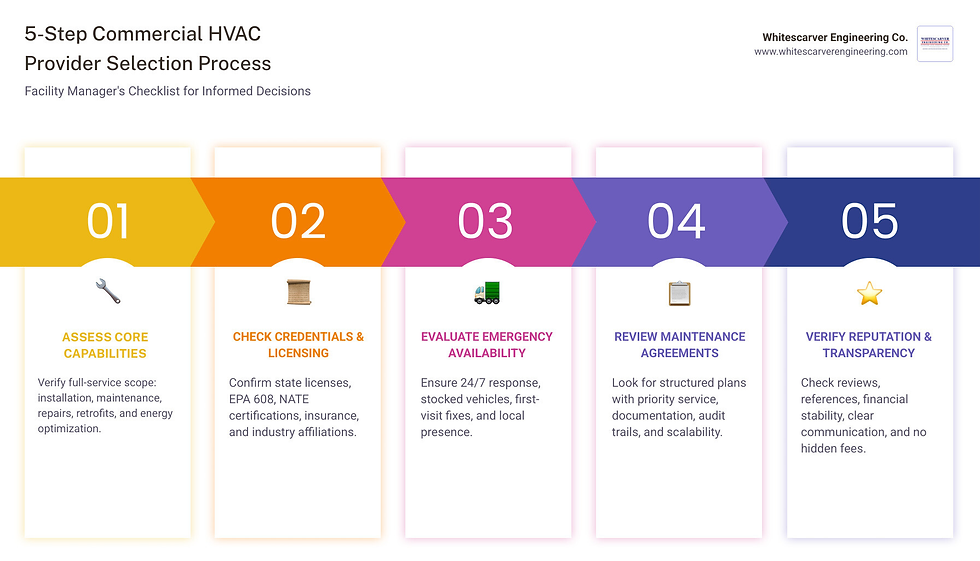
How to evaluate commercial HVAC service providers comes down to checking these key factors:
Core service capabilities - Installation, maintenance, repairs, and emergency support
Credentials and licensing - Valid state licenses, EPA 608 certification, insurance, and NATE certification
Emergency availability - Confirmed 24/7 response with clear dispatch processes
Technician quality - Ongoing training, documented qualifications, and diagnostic capabilities
Maintenance agreements - Structured plans with clear documentation and audit trails
Reputation and references - Verified reviews and references from comparable commercial clients
Transparency - Clear communication, honest scoping, and no hidden fees
Commercial HVAC systems are not just comfort systems - they support employees, customers, equipment, and inventory around the clock. When something goes wrong, the impact on operations can be immediate and costly. Yet many facility managers in Virginia still select providers based on price alone or a quick internet search, without a structured way to compare what they're actually getting.
The stakes are real. Commercial systems are significantly more complex than residential ones - larger in scale, more demanding in operation, and often running continuously across specialized spaces. Choosing the wrong provider doesn't just mean a bad service call. It can mean recurring failures, compliance gaps, voided warranties, and unplanned downtime that disrupts your entire operation.
With commercial HVAC services accounting for over 30% of the total HVAC services market, there is no shortage of providers to choose from. But volume doesn't equal quality. The right provider for your facility is the one that matches your specific requirements - not just the one with the flashiest website or the lowest opening quote.
This guide walks facility managers through a clear, repeatable process for evaluating commercial HVAC providers so you can make a confident, well-informed decision.
Assessing Core Service Capabilities and Technical Expertise
When you begin looking at how to evaluate commercial HVAC service providers, the first step is determining if they can actually handle the full lifecycle of your equipment. A "one-stop-shop" approach is often best for commercial facilities because it ensures that the team maintaining the system is the same one that understands its design and installation history.
A reliable partner should offer a comprehensive Services suite that includes:
System Design and Engineering: Commercial spaces have unique airflow needs and layouts. A provider should be able to evaluate your building’s specific demands to ensure the system is sized correctly.
Precision Installation: Poor installation is a leading cause of premature system failure. You need a team that coordinates with other building systems and adheres to strict project schedules.
Systems Repairs & Retrofits: As technology advances, you may not always need a full replacement. A high-quality provider can offer retrofitting options to improve the efficiency of legacy equipment.
Advanced Diagnostics: Modern commercial systems require more than a wrench and a screwdriver. Look for providers who use sophisticated diagnostic tools to identify root causes rather than just treating symptoms.
Operational efficiency is another major factor. According to industry research, routine maintenance can save up to 40% on energy bills. Therefore, your provider should focus on Commercial HVAC Optimization Guide Roanoke VA strategies that keep your utility costs low while maximizing equipment lifespan.
Specialized Knowledge for Complex Systems
Commercial environments aren't just "big houses." They involve intricate Commercial HVAC Systems like VAV (Variable Air Volume) units, chilled water systems, and complex multi-zone controls.
If your facility has specialized needs—such as server rooms that require precise climate control or large industrial spaces with specific airflow balance requirements—you need a provider with proven experience in those areas. When a system reaches the end of its 15-to-20-year lifespan, you’ll also want an expert to guide you through the Commercial HVAC Replacement Guide Salem VA to ensure your new investment outperforms the old one.
How to Evaluate Commercial HVAC Service Providers Based on Credentials
Credentials are the "proof in the pudding." In Virginia, and specifically in the Roanoke and Blue Ridge areas, specific standards must be met to ensure safety and legal compliance.
Certification/Credential | What It Means for Your Facility |
State Licensing | Ensures the provider meets Virginia’s legal requirements for mechanical contracting. |
EPA 608 Certification | Mandatory federal law for any technician handling refrigerants to prevent environmental damage. |
NATE Certification | North American Technician Excellence; represents the "gold standard" of technical knowledge. |
BBB Accreditation | Indicates a commitment to resolving customer disputes and maintaining ethical business practices. |
Insurance (Liability & Workers' Comp) | Protects your business from financial responsibility for on-site accidents or property damage. |
At Whitescarver Engineering Co., we take these credentials seriously. With over 75 years of experience and an A+ BBB accreditation since 1974, we understand that trust is built on a foundation of verified expertise. You can learn more about our history and commitment to quality on our About page.
Verifying Regulatory and Safety Compliance
Safety isn't just a buzzword; it’s a liability shield for your company. When looking at how to evaluate commercial HVAC service providers, ask for proof of their safety protocols. This includes adherence to OSHA standards and regular safety inspections of their own equipment and your job site.
In our Commercial HVAC Roanoke VA Guide, we emphasize that local knowledge is irreplaceable. A provider must be familiar with regional building codes and regulations. Furthermore, ensuring that technicians have undergone background checks and follow a strict Commercial HVAC Installation Guide Blue Ridge VA protocol ensures that your facility remains compliant and your employees stay safe.
Reliability, Response Times, and Emergency Support
In the commercial world, an HVAC failure is rarely just an inconvenience—it’s an emergency. Whether it’s a data center overheating or a retail space becoming unbearable for customers, you need to know exactly how fast your provider can get there.
True 24/7 availability means more than just having an answering machine. It means a live person answering the phone and a dispatched technician who can arrive within a guaranteed window. We recommend looking for providers who maintain a local presence. A team based in your backyard can respond much faster than one traveling from three counties away.
Key indicators of a reliable emergency partner include:
Stocked Service Vehicles: A provider should have "rolling warehouses" stocked with common genuine parts. This increases the chances of a first-visit resolution, minimizing your downtime.
Clear Communication: You should receive real-time updates on technician arrival times and the status of the repair.
Local Expertise: Using a Commercial HVAC Repair Salem VA Guide or following Commercial HVAC Repair Blue Ridge Tips helps you identify providers who understand the local climate's impact on your specific system type.
Why Rapid Response is Key to How to Evaluate Commercial HVAC Service Providers
Rapid response is the difference between a minor fix and a total operational shutdown. If you are managing critical infrastructure, you might even consider a 24-Hour HVAC System Design in Roanoke VA that prioritizes redundancy and quick-access service ports.
When evaluating a provider, ask for their average response time for emergency calls. If they can't give you a specific number or a range, that’s a red flag. Efficient dispatching and real-time tracking are no longer "extras"—they are essential tools for modern facility management.
Reviewing Maintenance Plans and Long-Term Support Agreements
The most expensive HVAC system is the one that only gets attention when it breaks. Preventative care is the secret to lower life cycle costs. A well-structured Maintenance Services plan can extend the life of your equipment from the typical 15 years to well over 20.
A professional maintenance plan should include:
Performance Checks: Testing all electrical connections, lubricating moving parts, and checking refrigerant levels.
Filter Optimization: Regularly changing filters to maintain airflow and indoor air quality.
Asset History Tracking: Keeping a detailed log of every service performed on every piece of equipment. This is vital for making "repair vs. replace" decisions later on.
Our Commercial HVAC Maintenance Guide Roanoke VA highlights that a good maintenance agreement isn't just a bill—it's a roadmap for your system's health.
Using Maintenance Contracts to How to Evaluate Commercial HVAC Service Providers
A maintenance contract is a great way to "test drive" a long-term partnership. When reviewing a contract, look for administrative predictability. Does the provider offer standardized reporting? Is there an audit trail for compliance purposes?
A solid agreement should offer priority scheduling, meaning you go to the front of the line during peak seasons. As your business grows, your provider’s ability to offer scalable solutions across multiple sites becomes increasingly important. This level of Services ensures that your HVAC partner grows with you, rather than becoming a bottleneck.
Identifying Red Flags and Verifying Reputation
Part of knowing how to evaluate commercial HVAC service providers is knowing who to avoid. Watch out for these common red flags:
Vague Quotes: If a provider won't give you a detailed, written breakdown of labor and parts, keep looking.
Lack of Brand-Agnostic Expertise: Some providers only work on one or two brands. In a commercial setting, you need a team that understands all major manufacturers.
No References: Any reputable company should be able to provide references from other commercial clients in your industry.
High Technician Turnover: If you see a different face every time a truck pulls up, it may indicate a lack of consistent training or poor company culture.
Hidden Fees: Watch out for "trip charges" or "diagnostic fees" that weren't mentioned upfront.
Always check online reviews, but don't stop there. Call the references provided. Ask about their responsiveness, the cleanliness of their work, and how they handled things when a repair didn't go perfectly. If you have questions about our own track record or want to see how we handle these standards, we invite you to Contact us directly.
Frequently Asked Questions about Evaluating HVAC Providers
What certifications are mandatory for commercial HVAC technicians?
Technicians must have EPA 608 certification to handle refrigerants legally. In Virginia, the company should also hold a valid Class A contractor's license with a mechanical (HVAC) specialty. Optional but highly recommended certifications include NATE (North American Technician Excellence), which proves a higher level of field expertise.
How often should a commercial HVAC maintenance agreement be reviewed?
We recommend reviewing your agreement annually. This allows you to adjust the scope of service based on the age of your equipment, any facility expansions, or changes in how the building is used (such as increasing occupancy or adding heat-generating equipment).
Why is local experience important for commercial systems?
Local providers understand the specific climate challenges of Virginia—from the humid summers to the freezing winters in the Blue Ridge mountains. They are also familiar with local utility programs and municipal building codes, which can save you time and money during inspections and upgrades.
Conclusion
Selecting an HVAC partner is one of the most important decisions a facility manager can make. By focusing on core capabilities, verified credentials, and a proven track record of reliability, you can ensure your building remains comfortable and your operations stay stable.
At Whitescarver Engineering Co., we combine 75 years of technical excellence with a deep commitment to the Virginia community. Whether you are looking for a new installation, a complex retrofit, or a reliable maintenance partner, we have the experience to deliver second-to-none technical solutions for all your Commercial HVAC Systems.


Comments