
Why Your Building Needs a Professional HVAC Design to Breathe Easy
What an HVAC Engineer Actually Does for Commercial Buildings (And Why It Matters)

Understanding what an HVAC engineer does for commercial buildings starts with a simple truth: these systems do far more than keep people comfortable. A commercial HVAC engineer designs, oversees, and optimizes the heating, ventilation, and air conditioning infrastructure that makes large-scale facilities safe, functional, and energy-efficient.
Here is a quick breakdown of their core responsibilities:
Responsibility | What It Means in Practice |
System Design | Calculates heating and cooling loads; selects equipment sized for the building |
Blueprint Creation | Produces detailed plans for ductwork, venting, and air distribution |
Installation Oversight | Supervises contractors to ensure specs are met on-site |
Compliance | Ensures designs meet building codes and ASHRAE standards |
Energy Efficiency | Integrates smart controls, modeling tools, and sustainable technologies |
Maintenance Planning | Designs systems for long-term performance and serviceability |
Specialized Environments | Addresses unique demands of hospitals, data centers, and industrial facilities |
Buildings account for nearly 40% of global energy consumption globally, and HVAC systems represent one of the largest contributors within that figure. For facility managers and building owners, that statistic translates directly into operating costs, occupant health, and regulatory risk — all of which fall squarely within an HVAC engineer's scope of work.
In a commercial context, the stakes are considerably higher than in residential settings. A poorly designed system in an office complex, manufacturing plant, or healthcare facility does not just create discomfort — it can compromise air quality, trigger code violations, and drive up energy expenditures significantly. That is why the role of a qualified HVAC engineer is foundational to any serious commercial building project, from new construction to large-scale retrofits.
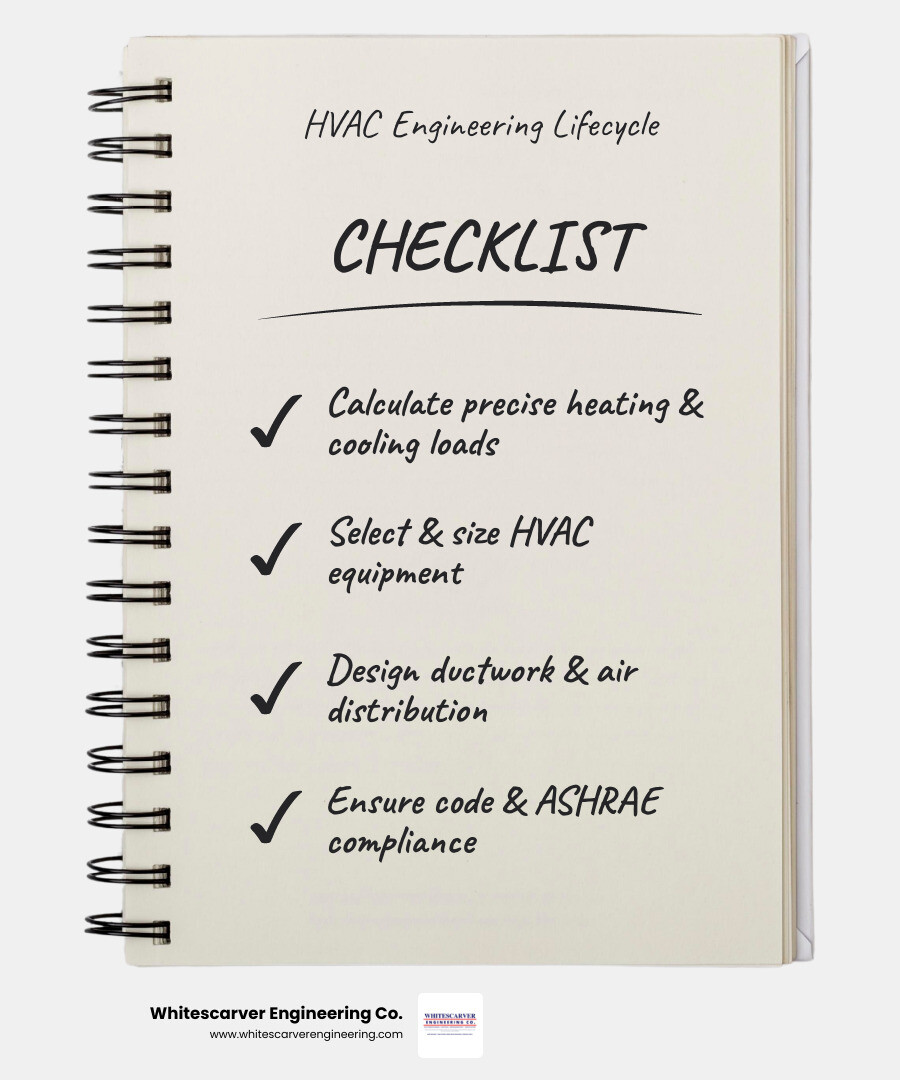
What does an hvac engineer do for commercial buildings?

When we look at a commercial structure, we see more than just steel and glass; we see a living environment that requires a precise balance of temperature, humidity, and airflow. The primary focus of what an HVAC engineer does for commercial buildings is centered on Engineering Design. This is the "brain" work that happens long before a single piece of equipment is craned onto a rooftop.
The process begins with exhaustive load calculations. Unlike a home, where a "rule of thumb" might suffice, commercial spaces have massive variables. We must account for the building's orientation to the sun, the number of occupants, the heat generated by computers and machinery, and the R-value of the insulation. If these calculations are off by even a small margin, the building may suffer from "short-cycling" or, conversely, an inability to reach the desired setpoint during a humid Virginia summer.
Once the loads are determined, we move into equipment selection and blueprint creation. This involves choosing between Commercial HVAC Systems such as chilled water systems, packaged rooftop units (RTUs), or Variable Refrigerant Flow (VRF) technology. The engineer then maps out the "circulatory system" of the building—the ductwork layout and vent placement. Every turn in a duct creates static pressure; every vent placement affects how air mixes in a room. We ensure that air is distributed evenly so that one office isn't a refrigerator while the conference room next door feels like a sauna.
Specialized Design for High-Stakes Environments
In many commercial sectors, HVAC is a matter of mission-critical safety. In Roanoke and the surrounding region, we work with facilities where standard "comfort cooling" is secondary to process requirements. Healthcare facilities, data centers, and industrial plants require a level of precision that only a professional engineer can provide.
For instance, ASHRAE 62.1 Ventilation Requirements for Commercial Spaces dictates the amount of fresh outdoor air that must be introduced into a space. In an industrial plant in Salem or a lab in Blacksburg, we must also manage sterile airflow and humidity control to protect sensitive products or research. Process cooling is another area where we shine, designing systems that remove heat from manufacturing equipment to prevent downtime and equipment failure.
What does an hvac engineer do for commercial buildings like hospitals and data centers?
In hospitals, the HVAC system is a primary tool for infection control. We design systems that create negative pressure rooms to keep airborne contaminants from escaping, or positive pressure environments for surgical suites to keep pollutants out. This requires specialized filtration (such as HEPA) and high air-exchange rates that go far beyond standard office requirements.
Data centers present a different challenge: heat density. Servers generate immense amounts of heat in a concentrated area. What an HVAC engineer does for commercial buildings of this type involves redundancy planning and precision cooling. We ensure that if one cooling unit fails, another is ready to take over immediately, preventing millions of dollars in hardware damage and data loss. This involves a deep understanding of How ASHRAE Standards Affect Commercial HVAC Design, ensuring that the facility remains compliant while operating at peak reliability.
Sustainability and Regulatory Compliance
In May 2026, the push for "green" buildings is no longer a trend—it is a regulatory and economic necessity. A major part of what an HVAC engineer does for commercial buildings is navigating the complex world of energy efficiency and sustainability. We utilize the ASHRAE 90.1 Energy Efficiency Standard Explained as our roadmap to ensure that every system we design minimizes the building's carbon footprint.
For many of our clients in the Virginia corridor, this means aiming for LEED accreditation or simply trying to slash utility bills that have become a significant overhead burden. We use advanced energy modeling software to simulate how a building will perform under different conditions, allowing us to integrate renewable energy sources like solar or geothermal where appropriate. Our Commercial HVAC Optimization Guide Roanoke VA highlights how these strategic design choices can lead to massive long-term savings.
What does an hvac engineer do for commercial buildings to ensure long-term efficiency?
Design is only the first step; long-term efficiency requires ongoing performance auditing and system balancing. We implement Commercial HVAC Controls Explained to give facility managers real-time insights into their operations. By using smart sensors and IoT (Internet of Things) integration, we can move from reactive repairs to predictive maintenance.
Imagine a system that alerts us because a compressor is drawing 10% more power than it should, indicating a potential failure before it actually happens. This level of oversight reduces the "unpredictable liability" of HVAC and turns it into a managed asset. We also perform "testing and balancing" (TAB) to ensure that the air and water flows throughout the building match the original design specifications, which is often the difference between a system that works and one that excels.
Advanced Technology and Collaborative Integration
Modern engineering is a team sport. As a leading HVAC System Design Company in Roanoke VA, we spend a significant portion of our time in collaborative integration. We work alongside architects, structural engineers, and electrical contractors to ensure the HVAC system fits seamlessly into the building’s "bones."
We use Building Information Modeling (BIM) and CAD software to create 3D replicas of the mechanical systems. This allows us to spot "clashes"—such as a duct trying to occupy the same space as a structural beam—before construction even begins. This MEP (Mechanical, Electrical, and Plumbing) coordination is vital for our projects, such as Commercial HVAC System Design in Vinton VA, where tight construction schedules demand that everything works correctly the first time.
What does an hvac engineer do for commercial buildings during the retrofitting process?
Retrofitting is where engineering truly becomes an art form. In historic areas of Roanoke or Salem, we often deal with legacy integration. We might be tasked with installing high-efficiency VRF systems into a building designed in the 1920s that has almost no ceiling clearance for ductwork.
In these cases, HVAC System Engineering in Salem VA involves creative problem-solving to work around space constraints. We evaluate the existing infrastructure to see what can be salvaged and what must be replaced. Whether it’s ductwork rehabilitation or a complete equipment upgrade, the Best HVAC System Design in Vinton VA focuses on maximizing modern performance within the physical limits of an older structure.
Overcoming Modern Infrastructure Challenges
The challenges facing commercial buildings today are more complex than ever. From shifting regulatory compliance to the rapid evolution of building automation, an HVAC engineer must stay ahead of the curve. One of the most common decisions we help building owners make is choosing the right system architecture.
For example, we often compare Variable Air Volume (VAV) and Variable Refrigerant Flow (VRF) systems for our clients:
Feature | Variable Air Volume (VAV) | Variable Refrigerant Flow (VRF) |
Primary Medium | Air | Refrigerant |
Energy Efficiency | High (especially in large open spaces) | Exceptional (best for zoned control) |
Space Requirement | Requires significant ductwork | Minimal (uses small refrigerant lines) |
Maintenance | Centralized in mechanical rooms | Distributed throughout the building |
Ideal Application | Large offices, auditoriums | Hotels, multi-tenant offices, retrofits |
Beyond equipment, we must also address safety protocols and emerging technologies. This includes integrating UV-C germicidal lamps for air purification or implementing Variable Frequency Drives (VFDs) that allow motors to run at speeds matched to the actual load, which can extend motor life by up to 300%.
Frequently Asked Questions
How do HVAC engineers improve indoor air quality in large offices?
We improve IAQ by designing systems that balance outdoor air intake with high-efficiency filtration (MERV 13 or higher) and proper humidity control. We also ensure that air distribution is calculated to prevent "dead zones" where CO2 or pollutants can accumulate, creating a healthier and more productive environment for employees.
What role does an HVAC engineer play in reducing a building's carbon footprint?
The engineer is the primary architect of a building's energy use. By performing energy modeling, selecting high-efficiency chillers or VRF systems, and integrating smart building automation, we can reduce a building's energy consumption by 30% to 45%. We also ensure compliance with standards like ASHRAE 90.1, which are designed specifically to lower the environmental impact of commercial structures.
Why is professional load calculation necessary for commercial retrofits?
Commercial buildings change over time. An office that was designed for 20 people in 1990 might now house 50 people and a server room. Professional load calculations ensure that new equipment is sized for the current and future use of the building, not just a "like-for-like" replacement of the old unit, which is often inefficient or undersized for modern needs.
Conclusion
At Whitescarver Engineering Co., we understand that a commercial HVAC system is a long-term investment in your facility's future. Since 1937, we have provided the Roanoke, Salem, and Vinton areas with the technical solutions required to keep complex buildings running smoothly. Whether you are planning a new industrial project or looking to optimize an existing commercial complex, our team brings over 75 years of heritage and B2B reliability to every project.
From initial Engineering Design to 24/7 emergency service, we are committed to ensuring your building "breathes easy." When you partner with us, you aren't just getting a contractor; you are gaining an engineering partner dedicated to safety, efficiency, and industrial-grade performance. Contact us today to discuss how we can bring our expertise to your next commercial or industrial HVAC project in Virginia.


Comments