
HVAC Solutions for Commercial Building Comfort Complaints
- RaShawn Hairston
- Jun 18
- 9 min read
When Comfort Complaints Signal a Bigger HVAC Problem in Your Building

Commercial building comfort complaints and HVAC solutions are two sides of the same conversation — and if you manage a commercial or industrial facility in Virginia, you've almost certainly been in the middle of it. One tenant says their office is freezing. Another, just down the hall, says it's too hot. A third says the air feels stale no matter what the thermostat reads.
These complaints are frustrating, but they're also telling you something important: your HVAC system is no longer delivering conditioned air the way it should.
Here's a quick overview of the most common comfort complaints and what typically causes them:
Complaint | Likely HVAC Cause |
One area too hot, another too cold | Airflow imbalance, stuck dampers, or zoning issues |
Stuffy or stagnant air | Inadequate ventilation or blocked return air |
Temperature swings throughout the day | Sensor drift, oversized equipment, or short cycling |
Complaints that get worse over time | Gradual performance decline — dirty coils, worn motors, clogged filters |
Problems appear after a renovation | Layout changes disrupted original airflow design |
Rising energy bills alongside complaints | Duct leakage, dirty equipment, or aging inefficient systems |
The challenge for most facility managers is that these problems rarely come from a single broken part. They build slowly — a clogged filter here, a drifting sensor there, a wall added during a tenant build-out — until the system can no longer keep up with the building's actual needs.
HVAC systems account for 39% of energy used in commercial buildings in the United States, making them the single largest energy consumer in most facilities. When they underperform, everyone feels it — and the utility bills confirm it.
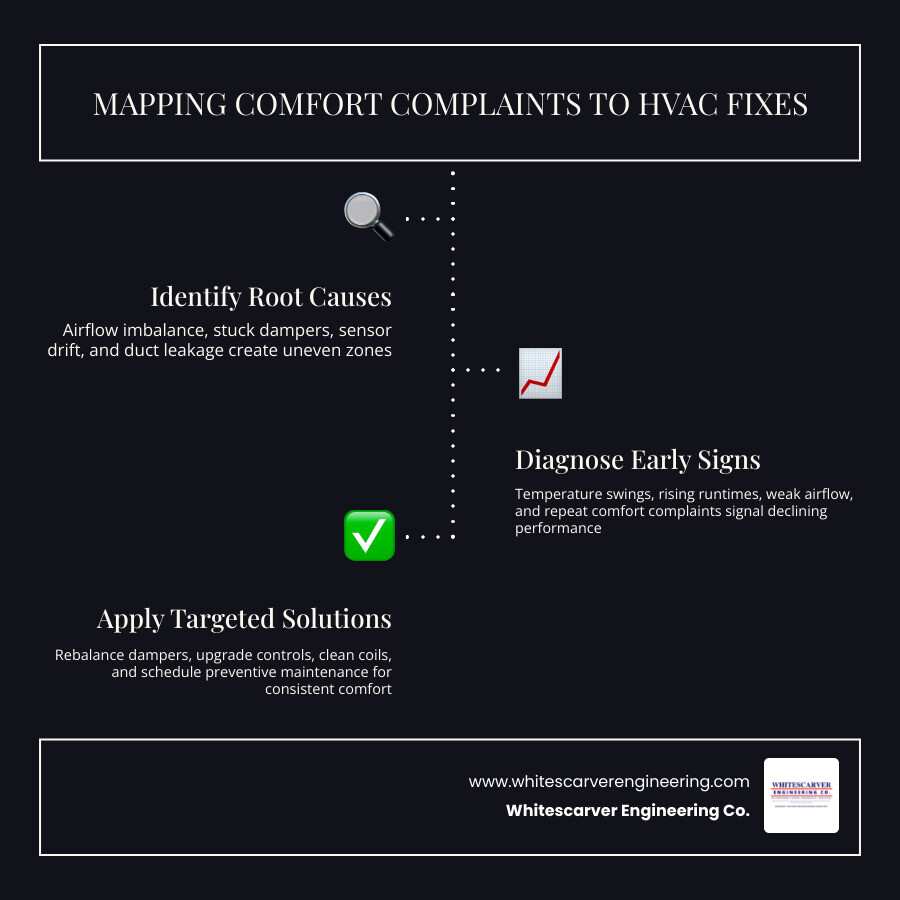
This guide walks through the root causes of recurring comfort complaints, how to diagnose them early, and which HVAC solutions actually resolve the problem rather than just shifting it to another zone.
Why Some Buildings Have More HVAC Complaints Than Others
If you manage a portfolio of properties in the Roanoke area, you’ve likely noticed a frustrating trend: some buildings are virtually silent, while others generate a steady stream of work orders. The reason isn't always the age of the equipment; it’s often about how the building interacts with its environment.
Commercial buildings are essentially collections of microclimates. An interior office with no windows has a completely different heat load than a perimeter office with floor-to-ceiling glass. While the interior office relies entirely on the HVAC system for air movement and cooling, the perimeter office is at the mercy of solar gain.
How HVAC Design Affects Tenant Comfort plays a massive role here. If a system wasn't designed to handle the specific solar loads of south- or west-facing windows, those zones will consistently overheat in the afternoon, regardless of how "well" the central plant is running.

Why “commercial building comfort complaints and hvac solutions” vary from one property to another
Building orientation is a primary driver of these discrepancies. In Virginia, buildings with heavy western exposure face intense heat gain in the late afternoon. If the zoning strategy doesn't account for this, the thermostat in the center of the floor might feel fine, while the people in the "hot seats" near the windows are miserable.
Occupancy loads also fluctuate. A conference room designed for six people that now routinely holds twenty will quickly become a source of complaints. Similarly, the "equipment heat" from modern server rooms or even high-density clusters of computers and printers can overwhelm a system designed for the lower-tech office standards of twenty years ago.
How design conditions and daily use create uneven comfort
Most commercial HVAC systems are designed for "peak loads"—the hottest or coldest days of the year. However, systems spend about 97% of their time operating at "part-load." If the system can't scale down effectively, you end up with uneven comfort. We often see "control drift," where sensors lose their calibration over time, telling the system a room is 72 degrees when it’s actually 76. This leads to a mismatch between what the Building Automation System (BAS) sees and what the occupants feel.
Why complaints often appear before major HVAC failure
Tenants are often your best early-warning system. HVAC systems rarely fail overnight; they degrade. You might notice:
Weak airflow: Tenants complaining that they can't "feel" the air moving.
Long runtimes: The system stays on for hours but never quite reaches the setpoint.
Short cycling: The unit turns on and off rapidly, which fails to remove humidity and leaves the air feeling "clammy."
Stale air: A sign that ventilation dampers are stuck or filters are so clogged that fresh air isn't circulating.
The Most Common Causes of Temperature Inconsistencies in Commercial Spaces
When we investigate commercial building comfort complaints and hvac solutions, we find that the "root cause" is usually hidden in the distribution system rather than the rooftop unit itself.
How Commercial HVAC Affects Indoor Air Quality is directly tied to maintenance. Clogged filters and dirty coils don't just hurt air quality; they restrict airflow. When airflow drops, the air that does make it through the ducts is often the wrong temperature, leading to those infamous hot and cold spots.
The top root causes behind commercial building comfort complaints and hvac solutions
Airflow Imbalance: Over time, dampers can shift or be manually adjusted by unauthorized personnel. This results in some vents blowing too hard (causing drafts) and others barely whispering.
Duct Leakage: It is estimated that 20% to 30% of conditioned air is lost through leaky ductwork. If that air is escaping into the plenum instead of reaching the office, your system has to work 30% harder for 0% more comfort.
Thermostat Placement: A thermostat mounted near a heat-producing copier or in the direct path of a supply vent will give false readings, causing the whole zone to be mismanaged.
How tenant renovations and layout changes disrupt HVAC performance
This is perhaps the most common cause of "sudden" issues. When a tenant moves a wall to create a private office or drops a ceiling for aesthetic reasons, they change the "path of least resistance" for the air. A room that was once part of an open-plan floor is now a closed box with no return air path.
Commercial HVAC System Design in Vinton VA must be revisited whenever a building's interior changes. Adding an IT room or a high-density "war room" without adjusting the ductwork is a guaranteed recipe for a comfort complaint.
How aging equipment slowly reduces comfort and consistency
As systems age, mechanical components like fan motors and actuators for dampers begin to fail. A "stuck" zoning damper is a classic culprit; it can leave one suite in a permanent deep-freeze while the suite next door swelters. Furthermore, older systems often use outdated refrigerant and controls that simply lack the precision of modern high-performance equipment.
How to Diagnose Uneven Airflow Before Complaints Get Worse
Diagnosis starts with data. Facility teams should look for "trends" in their BAS. If one zone is consistently 4 degrees off-setpoint while the chiller is running at 100%, you have a distribution problem.
What uneven airflow feels like to tenants and occupants
To a tenant, uneven airflow feels like "stuffiness." Even if the temperature is technically 70 degrees, a lack of air movement makes the space feel stagnant and humid. Conversely, excessive air velocity creates noisy vents and annoying drafts that make people reach for space heaters—which only adds more heat load to the space and confuses the HVAC sensors further.
Practical ways facility teams can spot early warning signs
Comfort Maps: Log complaints on a floor plan. If they cluster in one corner, you likely have a localized airflow or solar gain issue.
Humidity Checks: If tenants complain about "stale" air, check the relative humidity. High humidity often points to oversized equipment that is short-cycling.
Visual Inspections: Look for blocked return air grilles. Often, tenants will push filing cabinets or partitions in front of vents, unintentionally sabotaging their own comfort.
When to use professional diagnostics and system review
If simple filter changes and vent inspections don't work, it’s time for a professional Commercial HVAC Optimization Guide Roanoke VA. This involves:
TAB Testing (Testing, Adjusting, and Balancing): Measuring the actual CFM (cubic feet per minute) at every vent to ensure it matches the original design.
Static Pressure Checks: Identifying if the ductwork is restricted or if the blower motor is failing.
Sensor Calibration: Verifying that every thermostat and CO2 sensor is telling the truth.
HVAC Solutions That Reduce Complaints and Improve Efficiency
Once the problem is diagnosed, the focus shifts to commercial building comfort complaints and hvac solutions that provide long-term relief rather than temporary band-aids.
The most effective fixes for recurring comfort complaints
Often, "rebalancing" the system is the most cost-effective solution. By adjusting the manual and motorized dampers, we can redirect air from over-cooled areas to the "hot spots." Cleaning the evaporator and condenser coils can also restore lost capacity, sometimes improving heat transfer efficiency by 20% to 25%.
Modern upgrades that improve comfort and energy performance
For older buildings, a controls upgrade is often the best investment. How Building Automation Systems Save Energy by allowing for precision "zoning." Instead of one thermostat controlling half a floor, modern DDC (Direct Digital Control) systems can manage individual VAV (Variable Air Volume) boxes.
Adding Variable Frequency Drives (VFDs) to fan motors allows the system to slow down when demand is low, preventing the "blast of cold air" followed by "dead silence" cycle that tenants hate.
Solution | Short-Term Fix | Long-Term Strategic Solution |
Airflow | Clearing blocked vents | Professional Air Balancing (TAB) |
Controls | Recalibrating thermostats | Upgrading to DDC/BAS with remote monitoring |
Capacity | Cleaning coils & filters | Right-sizing equipment with VFDs |
Efficiency | Adjusting setpoints | Implementing ASHRAE 90.1 standards |
Why high-performance HVAC systems deliver better building outcomes
High-performance HVAC equipment can result in energy, emissions, and cost savings of 10%–40%. In more advanced scenarios, whole-building design coupled with an "extended comfort zone" strategy can produce savings of 40%–70%.
By following How ASHRAE Standards Affect Commercial HVAC Design, building owners can ensure they aren't just meeting the minimum code but are actually optimizing for the specific climate of Western Virginia. This leads to How to Reduce HVAC Energy Costs in Commercial Buildings while simultaneously silencing the complaint line.
How Preventive Maintenance Prevents Recurring HVAC Complaints
The secret to a quiet building is proactive care. Reactive repairs—fixing things only when they break—are 3 to 5 times more expensive than scheduled maintenance. More importantly, reactive repairs only fix the "symptom," leaving the underlying "illness" (like duct leaks or sensor drift) to cause another complaint next week.
How to Maintain Commercial HVAC Systems involves a structured approach:
Quarterly: Filter changes and belt inspections.
Semi-Annually: Coil cleaning and refrigerant level checks.
Annually: Full system commissioning, including checking the economizer and all safety controls.
Why reactive repairs do not solve recurring comfort problems
When a technician is called out for a "hot call," they often just lower the setpoint or "force" a damper open. This might make that one tenant happy for an hour, but it usually starves another part of the building of air, leading to a "cold call" from the next suite over. A maintenance agreement ensures the entire system is balanced and functioning as a unit.
What a strong maintenance plan should catch early
A professional maintenance plan identifies the "small" things before they become "big" complaints:
Sensor Drift: Catching a thermostat that is 2 degrees off before the tenant notices.
Stuck Dampers: Finding a frozen actuator in the spring before the summer heat makes it a crisis.
Motor Wear: Spotting a vibrating bearing before the fan fails and shuts down the whole floor.
How maintenance supports comfort, uptime, and energy reduction
Properly maintained systems fail 40% less often and last up to 30% longer. For a facility manager, this means more predictable budgets and fewer emergency weekend calls. It also ensures that the building continues to meet the energy-efficiency goals set during its design.
Frequently Asked Questions About Commercial Building Comfort Complaints and HVAC Solutions
Why is one tenant too hot while another is too cold in the same building?
This is usually caused by airflow imbalance or zoning issues. Commercial buildings have different "thermal zones" based on sunlight (solar gain) and occupancy. If the ductwork isn't balanced to deliver more air to the sunny side of the building, those offices will always be warmer. Layout changes, like adding walls, can also block the original airflow paths.
What are the first signs that a commercial HVAC system is losing performance?
The first sign is often a rise in humidity or uneven temperatures. If the air feels "stuffy" or if the system is running for much longer cycles than it used to, it’s likely struggling with dirty coils, low refrigerant, or failing motors. Rising energy bills without a change in weather are another major red flag.
Which upgrades help reduce comfort complaints and improve efficiency the most?
Upgrading to Variable Frequency Drives (VFDs) and Smart Building Controls (DDC) offers the highest ROI. These allow the system to provide exactly the amount of cooling needed for each specific zone, rather than being "all on" or "all off." Rebalancing the air distribution (TAB) is also a highly effective, non-invasive solution.
Conclusion
Resolving commercial building comfort complaints and hvac solutions requires more than just a quick fix; it requires a technical partner who understands the complexities of large-scale Virginia facilities. At Whitescarver Engineering Co., we bring over 75 years of heritage to every project, providing custom industrial HVAC solutions that prioritize both tenant comfort and energy cost reductions.
Whether you are dealing with a "problem building" that needs a full system retrofit or you are looking for a maintenance agreement that actually prevents downtime, our team is ready to help. We provide 24/7 service for commercial clients across Roanoke, Salem, Vinton, and the surrounding corridor, ensuring your facility remains a productive, comfortable environment for everyone inside.
For more information on optimizing your facility, visit our Commercial HVAC Systems page.


Comments