
Keep Your Operations Online by Investing in Routine Commercial HVAC Care
Whitescarver Engineering

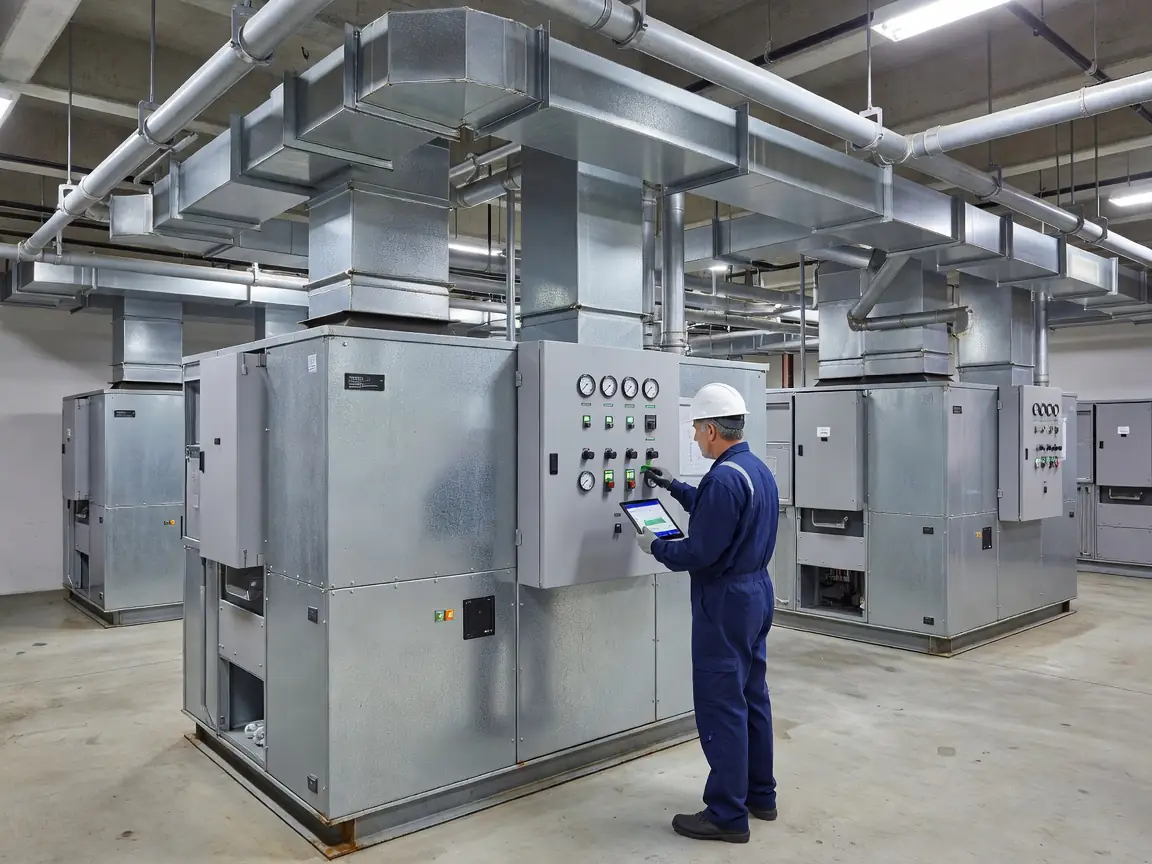
How Commercial HVAC Maintenance in Roanoke, VA Helps Prevent Downtime
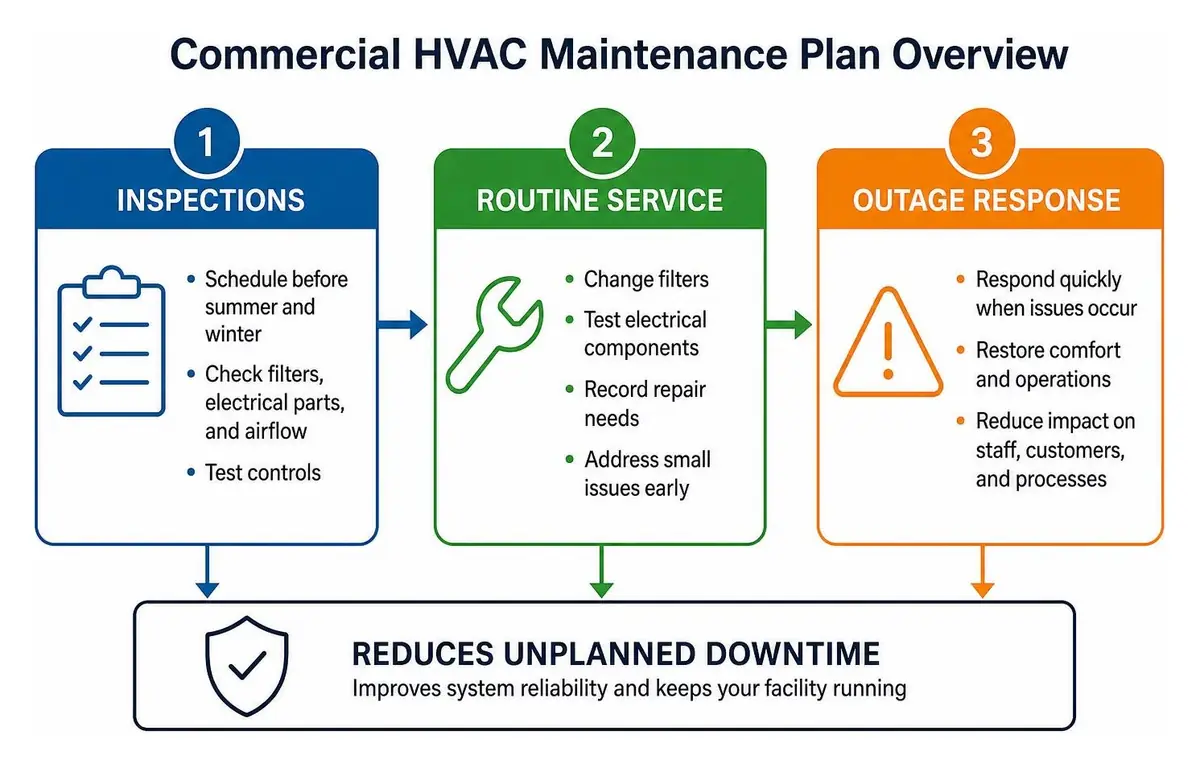
A commercial HVAC maintenance plan helps prevent unplanned downtime by finding worn parts, blocked airflow, and control faults before equipment stops. For Virginia businesses, the first step is to schedule inspections before summer heat and winter cold. Have filters changed, electrical parts tested, and repair needs recorded. A failed system can interrupt work, affect temperature-sensitive operations, and leave staff or customers uncomfortable. Commercial HVAC maintenance in Roanoke, VA gives facility managers a way to track system health and prepare for seasonal demand. No plan prevents every outage, but routine care makes surprise failures less likely.
Explore Whitescarver Engineering Co.'s commercial services or request a maintenance agreement.
You can ask Whitescarver Engineering Co. about routine HVAC care to help keep your facility running.
Why Facility Systems Fail: Key Causes of Unplanned Commercial HVAC Outages in Virginia
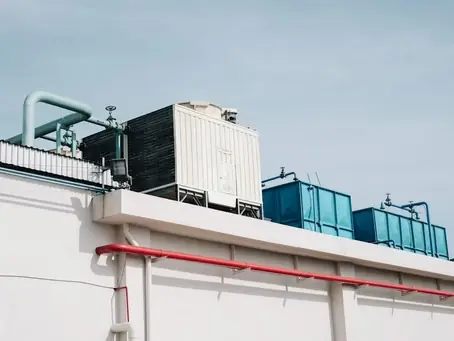
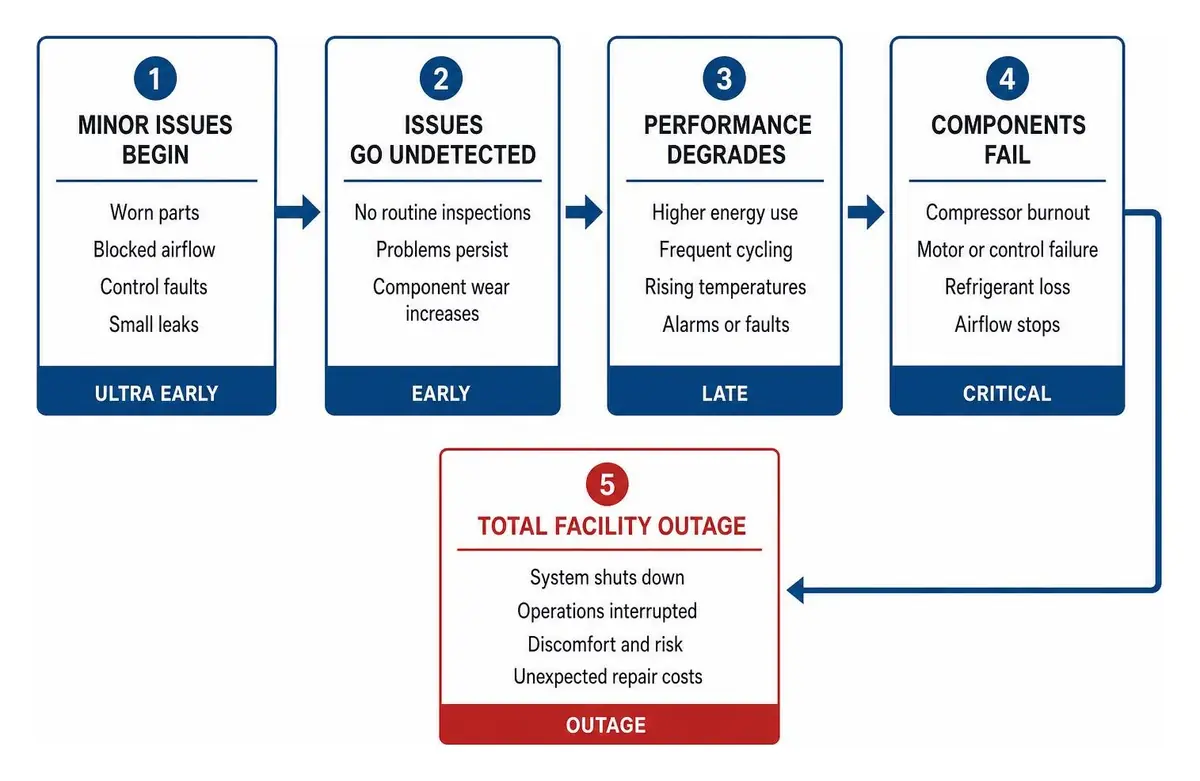
When an industrial chiller, rooftop package unit, or facility air handler goes offline unexpectedly, operations grind to a halt. In commercial facilities, unexpected outages are rarely random flukes; they are almost always the culmination of undetected component wear, electrical stress, or extreme weather strain. Comparing preventive maintenance vs reactive repairs for commercial HVAC systems shows that reactive management forces facilities to absorb massive disruptions, whereas planned servicing stops small technical discrepancies from cascading into total system failures.
Across commercial buildings, the leading physical triggers of unexpected downtime include:
- Electrical Contact Wear and Contactor Welding: Repeated cycling under heavy facility loads causes electrical contacts to pit, arc, or weld shut, leading to sudden compressor burnout.
- Refrigerant Leaks and Pressure Imbalances: Even minor pinhole leaks gradually decrease operating pressure, forcing compressors to overheat and seize.
- Sensor and Calibration Drift: Faulty economizer controls and temperature sensors cause units to short-cycle, freeze evaporator coils, or run continuously until mechanical safety trips engage.
- Airflow Restrictions: Neglected filtration and clogged evaporator or condenser coils increase static pressure, putting extreme thermal strain on blower motors and heat exchangers.
Managing Peak Virginia Weather Extremes on Commercial Equipment
Virginia’s climate swings significantly from sweltering, humid summers across the valleys to sub-freezing winter cold snaps. These dramatic seasonal shifts place intense mechanical stress on commercial equipment. In July and August, elevated ambient humidity forces cooling systems to work twice as hard to handle latent heat loads, driving up head pressures and accelerating coil degradation.
Understanding how a maintenance agreement protects Virginia businesses from peak season HVAC failures helps building operators safeguard operations against these regional environmental stresses before extreme weather hits.
The Hidden Operational Risks of Deferred System Care
Putting off routine inspections often seems harmless until equipment abruptly shuts down during critical production runs. When facility teams bypass scheduled care, minor issues like loose fan belts, dry bearings, and clogged condensate pans escalate rapidly.
A slipping belt reduces CFM output, forcing the motor to pull excessive amperage until it trips an overload breaker. Dirty coils restrict ventilation, degrading indoor air quality and creating hot spots across the facility. Following a quick start guide to preventing equipment damage downtime in Virginia ensures that mechanical strain is resolved long before equipment suffers structural failure.
Step-by-Step: How a Commercial HVAC Maintenance Plan Reduces Unplanned Downtime for Virginia Businesses
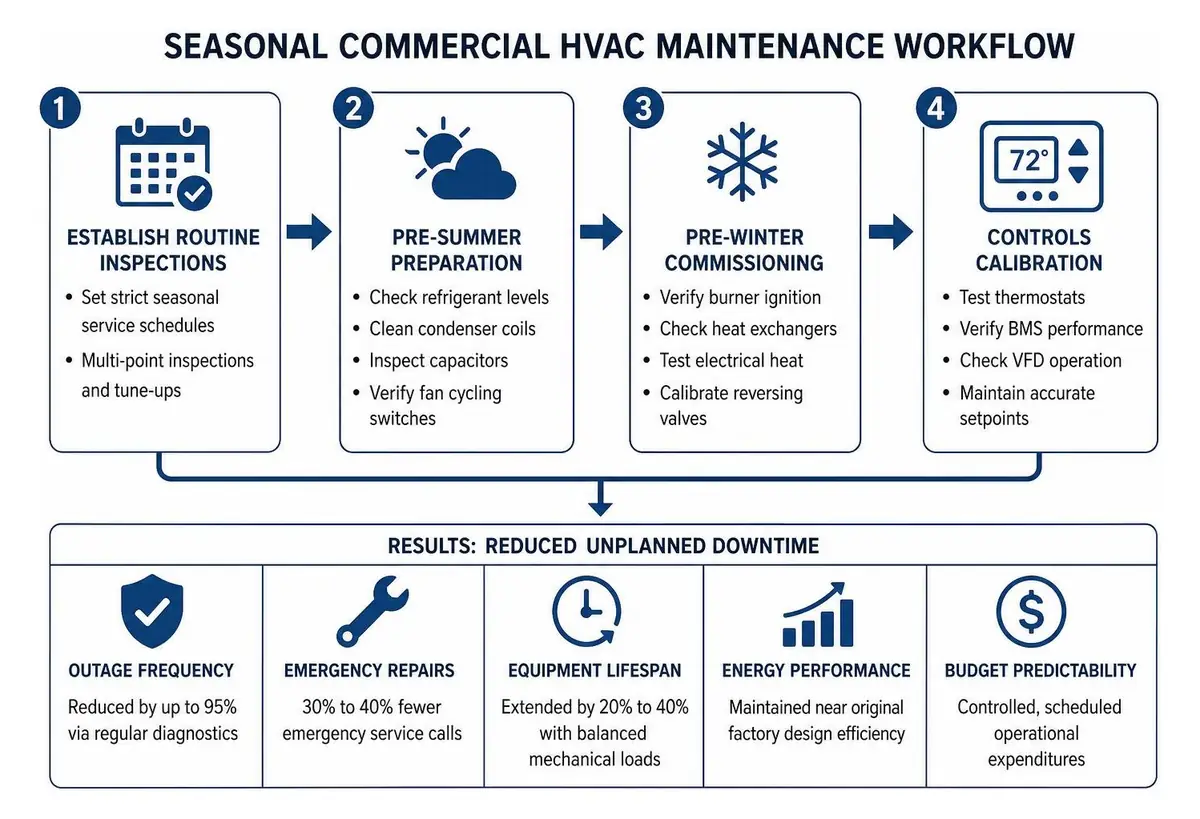
Facility directors often ask how structured service protocols translate directly into continuous uptime. Exploring how a maintenance agreement reduces HVAC downtime reveals that structured servicing replaces unpredictable failures with scheduled, controlled adjustments. Routine care reduces the likelihood of system breakdowns by up to 95%, ensuring that critical heating, cooling, and ventilation assets run smoothly day after day.
The breakdown below highlights how proactive servicing compares to run-to-failure approaches across essential facility metrics:
| Reliability Metric | Proactive Commercial Maintenance Plan | Reactive / Run-to-Failure Approach |
|---|---|---|
| Outage Frequency | Reduced by up to 95% via regular diagnostics | Frequent, unpredictable catastrophic shutdowns |
| High dependence on rush orders and emergency labor | ||
| Equipment Lifespan | Extended by 20% to 40% with balanced mechanical loads | Premature failure due to compounded internal wear |
| Energy Performance | Maintained near original factory design efficiency | Degrades by 5% to 15% annually from dirty coils/friction |
| Budget Predictability | Controlled, scheduled operational expenditures | Volatile, unplanned capital outlays for sudden replacements |
Step 1: Establish Routine Multi-Point Inspections and Seasonal Tune-Ups
The foundation of reliability starts by understanding what is a commercial HVAC preventive maintenance agreement and setting strict seasonal service schedules.
- Pre-Summer Preparation: Technicians measure refrigerant subcooling and superheat, acid-wash condenser coils, inspect capacitor microfarad ratings, and ensure fan cycling switches trigger reliably.
- Pre-Winter Commissioning: Teams verify burner ignition sequences, check heat exchangers for micro-fractures, test electrical heating elements, and calibrate reversing valves.
- Controls Calibration: Thermostats, building management systems (BMS), and variable frequency drives (VFDs) are tested to maintain accurate environmental setpoints without unnecessary short-cycling.
Step 2: Implement Proactive Rooftop Unit and Component Servicing
Rooftop units (RTUs) face continuous weather exposure, from driving rain to rooftop heat spikes. Reviewing how rooftop unit maintenance prevents downtime for Virginia businesses emphasizes the importance of hands-on component care:
- Compressor Diagnostics: Technicians perform megohmmeter testing on motor windings to detect insulation breakdown before an electrical short destroys the compressor.
- Condensate Line Clearing: Technicians treat drain pans and flush P-traps to prevent water backups, which could trip float switches and shut down units to protect interior ceilings.
- Mechanical Lubrication and Tensioning: Bearings are greased to prevent friction-induced seizures, and blower belts are aligned and tensioned to preserve airflow stability.
Even with rigorous preventive care, extreme industrial conditions or power grid surges can occasionally cause operational hitches.
Essential Elements of an Effective Virginia Commercial Service Agreement
When evaluating if a commercial HVAC maintenance plan is worth it, facility executives must evaluate the specific terms and technical depth of the service agreement. A quality commercial plan is customized around the facility's specific equipment—such as custom industrial HVAC projects, large chillers, cooling towers, and package RTUs—rather than offering a generic, residential-style filter swap.
Key components of an industrial-grade maintenance agreement include:
- Customized Service Frequencies: Quarterly or bi-monthly inspections tailored to building occupancy, operating hours, and equipment age.
- Detailed Service Logs and Asset Tracking: Documented equipment histories that satisfy OEM warranty criteria and assist in long-term capital forecasting.
- Clear Scope of Covered Assemblies: Transparent definitions of checked systems, including mechanical, electrical, hydronic, and pneumatic controls.
Key Inspection Checkpoints for Facility Reliability: How a Commercial HVAC Maintenance Plan Reduces Unplanned Downtime for Virginia Businesses
A structured technical checklist ensures no critical component is overlooked. Utilizing a dedicated commercial HVAC maintenance checklist for facility managers ensures field teams methodically verify every vital sub-assembly:
- Electrical Assemblies: Tightening terminal lugs, inspecting contactor surfaces for pitting, checking transformer outputs, and measuring motor operating amperages against nameplate ratings.
- Hydronics and Air Handling: Checking chilled/hot water valves for seat leakage, verifying actuator movement, checking duct connections for static loss, and cleaning intake louvers.
- Refrigeration Circuits: Checking oil levels in sight glasses, evaluating thermostatic expansion valve (TXV) modulation, and testing safety high/low pressure cutoffs.
Long-Term Equipment Health: How a Commercial HVAC Maintenance Plan Reduces Unplanned Downtime for Virginia Businesses
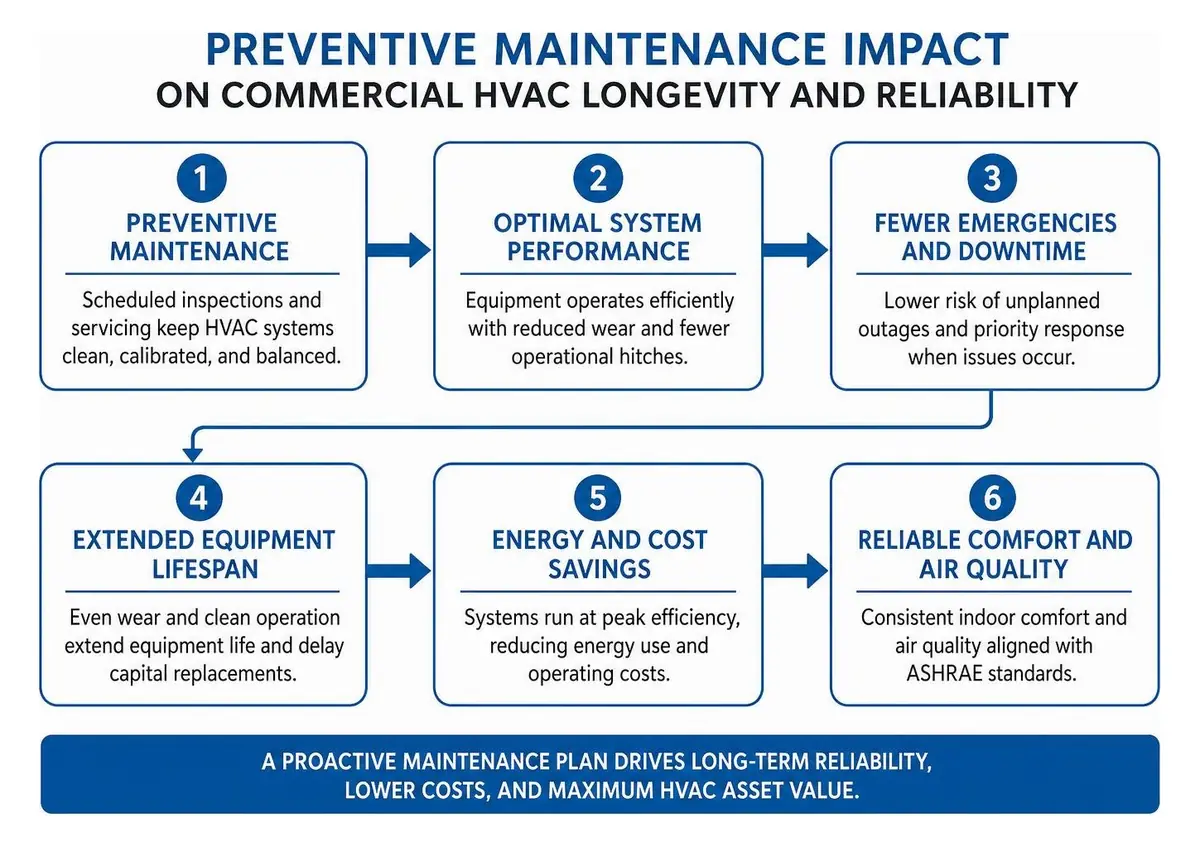
When heating and cooling equipment operates under clean, balanced conditions, mechanical stress is evenly distributed across system components.
This mechanical balance leads to substantial energy cost reductions, helping equipment operate at peak thermal efficiency. It also extends equipment lifespan by 20% to 40%, protecting facilities from premature capital replacements while keeping indoor air quality aligned with ASHRAE standards.
Frequently Asked Questions About Commercial HVAC Reliability
How often should commercial HVAC systems undergo professional maintenance?
Most commercial and industrial facilities require comprehensive professional maintenance at least quarterly. High-demand facilities—such as manufacturing plants, laboratories, and server rooms—often benefit from bi-monthly or monthly inspections to monitor heavy mechanical loads, while standard commercial spaces maintain dependable operation with four scheduled seasonal service visits per year.
How does proactive maintenance protect manufacturer equipment warranties?
Commercial HVAC manufacturers require proof of routine, professional maintenance to honor warranty claims on high-value parts like compressors, heat exchangers, and control boards. If a component fails prematurely, manufacturers may deny warranty coverage if lack of care or dirty coils contributed to the breakdown. A structured service agreement creates an unbroken, professional service log that validates warranty compliance.
What impact does regular maintenance have on facility indoor air quality?
Routine maintenance directly improves indoor air quality by ensuring filtration systems operate at their intended MERV efficiency ratings, removing airborne contaminants, dust, and allergens. In addition, cleaning evaporator coils and sanitizing condensate drainage systems stops mold and bacteria from proliferating inside air handling units and circulating through occupied facility zones.
Conclusion
Operational continuity is the cornerstone of every successful facility, and unplanned HVAC breakdowns introduce unacceptable productivity disruptions. By transitioning from reactive repairs to a structured commercial service plan, Virginia organizations can safeguard their building assets, lower energy consumption, and eliminate unexpected outages.
Whitescarver Engineering Co. has provided commercial and industrial HVAC and refrigeration engineering, maintenance, and installation services throughout Virginia since 1937.
Protect your building's assets and ensure year-round reliability by partnering with our team for expert commercial maintenance services today.
Facility intake
Need Help?
Tell us what facility, system, or maintenance risk needs attention so the first conversation starts with useful context.
About the Author
Whitescarver Engineering
Related Posts
- A Quick Start Guide to How a Maintenance Agreement Protects VA Businesses from Peak-Season HVAC Failures
- Cheat Sheet to Rooftop Unit Maintenance for Virginia Businesses
- How a Maintenance Agreement Reduces HVAC Downtime: A Practical Guide
- How to Plan a Phased Commercial HVAC Upgrade Without Business Disruption in Virginia
- How Businesses Across Virginia Keep Commercial HVAC Running Through Extreme Seasons
Related service: Service Agreements
Related Articles
Engineering-led support
Ready to Get Started?
Whether you need a repair, maintenance, or a new installation, our expert team is here to help.