
A Quick Start Guide to Commercial HVAC Retrofits for Energy Conservation in Virginia
How Commercial HVAC Retrofits Support Energy Conservation Goals for Virginia Businesses

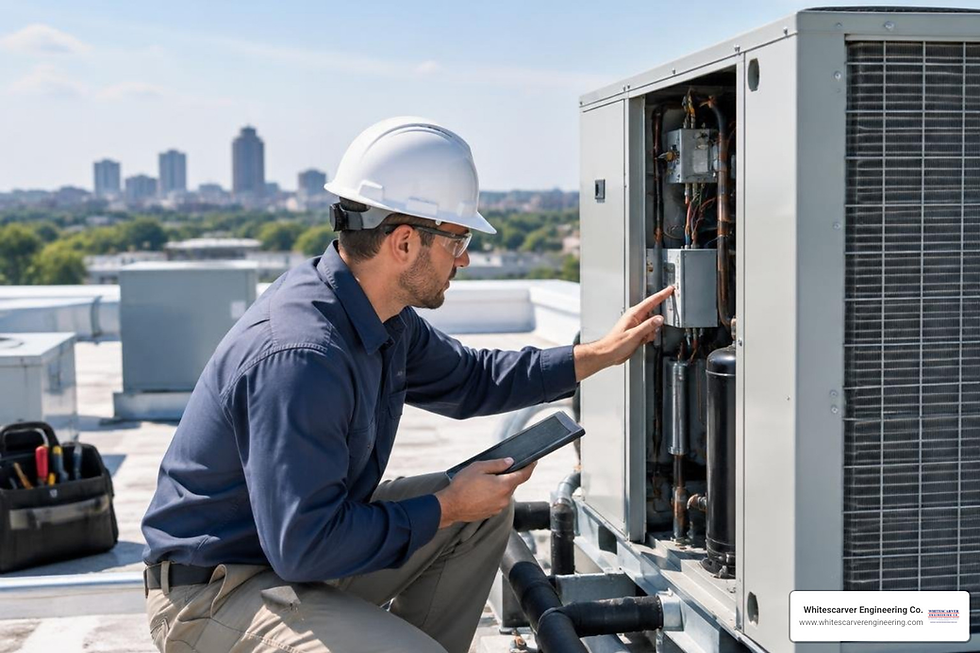
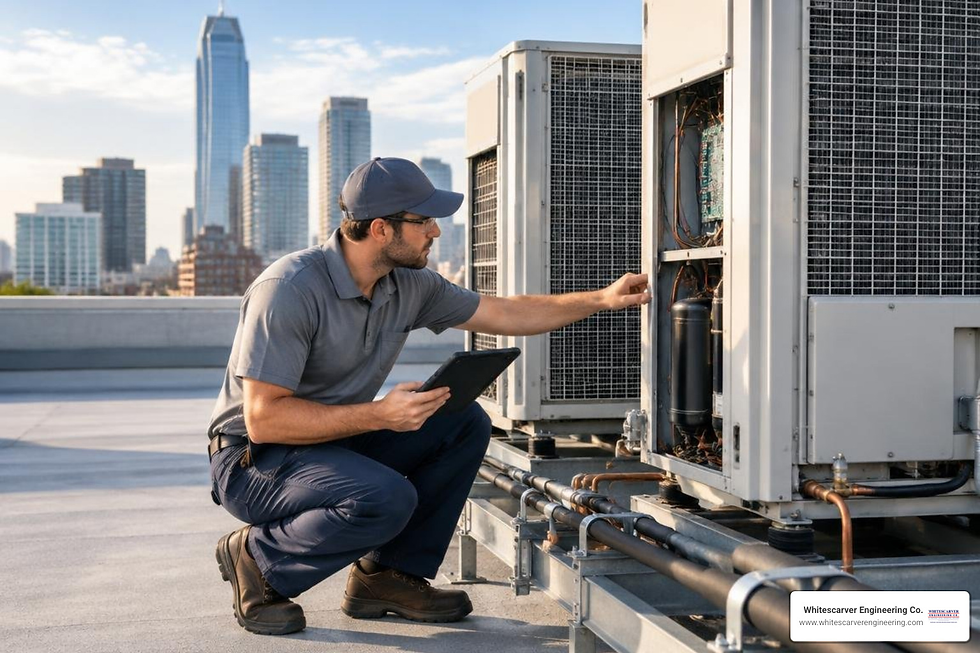
How commercial HVAC retrofits support energy conservation goals for Virginia businesses is simple: they reduce wasted heating, cooling, and ventilation energy while improving control over when equipment runs. For facility managers in Roanoke, VA, a retrofit can update aging commercial HVAC equipment, airflow, controls, and system performance without waiting for a full building replacement. These improvements can lower peak electrical demand, support utility demand-side management goals, and create steadier indoor temperatures. Whitescarver Engineering Co. helps commercial and industrial facilities throughout Roanoke, Salem, Vinton, and the Blacksburg/Christiansburg corridor plan reliable energy-conservation improvements for large-scale HVAC and refrigeration systems.
Explore energy conservation strategies for commercial buildings or learn about systems repairs and retrofits.
I'm Hugh Joyce, and contact Whitescarver Engineering Co. about a commercial HVAC retrofit that supports your facility's energy goals.

How Commercial HVAC Retrofits Support Energy Conservation Goals for Virginia Businesses
In commercial and industrial operations, heating, ventilation, and air conditioning account for a major share of total power usage. National data indicates that space heating alone accounts for close to one-third of end-use energy consumption in commercial buildings across the country. In Virginia, state energy legislation—including the Grid Transformation and Security Act and state retail consumption reduction targets—places a major emphasis on Demand-Side Management (DSM) and grid stability.
When we evaluate how commercial hvac retrofits support energy conservation goals for virginia businesses, the impact becomes immediately apparent. By upgrading worn mechanical components, optimizing fan speeds, and integrating digital controls, commercial retrofits eliminate system waste without requiring the total structural overhaul of a full system teardown.
Retrofitting allows commercial facilities to target high-draw components directly. Instead of letting legacy mechanical plants burn unnecessary power, targeted retrofits align facility load profiles with current Virginia efficiency standards. These retrofits help lower energy cost structures, directly cut operational emissions, and contribute toward long-term decarbonization targets.

Climate-Specific High-Efficiency Retrofit Technologies
Virginia's climate brings hot, humid summers and cool winters. This variation demands HVAC systems capable of handling both cooling loads and substantial moisture control, as well as efficient winter heating. Installing technology specifically tailored to this climate ensures that commercial facilities run efficiently all year long.
Key retrofit technologies that yield significant energy savings in Virginia include:
Variable Frequency Drives (VFDs): Legacy motors and pumps usually operate at full speed regardless of actual load demand. Retrofitting VFDs on fan motors, chillers, and pumps allows equipment to scale electrical draw precisely up or down depending on real-time building demand.
Air-Side Economizers: Utilizing outdoor air for free cooling during crisp spring and autumn mornings reduces chiller and compressor runtime. Integrated sensors and logic controllers regulate outdoor air dampers automatically.
Heat Recovery Chillers and VRF Systems: Variable Refrigerant Flow (VRF) systems and heat recovery chillers capture rejected heat energy from cooling cycles and redirect it to reheat loops, hot water loops, or adjacent zones requiring heat.
Advanced Duct Sealing and Insulation: Inefficient or oversized ductwork leads to severe pressure imbalances and air leakage. Sealing and insulating commercial supply and return lines ensures conditioned air reaches its intended space without energy loss.
Variable Air Volume (VAV) Terminal Upgrades: Upgrading fixed-volume air systems to modern VAV architecture allows individual zones to adjust airflow dynamically based on occupancy and local thermal loads.
Improving Indoor Air Quality and Comfort Through Retrofits
Energy conservation should never come at the expense of occupant comfort or clean indoor air. Older commercial HVAC equipment often struggles to maintain stable humidity levels during damp summer months in the Roanoke region, leading to moisture accumulation, stale air, and fluctuating temperatures.
When we retrofit commercial HVAC units, we optimize thermal performance and indoor air quality simultaneously:
Enhanced Filtration: Upgrading blower assemblies and filter racks allows for high-efficiency MERV-rated filtration that traps airborne particulates without straining fan motors.
Precise Humidity Management: Modulating coils and variable-capacity compressors strip latent moisture effectively, eliminating cold, clammy indoor environments and suppressing mold or bacterial growth.
Consistent Temperature Zoning: Modern VAV box retrofits and smart actuators prevent hot and cold spots across expansive office layouts, manufacturing floors, and retail spaces.
Virginia Utility Rebates and Financial Incentive Programs
Virginia utilities offer financial programs designed to assist commercial enterprises in funding energy-efficiency initiatives. Both Dominion Energy and Appalachian Power Company (APCo) manage comprehensive Demand-Side Management (DSM) programs designed to reduce baseline grid demand.
In historic program reporting, APCo demonstrated the impact of these programs by reaching roughly 18 million megawatt-hours (MWh) of electric savings through its program offerings. Additionally, APCo recorded a reduction of approximately 9.84 million kWh across its own facilities—a 43% decrease compared to a 2007 baseline—showing the transformative potential of systematic HVAC and controls retrofits. Similarly, Dominion Energy achieved 93% of its planned net energy savings targets across its customer efficiency programs.
Commercial property owners can take advantage of several incentive pathways:
Prescriptive Rebates: Direct financial rebates for installing pre-approved high-efficiency equipment, such as premium-efficiency rooftop units (RTUs), VFD installations, advanced economizer controls, and high-efficiency heat pumps.
Small Business Direct Install Programs: Accelerated programs offering on-site facility assessments, energy tune-ups, and incentives for upgrading cooling and heating units in smaller commercial structures.
Custom Equipment Incentives: Tailored financial incentives for specialized commercial facilities, cleanrooms, or manufacturing sites executing complex HVAC engineering solutions.
Read our complete overview on how businesses can save on HVAC upgrades in Virginia to explore specific program options.
Energy Service Agreements and Third-Party Financing Options
While utility rebates lower overall investment thresholds, major equipment retrofits still require careful capital planning. To avoid tying up working capital, many Virginia businesses use third-party financing structures to launch energy projects immediately.
Energy Service Agreements (ESAs): An ESA is an off-balance-sheet financing arrangement where a service provider funds, installs, and maintains energy-efficient HVAC equipment. The commercial building owner pays a monthly fee derived directly from verified utility savings.
Performance Contracting: Under an Energy Savings Performance Contract (ESPC), an energy service entity guarantees a specific benchmark of energy savings. If the upgraded system fails to meet those benchmarks, the provider covers the difference.
Commercial Property Assessed Clean Energy (C-PACE): Local jurisdictions allow commercial building owners to finance energy efficiency and renewable energy upgrades through a long-term assessment attached to the property tax bill.
Navigating Virginia Building Codes, Sizing, and Permitting
Commercial HVAC retrofit projects in Virginia must comply with state construction codes and energy standards. The Virginia Uniform Statewide Building Code (USBC) establishes structural, mechanical, and safety compliance requirements, while energy standards fall under ASHRAE 90.1 guidelines.
Key regulatory considerations for commercial retrofits include:
Regional Energy Minimums: Modern commercial cooling systems must comply with updated efficiency mandates, such as the regional 15 SEER2 baseline standard for split systems.
EPA Section 608 Compliance: All refrigerant recovery, recycling, and retrofitting must be executed by certified technicians who follow federal guidelines governing low-GWP (Global Warming Potential) refrigerant transitions.
Local Mechanical Permits: Every jurisdiction across Virginia's counties and independent cities requires proper mechanical permits for equipment alterations, fuel conversion projects, or duct modifications.
When making decision framework choices for existing machinery, review our detailed guide on commercial HVAC retrofit vs. full replacement.
How Commercial HVAC Retrofits Support Energy Conservation Goals for Virginia Businesses Through Sizing and Audits
A common issue in commercial facilities is equipment oversizing. Historically, systems were oversized under the assumption that bigger was always better. However, an oversized HVAC system leads to severe short-cycling—where the compressor turns on and off rapidly. Short-cycling spike energy usage, subjects components to premature wear, and leaves relative humidity unmanaged.
To ensure long-term energy savings, retrofits must begin with precise diagnostic engineering:
Commercial Load Calculations: Performing updated load assessments using precise Manual J and commercial heat-load modeling ensures replacement compressors and coils are sized exactly to the building envelope's current demand.
Diagnostic Audits: Utilizing infrared thermal imaging and blower door diagnostics isolates building envelope leaks, duct pressure drop points, and insulation gaps before retrofitting mechanical hardware.
Comprehensive Commissioning: Testing, adjusting, and balancing (TAB) mechanical components ensures that every supply register, damper, VFD, and sensor operates according to engineering specifications.
Implementing Smart Building Automation Systems for Long-Term Efficiency
Hardware retrofits deliver maximum efficiency when paired with modern controls. Implementing a centralized Building Automation System (BAS) or Building Management System (BMS) transforms standalone HVAC equipment into a intelligent, energy-conserving network.
Smart building controls optimize efficiency through advanced operational features:
Dynamic Load Shedding and Peak Shaving: A smart BAS can automatically alter setpoints, trim supply fan speeds, or pre-cool thermal storage zones during peak demand windows to avoid costly high-tier utility ratchets.
Submetering and Energy Analytics: Granular submetering provides real-time visibility into exact power draw across chillers, boilers, air handlers, and process cooling loops, enabling facility operators to spot inefficiencies instantly.
Building Re-Tuning and Retro-Commissioning: Re-tuning uses low-cost or no-cost software adjustments to re-align dampening schedules, reset static pressure baselines, and fix sensor calibration drift based on real operational data.
Grid-Interactive Efficient Building (GEB) Integration: Advanced BMS frameworks allow commercial facilities to communicate directly with grid operators, adjusting building demand dynamically to support regional grid reliability.
To upgrade your existing control setup, review our systems repairs and retrofits services.
Frequently Asked Questions About Commercial HVAC Retrofits
How Commercial HVAC Retrofits Support Energy Conservation Goals for Virginia Businesses During Peak Demand?
Commercial retrofits target peak electric demand through intelligent control strategies, fan speed optimization, and high-efficiency compressors. During hot Virginia summer afternoons, electrical utility networks experience heavy grid strain. Retrofitted HVAC systems equipped with VFDs, smart thermostats, and BAS connectivity participate in peak load shaving. By staging mechanical cooling cycles and resetting chilled water temperatures slightly during peak windows, facilities curb excessive demand charges while maintaining internal occupant comfort.
What Is the Difference Between Retrofitting and Replacing Commercial HVAC Equipment?
A commercial HVAC retrofit modifies, restores, or upgrades specific components within an existing system framework—such as replacing old compressors, retrofitting VFDs, sealing duct networks, or updating control logic—without tearing out the entire infrastructure. A full system replacement involves completely removing all existing mechanical plants, air handling units, piping, and controls to install a brand-new mechanical footprint.
Read our article on when to retrofit vs. replace commercial HVAC system for a comprehensive comparison.
What Utility Incentives Are Available for Commercial HVAC Upgrades in Virginia?
Major Virginia energy providers, including Dominion Energy and Appalachian Power Company, offer structured commercial and industrial Demand-Side Management (DSM) incentive programs. These include prescriptive cash rebates for upgrading to high-efficiency rooftop units, installing variable frequency drives, retrofitting smart economizer controls, and completing commercial system recommissioning. Small-to-midsize commercial facilities can also access direct-install programs that provide site energy assessments and subsidized equipment tune-ups.
Explore our commercial energy conservation Roanoke VA guide for region-specific details.
Conclusion
Implementing commercial HVAC retrofits is one of the most effective, scalable paths for Virginia businesses to reach energy conservation goals. By upgrading key mechanical components, applying modern building controls, and leveraging available utility rebates, facility operators can significantly cut operational overhead, lower carbon footprints, and improve indoor air quality.
Since 1937, Whitescarver Engineering Co. has delivered premier commercial and industrial HVAC, refrigeration, and energy-conservation solutions across Virginia. Serving facilities throughout Roanoke, Salem, Vinton, and the Blacksburg/Christiansburg corridor, our team brings over 75 years of technical expertise to custom industrial HVAC projects, custom maintenance agreements, and 24/7 service for commercial clients.
Whether you are looking to trim peak electrical demand, upgrade industrial process systems, or execute a complex building automation retrofit, we are ready to assist. Learn more about our specialized systems repairs and retrofits services today, and partner with our team to achieve your facility's long-term energy goals.

Comments