
How to Diagnose Declining Commercial HVAC System Performance
How to Tell When Your Commercial HVAC System Is Losing Performance

When it comes to commercial HVAC system performance decline what to check, the most important starting points are:
Airflow restrictions - clogged filters, dirty blower wheels, slipping belts, or blocked return ducts
Coil fouling - dirty evaporator or condenser coils reducing heat transfer efficiency
Refrigerant charge - over or undercharge affecting cooling capacity (found in 77% of audited systems)
Electrical and controls issues - drifting sensors, faulty thermostats, or failing capacitors
Economizer failures - stuck dampers or bad actuators causing up to 40% of cooling complaints
Ductwork leakage - leaks responsible for up to 30% energy loss even when the main unit runs fine
Rising energy consumption - a year-over-year increase without occupancy changes often signals measurable degradation
Most commercial HVAC systems last between 15 and 20 years with proper maintenance. But research shows performance can degrade by roughly 5% per year even before a system fully fails — meaning a system that appears to be running may already be costing your operation significantly more than it should.
For facility managers and building owners in Roanoke, Salem, Vinton, and the Blacksburg/Christiansburg corridor, catching that decline early is the difference between a planned service call and an unplanned shutdown. Unplanned HVAC downtime in commercial buildings can cost tens of thousands of dollars per incident — far more than the diagnostic and preventive work that would have caught the problem months earlier.
This guide walks through exactly what to inspect, how to measure it, and how to decide whether a repair or a full system upgrade makes more sense for your facility.

Understanding Lifespans and Degradation Rates of Commercial Systems
To effectively manage a commercial or industrial facility, you must establish a baseline of how long your HVAC assets are designed to last. Every component in a complex mechanical loop has a distinct life expectancy, and understanding these timelines allows for proactive capital planning rather than reactive panic.
If we look at the average lifespans of commercial HVAC equipment:
Rooftop Units (RTUs): 15–20 years
Chillers (Centrifugal/Scroll/Screw): 15–25 years
Boilers (Water and Steam): 15–30 years
Air Handling Units (AHUs): 15–20 years
Heat Pumps: 10–15 years
Condensers: 10–20 years
Cooling Towers: 15–20 years
However, these lifespans are heavily dependent on maintenance. In fact, standard metrics developed by the U.S. Department of Energy (DOE) estimate that unmaintained systems degrade in efficiency by about 3% per year. Empirical studies, such as a multi-year monitoring project conducted on cooling systems, found that performance degradation can actually average 5% to 5.2% per year when systems are left to run without regular, structured tuning. Over a decade, that compounds into a massive efficiency gap where your system works twice as hard to deliver half the cooling capacity.
Several variables accelerate this rate of performance decay. High-capacity systems under constant load degrade faster than smaller systems with variable load profiles. Interestingly, systems with higher SEER ratings can sometimes degrade more slowly due to advanced modulation and diagnostic controls, but they are also more sensitive to unaddressed minor faults.
In our humid Virginia climate, seasonal transitions place intense physical stress on equipment. An RTU in Roanoke faces freezing winters, pollen-heavy springs, and hot, humid summers. This environmental volatility makes routine monitoring essential. For a deeper dive into equipment longevity, see our detailed guide on How Long Does a Commercial HVAC System Last.
Early Warning Signs of Commercial HVAC System Performance Decline: What to Check
Performance degradation rarely happens overnight. Instead, it leaves a trail of subtle, compounding clues. If your facility is experiencing any of the following symptoms, your system is actively losing efficiency:
Inconsistent or Uneven Temperatures: If certain zones or offices are freezing while others are overheating, the system is struggling to balance the thermal load. This is often caused by slipping blower belts, drifting zone sensors, or stuck dampers. To understand the physics behind this issue, read more about What Causes Uneven Temperatures in Commercial Buildings.
System Short Cycling: When a compressor turns on and off rapidly, it places extreme mechanical stress on the motor windings and capacitors. Short cycling can be triggered by low refrigerant charge, restricted airflow, or oversized equipment.
Rising Energy Bills: If your utility bills are creeping upward year-over-year while your facility's operational hours and occupancy remain unchanged, your HVAC system is consuming more kilowatt-hours to meet the same setpoints.
Declining Indoor Air Quality (IAQ): A stuffy, humid, or dusty office environment indicates that your air handler is failing to introduce enough outdoor air or that the filtration system is compromised. Poor IAQ directly impacts employee productivity and health. Explore this connection in our article on How Commercial HVAC Affects Indoor Air Quality.
When these early warning signs are ignored, minor performance drops quickly escalate into major mechanical failures. Learn how to spot these issues before they cause an operational shutdown by reading about the Signs Your Commercial HVAC System Needs Repair.
Commercial HVAC System Performance Decline What to Check
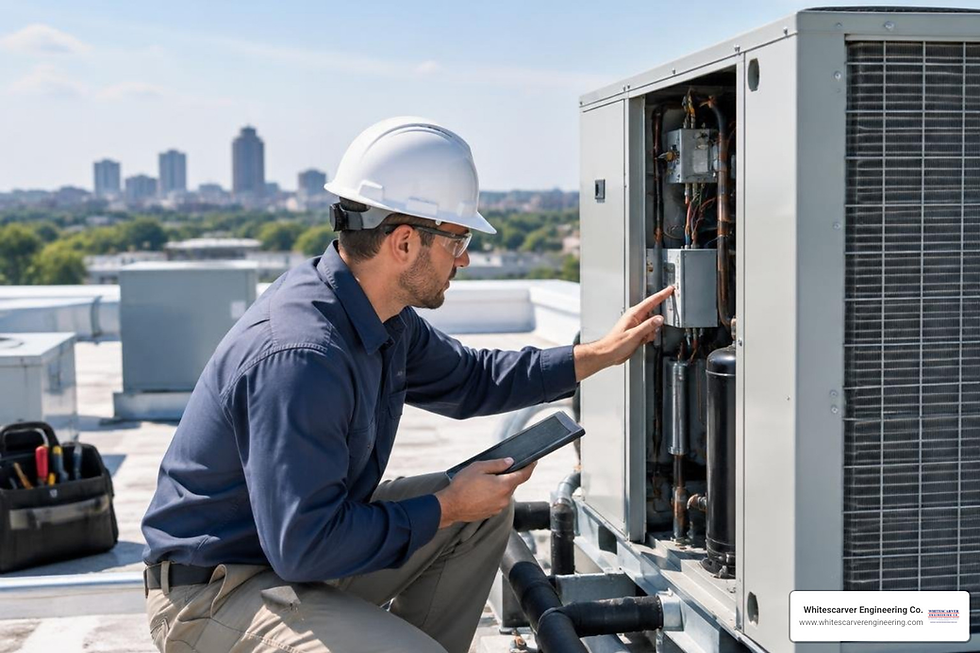
When diagnosing a system that is underperforming, a structured diagnostic checklist prevents wasted time and incorrect diagnoses. Here is exactly what our engineering teams inspect when assessing commercial system degradation:

1. Airflow Restrictions and Blower Assembly
Airflow is the lifeblood of any HVAC system. In fact, field studies show that up to 44% of systems operate with improper airflow, which reduces sensible cooling capacity by roughly 10%.
Filters: Check filter differential pressure. Do not rely on calendar schedules. If a filter bypasses air due to a damaged gasket, dirt accumulates directly on the coil.
Belts and Pulleys: Inspect blower belt deflection (ideally 1 inch of play per foot of span with 2-5 lbs of tension). Slipping belts can cut system efficiency by 5% to 10% and leave a fine black dust inside the cabinet.
Blower Wheels: Check the fan blades. Dirt accumulation on a centrifugal fan wheel disrupts the aerodynamic profile, severely reducing CFM output.
2. Coil Fouling (Evaporator and Condenser)
A thin layer of dirt acts as an thermal insulator. A mere 0.1-inch layer of dirt on a condenser coil can increase head pressure enough to reduce cooling capacity by 30% and raise energy consumption by 35%.
Condenser Coils: Outdoor coils face pollen, dust, and debris. They must be washed with appropriate coil cleaners annually. Straighten any bent coil fins using a specialized fin comb to restore unimpeded heat rejection.
Evaporator Coils: Dirty evaporator coils restrict heat absorption, leading to frozen coils, liquid refrigerant floodback, and eventual compressor failure.
3. Refrigerant Charge and Circuit Integrity
Refrigerant issues are incredibly common, with over 70% of audited field systems showing either an overcharge or undercharge. Even a minor 10% undercharge can reduce overall system efficiency by 20%.
Undercharge: Leads to low suction pressures, high superheat, and inadequate compressor cooling, which accelerates motor insulation breakdown.
Overcharge: Increases head pressure, reduces subcooling, and forces the compressor to work against high discharge pressures, spike amp draw, and potentially damage valves.
Look for oil staining around copper joints and valves, which is a primary indicator of a refrigerant leak.
4. Electrical and Control Failures
Electrical issues account for nearly 30% of all commercial HVAC failures.
Capacitors: Check microfarad ratings against nameplate specifications. Weak capacitors cause motors to run hot and draw excessive current.
Contactors: Inspect for pitted or welded contacts that can cause single-phasing on three-phase motors.
Sensor Drift: Thermistors and pressure transducers can drift out of calibration over time. A mixed-air sensor that drifts by just 3°F can completely disable economizer free cooling, costing thousands in unnecessary mechanical cooling.
5. Economizer Operation
Economizers are designed to bring in cool outdoor air for "free cooling" when ambient conditions permit. However, because they are exposed to the elements on the roof, they have a high failure rate. In fact, economizer issues cause roughly 40% of all commercial cooling complaints.
Check for rusted or stuck damper blades.
Verify that the actuator motor is responsive and that the enthalpy sensors are calibrated. If an economizer is stuck open during a humid Virginia summer, it introduces massive latent heat loads that your cooling coils cannot handle.
6. Ductwork Leakage and Integrity
Ductwork typically lasts 20 to 25 years, but older or poorly sealed duct systems are a massive source of energy waste. The average commercial duct system loses 20% to 30% of its conditioned air through joint leaks, unsealed seams, or degraded insulation. This means your high-efficiency RTU or chiller could be dumping valuable conditioned air directly into ceiling plenums or unoccupied mechanical spaces.
For a comprehensive review of local maintenance standards and seasonal requirements in our region, refer to our Commercial HVAC Maintenance Guide Roanoke VA.
Diagnostic Tools for Commercial HVAC System Performance Decline: What to Check
To move from guesswork to precise, data-driven diagnostics, we utilize advanced instruments and analytical methods:
Magnehelic Gauges and Manometers: These tools measure differential pressure across filter banks and evaporator coils. A high static pressure drop immediately points to restricted airflow or a fouled coil.
Weather-Normalized Regression Analysis: This mathematical approach compares your daily energy consumption (kWh) against outdoor temperature data (cooling degree days) to establish a "balance point." By comparing regression curves from previous years, we can empirically prove performance degradation over time, separating weather anomalies from actual equipment decay.
Smart Thermostat and BAS Trend Data: Modern Building Automation Systems (BAS) track compressor runtimes, supply air temperatures, and damper positions. Analyzing these trends allows us to spot short-cycling, sensor drift, and scheduling errors (such as systems running at full capacity in empty buildings overnight, which adds 8% to 15% to annual energy bills).
Distinguishing Between Repair and Replacement
When your HVAC system begins showing its age, the ultimate question for any facility manager is: Do we fix it, or do we replace it?
Making this decision requires analyzing several key financial and mechanical factors:
The 50% Rule of Thumb: If the cost of a single major repair (such as a compressor replacement, which typically ranges from thousands of dollars for large RTUs to significantly more for chillers) exceeds 50% of the cost of a brand-new unit, replacement is almost always the more financially sound option.
The Age of the Asset: If a rooftop unit is 18 years old and requires a new condenser fan motor and contactor, investing in those repairs is often a temporary fix. The remaining components, including the heat exchanger and compressor, are already near the end of their statistical life expectancy.
Changes in Building Usage: If your Roanoke facility has transitioned from warehouse storage to high-density office space or light manufacturing, your original HVAC design is no longer correct. In these cases, retrofitting or replacing the system to match the new thermal load is necessary.
Phased Ductwork Replacement: If your ductwork is leaking but your mechanical units are in good shape, we often recommend phased duct sealing or replacement during tenant improvements. This minimizes operational disruption while clawing back that 20% to 30% energy loss.
To evaluate whether a modern retrofit or a complete system replacement is right for your property, read our guide on When to Retrofit vs Replace Commercial HVAC System. Additionally, you can explore the long-term financial advantages in our article on the Benefits of Upgrading Commercial HVAC Equipment.
To properly allocate capital for these decisions, read our strategic guide on How to Budget for Commercial HVAC Maintenance and Repairs.
Proactive Maintenance Strategies to Prevent Performance Decline
The single most effective way to halt performance degradation is to transition from a reactive, "run-to-fail" model to a structured, proactive maintenance program. According to studies by the Building Owners and Managers Association (BOMA), proactive maintenance programs deliver an average of 545% Return on Investment (ROI) by extending equipment lifespan by up to 30% and reducing annual energy waste by 15% to 30%.
Here is a comparison of the two approaches:
Feature | Reactive Maintenance ("Run-to-Fail") | Proactive Preventive Maintenance |
Average Equipment Lifespan | Reductions of 30% to 40% | Full design life (15–25 years) |
Emergency Call-Outs | Frequent, unpredictable, and expensive | Reduced by up to 65% |
Energy Consumption | Spikes of 15% to 30% due to dirty coils/filters | Kept at or near design efficiency |
Repair Expenses | High (emergency rates, expedited shipping) | 37% lower overall annual repair costs |
Occupant Comfort | Frequent complaints and hot/cold spots | Stable temperatures and high IAQ |
To achieve these results, we align our maintenance agreements with ASHRAE Standard 180 (Standard Practice for Inspection and Maintenance of Commercial Building HVAC Systems). This involves:
Quarterly Inspections: Checking belt tension, verifying electrical connections, cleaning condensate pans to prevent clogs (which cause 18% of common breakdowns), and testing safety cutouts like freeze stats.
Filter Replacement: Changing filters based on differential pressure readings rather than arbitrary calendar dates.
Coil Cleaning: Performing thorough, non-destructive chemical coil cleanings semi-annually to maintain optimal heat transfer.
Implementing these steps is straightforward when you have a clear plan. Check out our comprehensive guide on How to Maintain Commercial HVAC Systems and learn more about the cost differences in Preventive Maintenance vs Reactive Repairs Commercial HVAC.
Frequently Asked Questions about Commercial HVAC Performance
How long does commercial ductwork typically last?
On average, commercial ductwork lasts between 20 and 25 years. While galvanized steel ducts can physically endure much longer, the joints, mastic sealants, gaskets, and external insulation degrade over time. This degradation leads to air leakage, which can cause up to a 30% loss of conditioned air. If you are experiencing uneven temperatures or rising energy bills despite having a newer, well-maintained RTU, a duct leakage test is highly recommended.
What are the most common causes of commercial HVAC airflow issues?
Airflow issues are responsible for roughly 70% of all commercial HVAC service calls. The most common causes include:
Clogged or overloaded air filters that restrict intake.
Slipping or worn blower belts that reduce fan speed and CFM output.
Dirty blower wheels where dust build-up destroys the fan blade aerodynamics.
Stuck zoning dampers or failed actuators that block air from reaching specific building zones.
Excessive system static pressure caused by undersized ductwork or dirty coils.
How does a building automation system help track performance decline?
A Building Automation System (BAS) acts as the central nervous system of your facility. It continuously monitors hundreds of data points, including supply air temperatures, return air relative humidity, compressor runtimes, and damper positions. A BAS helps track performance decline by:
Identifying sensor drift before it causes major temperature swings.
Logging alarm codes and identifying short-cycling patterns.
Trending energy usage against outdoor ambient temperatures to highlight efficiency losses.
Ensuring scheduling compliance so equipment is not running at full capacity during unoccupied hours.
Conclusion
Managing a commercial or industrial facility requires keeping a close eye on your bottom line, and your HVAC system is one of your largest operating expenses. Left unmaintained, performance decline is a silent drain on your budget, wasting energy, accelerating equipment failure, and driving tenant complaints.
At Whitescarver Engineering Co., we have provided commercial and industrial HVAC, refrigeration, and energy-conservation solutions to businesses in Roanoke, Salem, Vinton, and the surrounding region since 1937. With over 75 years of technical expertise and a long-standing BBB A+ accreditation, our team specializes in custom industrial HVAC projects, retrofits, and comprehensive maintenance agreements designed to maximize B2B reliability and lower operational costs.
If you suspect your system is losing its efficiency, do not wait for a complete breakdown. Contact our team of experts today to schedule a professional system evaluation and learn how we can keep your facility running at peak performance.
To explore our complete range of commercial solutions, visit our Whitescarver Engineering Commercial HVAC Systems Page.

Comments